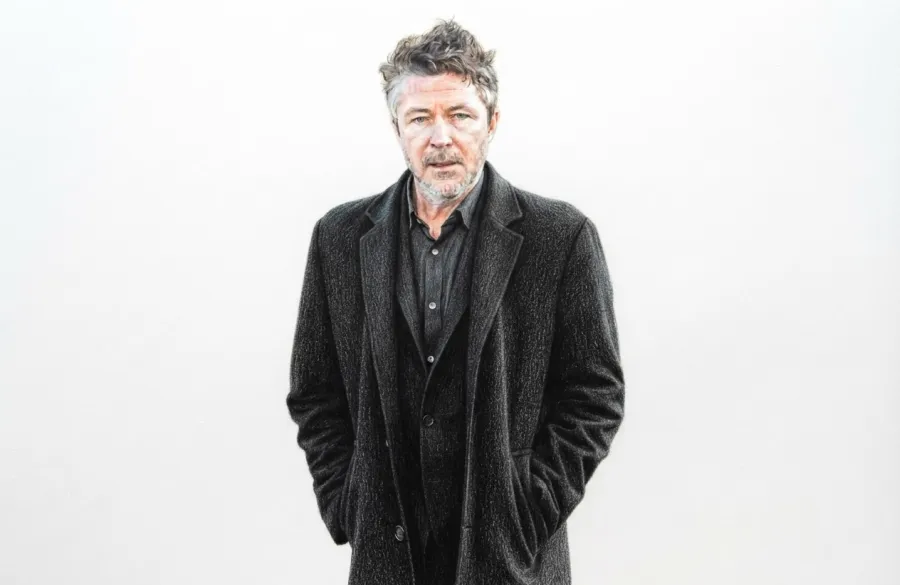
Aidan Gillen is the quietest dangerous man on television. Littlefinger in Game of Thrones, John Boy in Love/Hate, Frank Kinsella in Kin: three power players whose whole method is the murmur, the mumbled line delivered so softly you have to lean in, and the leaning in is the point. His crime-drama career is unusually coherent around that figure — the operator, never the copper — and Irish crime television in particular has built two series on him: a gang leader in RTÉ's Love/Hate and a fading patriarch in Kin, both covered shows on this site.
The Dublin crime years
Love/Hate (RTÉ, 2010–2011) is where Irish crime drama found its modern voice, created by Stuart Carolan, and Gillen's John Boy Power is its first great character: a gang leader of boundless appetite and coked paranoia, running Dublin's drug trade while failing, in every human respect that matters, to be a father or a friend. The performance is frightening without posturing. Gillen plays the volatility inside ordinary behaviour — a moment of warmth, a joke, a sudden rage with no warning, the collapse in the bedroom — and the series' most discussed shock, John Boy's own murder, arrives in that register, an early-series death that ended the reign at ten episodes and became one of Irish television's most talked-about endings. He won an IFTA for the role in 2012, his second win in the category.
Kin (RTÉ One and BBC One, 2021–2023) brought the patriarch a decade later: Frank Kinsella, a prominent Dublin crime family's second man, standing between his family and a Scandinavian cartel that has taken a debt out on his nephew. Where John Boy is appetite, Frank is endurance. Gillen plays him as exhausted authority, a gangster doing middle-management for a business that eats its children, and the series' critical reception treated him, correctly, as its centre of gravity. Kin is the other covered show here, and the pairing of the two series tells you what Gillen does in the genre: he is never the policeman and never the victim. He is the man the street is named after.
The Baltimore interlude
Between the two Irish series sits The Wire (HBO, 2004–2008), and Gillen's Tommy Carcetti is one of the reasons the phrase "the greatest television series ever made" survives its own usage. Baltimore councilman, then mayor, Carcetti is politics inside a police drama, the ambitious white politician climbing through a city's racial arithmetic while the drug war grinds on beneath him. Gillen was cast after producers saw him in Harold Pinter's The Caretaker on stage, which is the right provenance: Carcetti is a theatrical part in a naturalistic show, charm deployed as policy. He plays the campaign the way he plays Littlefinger — as strategy wearing manners. The Wire is American, so its place here is as context, but the IFTA he received for the role, in 2009, is a good measure of how well Irish audiences watched their own actor become the American scene's most fluent politician.
Littlefinger
Game of Thrones (2011–2017) made him globally famous as Petyr Baelish, the foster brother nobody counts who orchestrates a continent's civil war for ambition and spite. Forty-one episodes across seven seasons, ending at the hands of the Stark sisters in "The Dragon and the Wolf", and the performance underneath is recognisably the same instrument as John Boy's: soft speech, unreadable face, threat calibrated to the syllable. Fantasy is not this site's subject, but Littlefinger belongs in any account of Gillen as a performer, because it is the purest form of the type: the schemer whose only weapon is information. It also brought an IFTA nomination and a SAG ensemble nomination.
Around the genre
The rest of the record fills in the shape. Stuart Alan Jones in Russell T Davies's Queer as Folk (Channel 4, 1999–2000) was his defining British role before the crime years, a club owner written with a warmth the later parts keep off screen. James Marsh's Shadow Dancer (2012) put him in the Troubles thriller tradition as Gerry McVeigh, the IRA brother of Andrea Riseborough's informant, in the same film as Gillian Anderson — a useful cross-reference between two actors on this list, and one of the genre's most restrained films. The BBC's Peaky Blinders gave him Aberama Gold, a gypsy hitman ally of Tommy Shelby across series four and five, violence done as craft. In Blitz (2011) he is Barry Weiss, the cop killer hunting Jason Statham, a supporting genre turn rather than a case for his defence. And on the Irish screen since, Charlie Haughey in Charlie (2015) — an IFTA-winning turn as the taoiseach — and Milo Sunter in Mayor of Kingstown, and the announced BBC/RTÉ follow-up with Love/Hate's Stuart Carolan, Tall Tales & Murder, which reunion tells you where Irish crime drama thinks its best leading man lives.
How he works
The delivery is the signature and it deserves a precise description. Gillen speaks low, fast and at an angle, letting consonants fall away, so that menace arrives as intimacy: you are drawn into the sentence and the sentence is the trap. Directors exploit it. His Carcetti uses it to seem reasonable, his Littlefinger to seem unthreatening, his John Boy to keep a room unsure. Against type he can do plainness, and Queer as Folk and Kin both show it, but the genre has never once cast him as the police, and that absence is now part of his meaning in it: he is the crime-drama actor for the other side of the desk, the boss, the brother, the schemer, the man in the car outside.
The pattern
Two RTÉ crime series a decade apart, a Baltimore mayor, a Westerosi spider, a Troubles brother, a Birmingham hitman: the record is remarkably unified, and it is Irish in its centre of gravity even when the work is American. Gillen has spent twenty-five years playing the intelligent man on the wrong side of the line, and British and Irish crime drama has rewarded him with two of its most discussed characters in the genre's two most discussed decades. For readers of this site, the route is straightforward: Love/Hate and Kin are the essentials, Shadow Dancer is the bridge to Gillian Anderson, and The Wire is the context that shows how good he is when the material is the best there is.