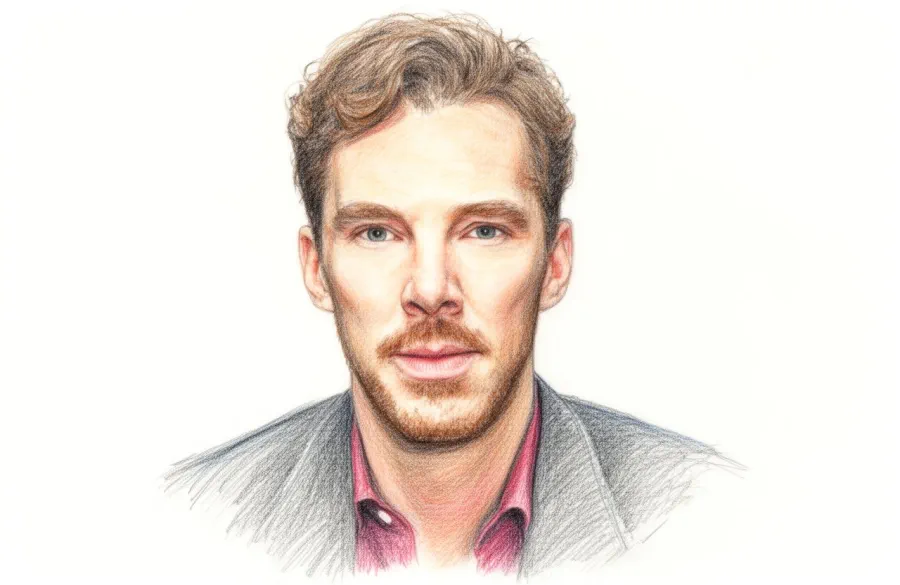
Early Life
Benedict Timothy Carlton Cumberbatch was born on July 19, 1976, at Queen Charlotte's Hospital in Hammersmith, and grew up in the London borough of Kensington and Chelsea. His parents, actors Timothy Carlton and Wanda Ventham, provided a creative backdrop, though they initially cautioned him against the profession's uncertainties. He has a half-sister, Tracy Peacock, from his mother's first marriage.
His path was set early. Educated at Brambletye School and later as an arts scholar at the prestigious Harrow School, he found his calling on the stage. At just twelve, he made his acting debut as Titania, Queen of the Fairies, in 'A Midsummer Night's Dream'. He was a member of Harrow's Rattigan Society, the school's drama club, and played Shakespearean roles there.
Before university, Cumberbatch took a formative gap year, traveling to India to teach English to Tibetan Buddhist monks—an experience that fostered a lifelong affinity for Buddhist philosophy and mindfulness. He then formally pursued acting, studying drama at the University of Manchester before refining his technique with a master's degree in classical acting from the London Academy of Music and Dramatic Art (LAMDA), an institution he would later lead as President in 2018.
Early Career & First Roles
Cumberbatch's professional journey began, fittingly, in classical theatre with two seasons at the New Shakespeare Company in London's Regent's Park. His early screen work in the early 2000s saw him taking supporting roles in series like 'Tipping the Velvet', 'Silent Witness', and 'Fortysomething'.
A significant breakthrough arrived in 2004 with his first lead television role, portraying the brilliant physicist Stephen Hawking in the BBC biopic 'Hawking'. His performance earned him a BAFTA TV Award nomination for Best Actor at the 2005 ceremony, for a broadcast that went out in 2004. This was followed by a notable turn as Edmund Talbot in the BBC miniseries 'To the Ends of the Earth'.
His film career began in earnest with roles in 'Amazing Grace' (2006) as William Pitt the Younger and 'Starter for 10' (2006). A pivotal moment came in 2007 with his chilling portrayal of the cynical chocolatier Paul Marshall in 'Atonement'.
Major Roles
Benedict Cumberbatch moves easily between modern detectives, tortured aristocrats, historical figures, and superheroes. For a mystery and crime audience, the thread through most of it is the brilliant, isolated mind working out a moral problem.
Sherlock Holmes in 'Sherlock' (2010–2017)
Benedict Cumberbatch, alongside co-creators Steven Moffat and Mark Gatiss, redefined the modern detective for a generation with his Sherlock Holmes in the BBC's 'Sherlock'. This was not the pipe-smoking, deerstalker-clad Victorian of pure nostalgia, but a "high-functioning sociopath" in 21st-century London, using texts, blogs, and a smartphone as deftly as a magnifying glass.
Cumberbatch makes the technology and the speed feel natural to a character who long predates both. He plays Holmes's intellectual arrogance and his impatience without softening either, and the rapid-fire deductions became the show's signature. Beneath that, he plays a slow, grudging move toward human connection, mostly with Martin Freeman's Dr. John Watson.
He plays Holmes's restlessness physically: fingertips pressed together in thought, pacing the room like a caged animal, or lying perfectly still on the sofa out of boredom. Logic shatters into emotion, and the character's isolation sits alongside a need for friendship he will not admit to. The role made Cumberbatch a global star and reset how a large part of the public pictures Sherlock Holmes.
Patrick Melrose in 'Patrick Melrose' (2018)
If Sherlock showed intellectual control, the 2018 miniseries 'Patrick Melrose' showed how much Cumberbatch could endure. In the adaptation of Edward St. Aubyn's semi-autobiographical novels, he plays the aristocrat across decades, from childhood abuse at his father's hands into drug addiction, self-loathing, and attempts at recovery.
He holds together the tonal extremes of St. Aubyn's writing: pitch-black satire of upper-class manners, the practical detail of heroin addiction and withdrawal, and a man trying to rebuild a self out of a ruined past. His drug-fueled paranoia in the first episode is frightening and funny at once, and the physical decline is played plainly.
As the series goes on, the addiction comes away and what is left is a wounded, intelligent man dealing with inherited trauma and the memory of his father. It won him the BAFTA TV Leading Actor award in 2019, and earned him a 2018 Primetime Emmy nomination for Outstanding Lead Actor in a Limited Series or Movie. For an audience used to his more controlled roles, it was the clearest evidence yet of how far he would go.
Other Notable Work
He has plenty of other parts worth naming. He voiced and played the dragon Smaug in Peter Jackson's 'The Hobbit' trilogy, all greed and contempt. In the Marvel films he is Doctor Stephen Strange, a sardonic surgeon who learns some humility on the way to becoming Sorcerer Supreme.
He received an Academy Award nomination for playing the codebreaker Alan Turing in 'The Imitation Game' (2014), and another for the rancher Phil Burbank in Jane Campion's 'The Power of the Dog' (2021). He is charismatic and menacing as the villain Khan in 'Star Trek Into Darkness' (2013), and plays the loyal Peter Guillam in the 2011 'Tinker Tailor Soldier Spy' film, directed by Tomas Alfredson.
Acting Style
Cumberbatch prepares thoroughly. He studies the psychology and history of a part and how the character moves, and he works from the outside in as much as the inside out. He changes his voice, posture, and movement to change how the character feels, which in turn changes how he feels while playing it.
His technique prioritizes subtlety and emotional honesty over grand theatricality. He is a master of the micro-expression and the loaded pause, understanding that the most powerful moments often live in what is unspoken. He has described acting as a constant search for new ways to express how people actually are, and treats listening as one of the job's essential skills. This results in performances that feel authentically inhabited, whether he is portraying a genius detective, a tortured addict, or a mythical beast.
Personal Life
Cumberbatch is fiercely protective of his private life. He was in a long-term relationship with actress Olivia Poulet for twelve years before their separation in 2010. In 2015, he married theatre director and opera singer Sophie Hunter. The couple have three sons together and maintain a family life largely away from the spotlight in London.
His personal philosophy has been shaped by his early experiences, including a harrowing incident in 2005 when he and two friends were briefly abducted at gunpoint in South Africa, an event he credits with teaching him to embrace life. The mindfulness practices he explored during his gap year in India continue to inform his outlook. Beyond acting, he is a committed philanthropist, supporting numerous charities, and in 2018 he assumed the role of President of his alma mater, LAMDA, guiding the next generation of performers.
In closing...
Benedict Cumberbatch takes difficult parts and makes them look easy: the world's most famous detective, a heroin addict working through his own history, a superhero who has to learn he is not the smartest man in the room. For an audience that cares about mystery and character, the body of work is worth the time.