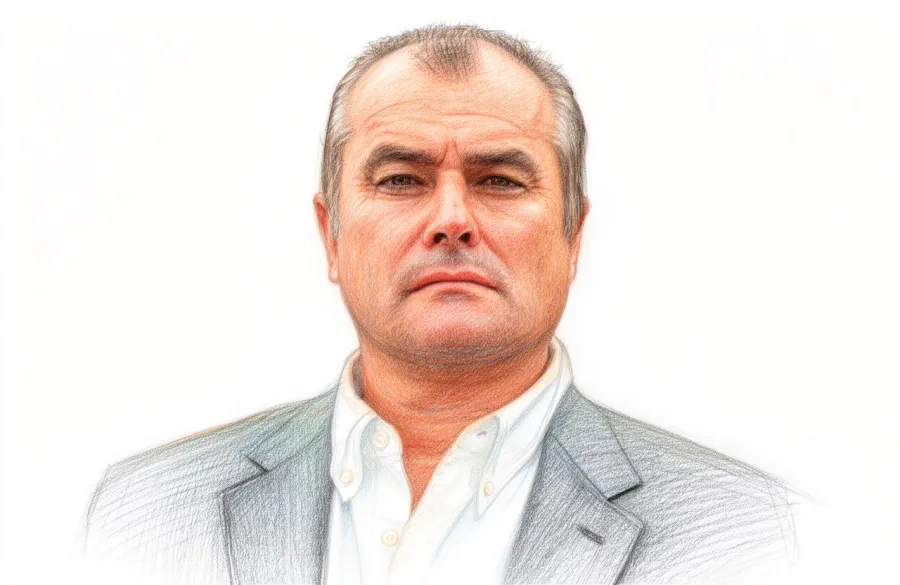
Early Life
Christopher Michael Ironside, who would later be known to audiences as Chris Ellison, was born on December 16, 1946, in St Pancras, London. His early years in the capital grew an interest in the arts, which he first pursued through formal education in visual design. He attended Wimbledon Art College and later Camberwell College of Arts, training to become a graphic designer.
Yet, the conventional path was not for him. He took a job in the Merchant Navy, and the years at sea shaped him. The people he met there later fed into his acting, and it was where his interest in performance took hold. Before committing to acting, he drove a minicab, another job that taught him to read people.
Art student, sailor, cabbie: those jobs gave him a store of real-world detail that he later put into his characters, long before he set foot on a professional stage.
Early Career & First Roles
Chris Ellison entered the profession as an assistant stage manager at Richmond Theatre. His acting debut followed in a production of 'Woman in a Dressing Gown' at the same venue. Through the late 1970s he built a working actor’s resume with guest spots on British television of the era.
He made early appearances on tough, contemporary series like 'The Sweeney' (1975), 'The Professionals', and 'Dempsey and Makepeace'. He usually played policemen or heavies, and that shaped his on-screen persona. He also took film work, with parts in 'Rosie Dixon - Night Nurse' (1978) and 'Lady Oscar' (1979). It was an apprenticeship, and it prepared him for the role that made his name.
Major Roles
Detective Chief Inspector Frank Burnside, The Bill (1984, 1988–1993, 1998–2000)
In 1984, Chris Ellison was cast as Detective Sergeant Tommy Burnside in the groundbreaking police procedural 'The Bill'. The show was known for its documentary-style realism and its focus on the uniformed officers of Sun Hill. It initially used Ellison’s character as a recurring foil—a brash, ambitious plain-clothes detective from the rival CID. Burnside was a bull in the china shop of Sun Hill’s more procedural world, and the character’s immediate impact was undeniable.
Ellison brought a raw energy that felt different from other television detectives of the time. Burnside was not a genteel solver of puzzles. He was a streetwise, often cynical operator who played by his own rules. Ellison played the character’s morality as genuinely complicated: Burnside was dedicated to justice, and his methods were frequently questionable. That grey area made him unpredictable.
Ellison played Burnside as a guest in 1984, as a regular Detective Inspector from 1988 to 1993, and as a semi-regular Detective Chief Inspector from 1998 to 2000. His performance was built on physical presence and a direct, no-nonsense delivery. He used subtle facial expressions—a slight sneer, a hardened gaze—to communicate volumes about Burnside’s disdain for bureaucracy or his simmering anger. He balanced that intensity with rare moments of vulnerability, which complicated a man usually defined by his toughness.
Viewers remember Burnside from the late 80s and early 90s. He divided people, on screen and off, and that was down to how Ellison played him. The character redefined what a TV detective could be: less a hero, more a flawed, driven force of nature. Ellison’s work put real conflict at the centre of one of the UK’s most watched series.
Detective Chief Inspector Frank Burnside, Burnside (2000)
Frank Burnside was popular enough to earn his own spin-off series following Ellison’s 1998–2000 return to 'The Bill'. 'Burnside' (ITV, 6 July–10 August 2000, 6 episodes) followed DCI Burnside heading a National Crime Squad unit.
This new context allowed Ellison to explore different shades of the character. The aggression and bluntness were still there, but tempered by age and by his position outside the official force. The series went deeper into Burnside’s personal life and past, and gave Ellison more room to play a reflective side of the detective, never soft, in a world with even fewer rules than the CID.
Ellison slipped back into the role without missing a beat. 'Burnside' was a last outing for the character, and showed that his appeal was never just the badge. It rested on the morally ambiguous, often unlikeable man Chris Ellison had built from the start.
Other Notable Work
Frank Burnside remains his signature role, but Chris Ellison worked steadily across British television. He played the recurring character Mr. Wilson in the sitcom 'Bread' in 1986–1987, and Charlie Elkin in the drama 'Running Scared' (1986).
Later guest spots included 'Crime Traveller' (1997) and 'Judge John Deed'. He played Len Harker in the BBC soap opera 'EastEnders' in 2007, and appeared on 'Fort Boyard' (2003) and the celebrity edition of 'Pointless' (2017). He also voiced a 'Doctor Who' audio drama, 'The Game' (2005).
Acting Style
Chris Ellison’s acting style suited the realist television dramas that made up most of his career. It rested on presence rather than flourish. He had a commanding stillness on screen and a direct, economical way of speaking.
He was good at playing complex, often authoritative figures, especially those who work in moral grey areas. He could balance open intensity with small suggestion. A hardened gaze or a weary shift in posture could carry a character’s conflict or hidden vulnerability further than pages of dialogue. That approach made his performances, especially as Frank Burnside, feel like watching a real person.
Personal Life
Chris Ellison has kept his life away from the cameras private. He married Anita Joannou in 1979, and they have two children. The family has long lived in Brighton. His art training outlasted his acting start: in 1989 he illustrated the children’s book 'Otto and the Sea Circus', written by his later 'The Bill' co-star Tom Cotcher (DC Alan Woods).
In mid-2020, Ellison suffered a stroke. He was diagnosed with aphasia in summer 2020, and revealed it publicly in April 2022. Aphasia affects his ability to speak and find words, though his comprehension remains intact. His wife, Anita, became his full-time carer, supported by their children and former colleague Mark Wingett. Ellison has talked about the condition openly, campaigning for greater awareness of aphasia and giving interviews about his career.
In closing...
Frank Burnside is the part Chris Ellison is remembered for: a complex, often unlikeable figure who changed how the police procedural was written. Beyond that role, he worked steadily on British screens for decades. His stroke and aphasia have drawn fresh attention to a career that colleagues and audiences rate highly.