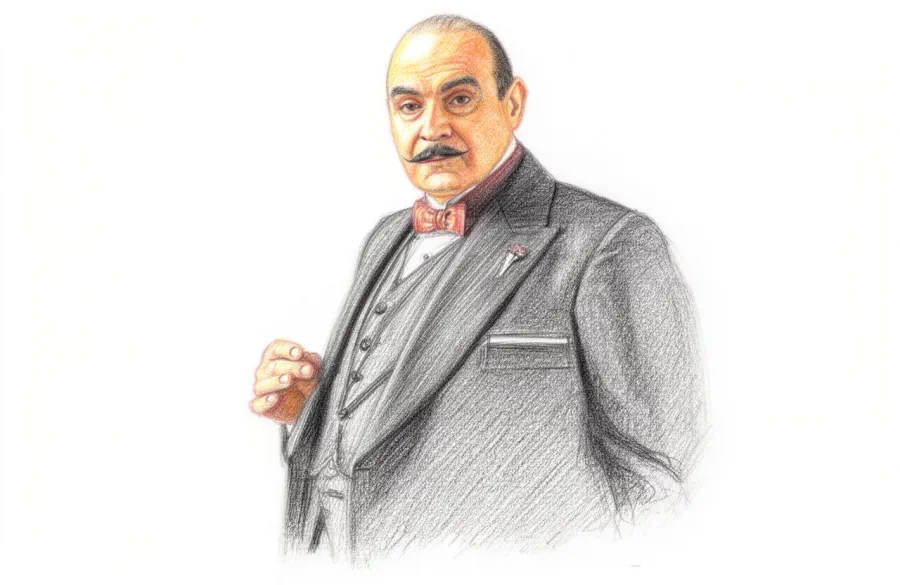
Principal Characters & Performances
Hercule Poirot
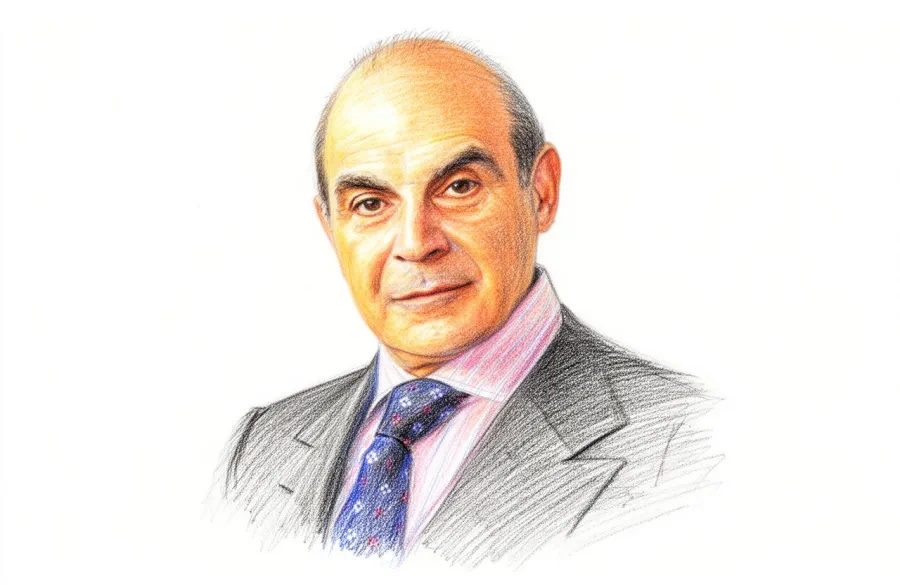
David Suchet's embodiment of Hercule Poirot is the unwavering centre of the entire series. Over twenty-four years and seventy episodes, Suchet crafted a performance of immense detail and consistency, from the precise, mincing walk to the fastidious care of his famous moustache.
He captured the detective's vanity and occasional pomposity without ever sacrificing his underlying intelligence and profound sense of justice. Suchet's Poirot is a man of deep faith and rigid morality, traits that become increasingly central as the series progresses into darker territory.
His performance charts the character's entire arc, from the energetic refugee of the First World War to the weary, physically diminished figure of his final case. This complete journey, portrayed by a single actor, renders Suchet's interpretation the definitive screen version for a generation of viewers.
Captain Arthur Hastings
Hugh Fraser brings a quintessential English decency and warmth to the role of Captain Arthur Hastings, Poirot's friend and chronicler. As the detective's foil, Hastings represents a more conventional, often baffled perspective, his straightforward mind contrasting sharply with Poirot's psychological methods.
Fraser perfectly captures Hastings' loyalty, his occasional exasperation, and his role as the audience's surrogate within the story. The character's presence, primarily in the early series and select later episodes like the finale, establishes the show's foundational dynamic.
His absence in many middle episodes is keenly felt, making his return in "Curtain" a powerful emotional anchor, highlighting how both men have aged and the deep, unspoken bond that exists between them despite their differences.
Notable Support and Guest Stars
The series boasted a formidable and deep bench of British acting talent across its run. Philip Jackson's Chief Inspector Japp is a wonderfully gruff yet ultimately respectful police counterpart, while Pauline Moran's Miss Lemon is the epitome of crisp, efficient secretaryhood.
David Yelland transitioned from a guest role to become Poirot's impeccable valet, George, in the later years. Zoë Wanamaker provided brilliant, scene-stealing energy as the flustered crime novelist Ariadne Oliver, a delightful fictional stand-in for Agatha Christie herself.
The guest rosters read like a who's who of British theatre, film, and television, featuring established names like John Gielgud, Fiona Shaw, and Peter Capaldi alongside then-emerging talents. Early appearances by actors such as Emily Blunt, Michael Fassbender, and a pre-Oscar Jessica Chastain underscore the series' reputation as a quality production that attracted the finest performers.
The World of Agatha Christie's Poirot
The series meticulously constructs the interwar period, primarily the 1930s, as a character in itself. Production design is dominated by the sleek lines and geometric patterns of Art Deco, seen in Poirot's own London apartment and the luxurious hotels he frequents.
This world spans from the grandeur of country houses like Styles Court to the cramped compartments of the Orient Express, from London's bustling streets to quiet English villages. The environment is one of sharp social contrasts and meticulous order, a perfect backdrop for disorder in the form of murder.
Technology like period automobiles, telephones, and radios grounds the stories in their era. When the action moves abroad, to Egypt or the Mediterranean, the production commits fully to location shooting, expanding the scope of Poirot's world while maintaining the same attention to atmospheric detail.
Origin Story
The series began on ITV on 8 January 1989, produced by London Weekend Television with Brian Eastman as the initial producer. It was conceived as a direct adaptation of Agatha Christie's Hercule Poirot stories, with screenplays by writers like Clive Exton.
Christopher Gunning's iconic theme music established its identity from the start. Early episodes were largely filmed in England, using locations and studios like Twickenham to create the period setting. The goal was straightforward: to bring the detective from page to screen with fidelity and style, a task entrusted to David Suchet from the very beginning.
Narrative Style & Tone
The show is classic whodunit storytelling, each episode a self-contained puzzle. The narrative almost always builds to a climactic gathering where Poirot meticulously explains his reasoning, revealing the culprit. The visual style is clean, composed, and symmetrical, reflecting the detective's own desire for order.
While the early seasons often feature a lighter tone, with humour stemming from the characters' interactions, the series undergoes a distinct evolution. The later feature-length episodes adopt a darker, more psychologically intense and morally ambiguous atmosphere.
The dialogue is peppered with Poirot's familiar phrases about his "little grey cells" and his pride in his Belgian heritage, maintaining a consistent voice for the character even as the stories around him grow more complex.
How is Agatha Christie's Poirot remembered?
The series is remembered as a landmark achievement in British television drama and the definitive adaptation of Agatha Christie's work for a global audience. Its legacy is anchored by David Suchet's unparalleled performance, which defined the character for millions.
It is praised for its unwavering commitment to period detail and for its remarkable completeness, having adapted every Poirot novel and short story collection over its long run. Critics and fans view it as the gold standard for literary detective adaptations.
The show maintained popularity through international syndication and streaming, introducing Christie to new generations. Its conclusion in 2013 after adapting Poirot's final case was treated as a significant cultural event, marking the end of a meticulously crafted twenty-four-year journey.
In Closing
Agatha Christie's Poirot stands as a rare television accomplishment: a long-running series that remained true to its source while evolving in depth, anchored by a performance for the ages. It is the complete portrait of a detective.