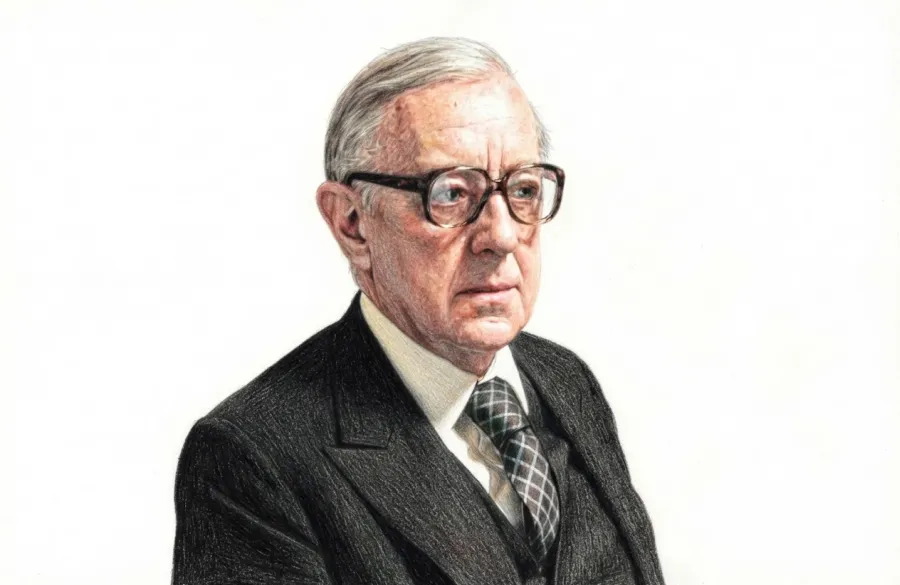
George Smiley is short, overweight, and dresses badly, and he is the best detective British television has produced. Alec Guinness played him twice: seven episodes of Tinker Tailor Soldier Spy in 1979, six of Smiley's People in 1982, both adapted from John le Carré for the BBC, and the two serials together turned a retired stage knight in his sixties into the definitive screen intelligence officer. It was the last third of an extraordinary career, and it happened because Guinness, preparing for the role, asked to meet a real spy.
Smiley
The BBC's Tinker Tailor Soldier Spy (1979) was directed by John Irvin, produced by Jonathan Powell, and written by Arthur Hopcraft with the compression and patience of Hopcraft's Granada training. Its premise is a detective story moved inside a government department: Smiley, pushed out of the Circus, Britain's intelligence service, after a failed operation in Czechoslovakia, is recalled quietly to find the Soviet mole sitting among the service's four most senior men. There are no car chases. The drama consists of men in rooms not saying things, and the audience of around thirteen million per episode kept it that way.
Guinness's Smiley is a performance of listening. The stoop, the peering glasses, the awful knitted clothes, the total absence of ego: he plays the character as a man who has made unremarkability his professional instrument. The great scenes are interrogations and silences, the betrayal revealed not by accusation but by the slow closing of logic around a colleague. Ian Richardson's Bill Haydon, Ian Bannen's Jim Prideaux, Bernard Hepton's Esterhase, Beryl Reid's Connie Sachs and Patrick Stewart's Karla fill the world around him, and the serial won Guinness the Broadcasting Press Guild's award for Best Actor in 1980. The preparation became its own legend. Le Carré arranged a lunch with Sir Maurice Oldfield, the actual Chief of the Secret Intelligence Service from 1973 to 1978, and Guinness studied him across the table, watching the older man run a finger around the rim of his wine glass and asking, in all seriousness, whether he was checking it for poison. Oldfield was checking whether it was clean. The actor's professional suspicion, applied at a polite lunch, is the character in miniature.
The screen performance went backwards into the books. In the novels le Carré wrote after 1979, Smiley acquired the stoop and the gaze that Guinness had given him, which is as close as literature comes to admitting it was rewritten by television. Smiley's People followed in 1982, six episodes directed by Simon Langton from John Hopkins's script: Smiley in retirement is returned to service by the murder of a Soviet defector in London, and the investigation becomes the dismantling of Karla, his Moscow counterpart, played by Stewart as a man whose own defeat is written into the ending. Guinness won an Emmy for it. Of the two serials it is the more emotional: Smiley's marriage, the dead agent's face, the last scene in a Berlin park where an old man finally tells his enemy to come over. If Tinker Tailor is the plot, Smiley's People is the price.
The detective, the criminal, the recruit
Guinness's crime career is not the two serials alone, and the wider pattern is odder than his reputation suggests. He played Fagin in David Lean's Oliver Twist (1948), the film's criminal and one of the most discussed performances in British film, admired for its skill and rightly criticised for its Jewish caricature; any honest account holds both facts. He played the lead in Father Brown (1954), G.K. Chesterton's detective priest, solving the genre's problems with mildness and surprise. And he played Jim Wormold in Our Man in Havana (1959), Graham Greene's satire of intelligence work, the vacuum-cleaner salesman who invents agents to earn his expenses and finds his fictions becoming lethal. Father Brown, Wormold and Smiley are the same screen type at three ages: the unassuming man whom clever people underestimate and who is cleverer than all of them. It is, in miniature, the argument of the whole genre, and Guinness made it three times without raising his voice.
The career around it
The filmography around the genre is national-institution territory. Born illegitimate in Maida Vale in 1914, his birth certificate's father column blank, educated at Fettes on money from the Scottish banker he believed was his father and never met, he was a copywriter in an advertising agency until a RADA scholarship at eighteen took him onto the stage. The Old Vic under Tyrone Guthrie in the 1930s, Broadway before the war, Royal Navy command of a landing craft in the Adriatic, and then the post-war film career: the eight D'Ascoynes of Kind Hearts and Coronets in 1949, including Lady Agatha, the inventor in The Man in the White Suit, the criminal mastermind of The Ladykillers, and then the Lean epics, the Academy Award for Colonel Nicholson in The Bridge on the River Kwai in 1957, Prince Faisal in Lawrence of Arabia, and, in 1977, Obi-Wan Kenobi, a role he regarded with contempt and negotiated a royalty share for that turned into his fortune. He was knighted in 1959. The character actor's career is the main thing here: eight murders in one film, a prison camp colonel's madness, a wizard, and a dowdy civil servant, all played with the same control.
How he works
Guinness is the least visible of great screen actors. The exterior is always mild, the interior always precise, and the interest lives in the gap. As Smiley he plays thought as behaviour: the pause before answering, the second question that sounds like the first one again, the glasses pushed up. The technique comes from the stage, from a career of playing parts smaller than the actor, and it is why the television work is the best of his late career: the camera close to an unremarkable face, doing the most private kind of detective work. Beryl Reid reportedly found him nervous company on Tinker Tailor, and he her, which is the sort of detail that survives because it matches the performances: two professionals both refusing to be ordinary about it.
The pattern
He was never a crime-drama actor, and the claim this site would make on him is exact: two BBC serials, in his mid-sixties, that defined George Smiley for everyone who has watched the character since. Gary Oldman's Smiley in the 2011 film is an impression of Guinness's posture. The genre's other claim on him is the film trio, Fagin, Father Brown, Wormold, which shows the same technique pointed at criminal, detective and dupe. Everything else, Ealing, Lean, a galaxy far away, is the larger career that a reader needs to place him. But the two serials are the reason he is here, and they are among the best things British television has made: a mole hunt conducted by a stooping man in a bad coat, played by an actor who asked a real spy what the work looked like and put the answer into the part.