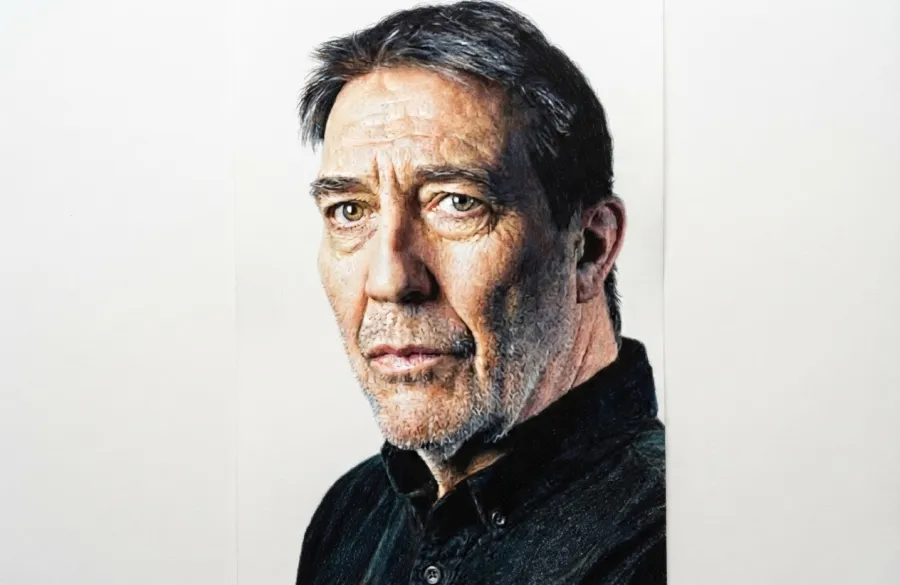
Ciaran Hinds made his professional debut as the back end of a pantomime horse. It was 1976, the Glasgow Citizens' Theatre, a Cinderella, and the man inside the costume was a RADA-trained Belfast law dropout who would spend the next half century playing Julius Caesar, a King-Beyond-the-Wall, and, in 2022, collecting an Oscar nomination for Kenneth Branagh's Belfast. British crime drama has used him more sparingly than it should have: one great detective role, one of television's most memorable villains, and a confession scene in a Granada Sherlock Holmes that is better than most people's whole filmography. The sparing is the point. When a performance of Hinds's arrives inside the genre, it changes the temperature of the whole programme.
Langton
Above Suspicion (ITV, 2009) is his principal British crime role. Lynda La Plante adapted her own detective novel for a series in which DC Anna Travis (Kelly Reilly), a green detective constable with a murdered father, joins the murder squad of DCI James Langton, played by Hinds as a man whose hunger for the top job is the most dangerous thing in the room. La Plante's series ran for four instalments: Above Suspicion in January 2009, then The Red Dahlia (2010), Deadly Intent (2011) and Silent Scream (2012), and Langton's character runs through all of them: mentor to Travis, former lover, driven boss, and a man you would not want as your enemy.
The performance is built on ambition made flesh. Hinds plays Langton as brilliant and unlovable in the same breath, a detective whose work ethic is a temperament, and the series' real subject, the mentor-junior relationship that La Plante keeps ambushing, works because his Langton never lets you settle on whether the interest in Travis is professional or personal. Reviewers routinely treated him as the best thing in the show, which is a defensible view: the material is procedural and the acting is not. Above Suspicion is a covered show on this site, and Reilly, his co-star, has her own profile here.
The villain before the detective
Prime Suspect 3 (1993) is the other essential credit. Hinds played Edward Parker-Jones, the head of a hostel at the centre of a paedophile ring in the third Jane Tennison serial, opposite Helen Mirren at the peak of the series' powers. It is a frightening performance without theatricality: Parker-Jones's menace is administrative, delivered in committees and social-work language, and Hinds plays the language for the horror inside it. It remains one of the most convincing depictions of organised exploitation in British television, and it belongs to a series that created the modern police-procedural template. For an actor's career it also matters as the thing that showed casting directors he could carry the genre's weight: the villain of Prime Suspect, four years before his own detective.
The same year he was Abel Mason in The Man Who Cried, a Catherine Cookson adaptation in which a man who has killed in a moment of temper builds a new life and then has to answer for the old one, and in 1994 he took the lead in the Granada Memoirs of Sherlock Holmes story "The Cardboard Box", as Jim Browner, the seaman at the centre of a domestic murder. The Conan Doyle stories live or die on the suspect, and this one lives: Browner's final confession, delivered to Holmes in the parlour, is one of the great pieces of confessional acting in the Brett series, and it demonstrates what Hinds does that more famous actors do not. He plays guilt as a physical weight. The man is not performing remorse; he is trying to stand up under it.
Belfast
The non-crime work is what most viewers know him from. A decade at the Glasgow Citizens' in the 1970s and 1980s gave him a stage grounding most film actors never get; Sam Mendes cast him as Richard III on a world tour in 1993 at short notice, replacing Simon Russell Beale, and the screen work expanded from there: Excalibur in 1981, then Jane Eyre's Rochester and Ivanhoe's Bois-Guilbert in the 1990s, then Julius Caesar in HBO's Rome (2005–07), which made him an American fixture. Mance Rayder in Game of Thrones, Aberforth Dumbledore in Harry Potter, and Captain Sir John Franklin in The Terror (2018), the doomed Arctic commander, which many critics consider his best television work outside crime: a performance in which imperial certainty meets its physical limit and a good man is dismantled by his own decision.
Belfast (2021) brought the recognition. As Pop, the grandfather of Branagh's autobiographical childhood, Hinds received the Academy Award nomination for Best Supporting Actor, and it is the screen's warmest version of the qualities he had been showing coldly for decades: the same stillness, the same economy, turned into tenderness. The film is also the connection to Jamie Dornan, who plays the father, and to the Belfast crime dramas this site covers: the same city, the same decades, seen through a family instead of a police station.
How he works
The actor's tools are stillness, carriage and a voice. He was an Irish dancer until nineteen, and the body remains visible in the way he holds and moves, which is why directors keep him slow. The Belfast accent, undimmed after four decades of working outside Ireland, does the rest: it reads as truth, in Caesar's camp, on the wall in Game of Thrones, in an ITV incident room. His villainy never shouts; his detectives never strut. He is the genre's ideal supporting and leading actor in one person, and British crime casting has used him too little because he has been needed everywhere else.
The pattern
Look at the crime record alone and it is compact but first-rate: the antagonist of Prime Suspect 3, a Cookson killer, a Conan Doyle seaman's confession, and four serials as La Plante's Langton opposite Kelly Reilly. Add the pattern across the whole career, authority figures who crack, and the crime work is the proof rather than the exception. Hinds is one of those actors British crime drama will always be able to call on at the moment it needs to be taken seriously, and when it has called, from Prime Suspect to Above Suspicion, he has answered with performances that outlast the series around them.