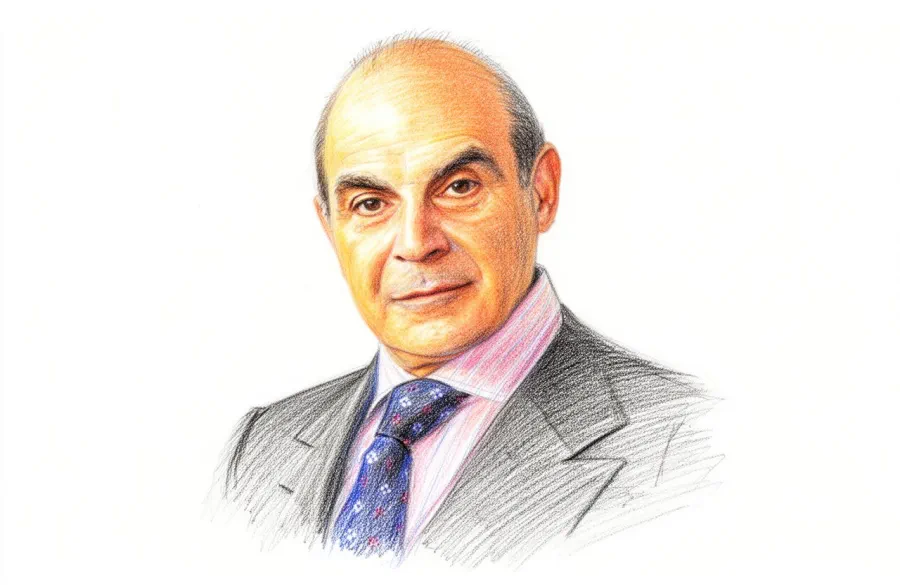
Early Life
David Suchet was born on May 2, 1946, in Paddington, London, into a family where artistry and intellect intertwined. His father, Jack Suchet, was a South African-born obstetrician of Lithuanian-Jewish descent, while his mother, Joan Patricia Jarché, was an English actress with Russian-Jewish and English Anglican roots. This blend of medical precision and theatrical flair would later become a hallmark of his own work.
He was the middle of three brothers. John became a journalist and broadcaster; Peter became a doctor and an advertising director. Grenham House boarding school and Wellington School in Somerset gave him structure, but at 16, when he joined the National Youth Theatre, acting took hold. He trained at the London Academy of Music and Dramatic Art (LAMDA), and later served as its Vice President.
Though raised without strong religious doctrine, a personal spiritual journey would lead him to become a practising Anglican in 1986. His heritage, from his paternal grandfather in Kretinga to his maternal grandfather, the famed Fleet Street photographer James Jarché, gifted him a rich, multifaceted perspective on character and human story.
Early Career & First Roles
Suchet’s professional journey began in 1969 at the Gateway Theatre in Chester, immersing himself in the demanding world of regional repertory across Worthing, Birmingham, Coventry, and Liverpool. This rigorous apprenticeship forged a formidable stage actor. He joined the Royal Shakespeare Company in 1973 and played Tybalt, Orlando and the Messenger, then Bolingbroke in 'Richard II' in 1980–81, opposite Alan Howard.
Early screen work included a bigfoot hunter in 'Harry and the Hendersons' (1987) and 'Oleanna' on the London stage in 1993.
Major Roles
Hercule Poirot in 'Agatha Christie's Poirot' (1989-2013)
David Suchet played Hercule Poirot from 1989 to 2013, a quarter-century in the part. He is the version most viewers picture when they think of the character: the fastidious Belgian detective with the stiff moustache and the exact way of doing things.
Suchet approached the role not as an impersonation but as a complete psychological and physical reconstruction. He compiled a 5-page file of 93 points on Poirot’s traits, drawn from Christie’s texts, down to his walking speed and the number of sugar cubes in his coffee. That preparation produced a consistent character: the fastidious walk, the moustaches (which Suchet insisted be exactly as described, "stiff and military"), the precise gestures, and the Belgian-accented English.
Over 70 episodes and 13 series he played Poirot as a vain, confident problem-solver in the 1930s who becomes a weary, troubled man after the war. He let the loneliness show, and the Catholic guilt, and the compassion for the people a murder leaves behind.
His last episodes, ending with 'Curtain: Poirot's Last Case', show a detective facing his own mortality and his moral limits. It is a quiet ending, and an earned one.
Augustus Melmotte in 'The Way We Live Now' (2001)
After Poirot came Augustus Melmotte in the 2001 BBC adaptation of Trollope’s 'The Way We Live Now', a role that earned him a BAFTA nomination. Melmotte is a mysterious European financier who forces his way into Victorian London society, driven by greed, fraud and a desperate wish to belong.
Outwardly Melmotte is bluster and bulk; underneath he is paranoid, insecure and quick to rage. Suchet played his vulgarity and his almost childlike wish to be accepted by the aristocracy that secretly despised him. He gave him a lumbering walk and a voice that could drop to a whisper or rise to a roar of wounded pride.
Suchet did not play Melmotte as a simple villain. He played the outsider who wants to be accepted by the people who despise him. The part won him both RTS and Broadcasting Press Guild awards.
Other Notable Work
He played historical figures too: Edward Teller in 'Oppenheimer' (1980) and Sigmund Freud in the 1984 series 'Freud'. On stage he played Salieri in 'Amadeus' on Broadway, and appeared in 'The Last Confession'.
Crime fans will also know him as Inspector Japp in 'Thirteen at Dinner' (1985), as Robert Maxwell in the 2007 TV film, as Lew Vogel in 'The Bank Job' (2008), and as the Landlord in the 2017 'Doctor Who' episode 'Knock Knock'.
Acting Style
David Suchet prepares. He builds a character from the text outwards: close reading, period research, a full backstory, even when none of it reaches the screen.
He uses posture, gait and gesture to show what a character is thinking, from Poirot’s fussiness to Melmotte’s bulk. He gives each one a separate voice and accent, shaped around how that character thinks. The actor tends to disappear behind the part.
Personal Life
Away from the camera and stage, David Suchet leads a life grounded in family and faith. He has been married to actress Sheila Ferris since 1976, and they have two children, Robert and Katherine. Robert has been reported as a captain in the Royal Marines and Katherine as a physiotherapist. His conversion to Anglicanism in 1986 and subsequent confirmation in 2006 is a central pillar of his life, a journey he has discussed with thoughtful openness, noting how it provides a moral framework that influences his choice of roles.
His personal passions reflect his artistic heritage and curiosity. An avid photographer, he channels the legacy of his grandfather, James Jarché. He also plays the clarinet. For many years, he made his home in Pinner, Greater London, and has been a dedicated supporter of various charitable causes.
In closing...
David Suchet is best known for Poirot, and that is fair: a quarter-century in the part, 70 episodes, 13 series. But he also played Trollope’s financier, Freud, Teller, Maxwell and Salieri, which is a wider career than the one role suggests.