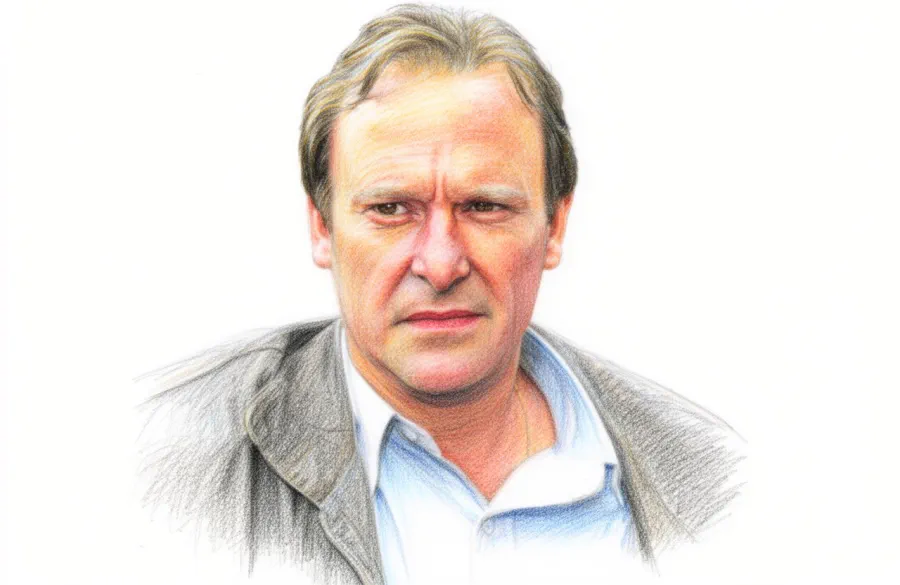
Early Life
Dennis Waterman was born in Clapham, South London, on 24 February 1948, the youngest of nine children. He trained at the Corona Theatre School, and by twelve he had made his screen debut. He died in hospital in La Manga, Spain, on 8 May 2022, aged 74, with his wife Pam at his side. The cause was lung cancer. His career ran from 1960 to 2020.
The young Waterman had confidence in front of the camera and on stage, and by thirteen he was performing in West End musicals. He learned on film sets and in rehearsal rooms rather than in a classroom.
Early Career & First Roles
Waterman started as a child actor. His first film role came in ‘Night Train for Inverness’ (1960), and he later took small roles with the Royal Shakespeare Company. He played Winthrop Paroo in ‘The Music Man’ in the West End, and the title role in a stage production of ‘Oliver!’. His break came in 1962 when the BBC cast him as William Brown in ‘William’.
He worked across transatlantic sitcoms (‘Fair Exchange’), Children’s Film Foundation adventures (‘Go Kart Go’), and new theatre: he was in the first cast of Edward Bond’s ‘Saved’ in 1965. By the late 1960s he was taking adult roles, including the film ‘Up the Junction’ (1968).
Major Roles
Dennis Waterman played three long-running television characters, one for each era of his career, and he became a familiar, tough but likable presence in the nation’s living rooms. He moved from juvenile lead to hard-bitten detective to everyman. He also played Detective Sergeant George Carter in The Sweeney.
Gerry Standing – New Tricks (2003–2015)
In the BBC’s ‘New Tricks’, Waterman played Gerry Standing, a former Detective Sergeant brought out of retirement to work in the Unsolved Crime and Open Case Squad (UCOS). Standing was an old-school copper: charming, occasionally dodgy, loyal to his team, with a streetwise intuition that procedure could not replicate. Waterman played him from the pilot in 2003 to series 11 in 2014, plus two episodes of series 12. Larry Lamb replaced him. The BBC cancelled the show in February 2015.
Gerry was a roguish charmer with a chequered past who often made ends meet with questionable side hustles, yet his moral compass, when it mattered, pointed north. Storylines about his ex-wife and daughter showed a softer side under the cockney swagger. His chemistry with co-stars James Bolam, Alun Armstrong, and later Denis Lawson carried the show: fractious, unbreakable camaraderie forged on the job.
The role drew on five decades of comic timing, dramatic weight, and everyman appeal. He also sang the show’s theme song, “It’s Alright, It’s Okay”, written by Mike Moran.
Terry McCann – Minder (1979–1994)
‘Minder’ made Waterman a national institution. As Terry McCann, a former boxer trying to go straight as a minder for the scheming used-car dealer Arthur Daley (George Cole), he created one of British television’s best-known double acts. Terry was the moral centre: the muscle with a conscience, dragged into Arthur’s plots while trying to keep his own code. Waterman played the exasperation and the loyalty straight. He appeared in series 1 to 7, from 1979 to 1989, and left after ‘The Wrong Goodbye’. The show ran to 1994 without him, explaining that Terry had married and emigrated to Australia; Gary Webster joined as Ray Daley for series 8 to 10.
He played Terry with a boxer’s wary poise and a quiet strength that made the protective role believable. The character’s decency was what stuck. Terry McCann was a working-class man navigating the grey areas of London life. His scenes with George Cole were the engine of the show: the straight man to Cole’s comic lead, and always holding his own. The theme song, “I Could Be So Good for You”, sung by Waterman, reached number 3 in the UK in November 1980 and stayed on the chart for twelve weeks. Terry McCann remains his defining role for an entire generation.
Other Notable Work
Beyond his three leads, Waterman carried other series. He played self-made millionaire Tony Carpenter in the sitcom ‘On the Up’ (1990–1992) and Thomas Gynn in the comedy-drama ‘Stay Lucky’ (1989–1993). Before ‘New Tricks’ he played a customs officer in ‘The Knock’ (1997–1999), which he joined for series 3 and 4 of a show that ran from 1994 to 2000. He sang the theme songs for ‘Stay Lucky’ and ‘On the Up’ as well. He could carry a series in several genres.
Acting Style
Dennis Waterman played naturalistic, charismatic parts, and he never seemed to be acting. His performances felt lived-in, as if he had walked off the street and onto the set. That made his characters, usually tough, streetwise Londoners, immediately believable. He was a man’s man with a twinkle in his eye, and could carry both resilience and vulnerability.
He moved between drama and comedy without a seam. He could play a hard dramatic scene, then switch to comic timing as the weary straight man. He sang the theme songs for his own shows, from ‘Minder’ to ‘New Tricks’, which built a bond with the audience. He was a professional whose work looked effortless.
Personal Life
Waterman married four times, most notably to actress Rula Lenska. That relationship ended with public discussion of his struggles with alcohol and violence, which he later spoke about openly. He had two daughters, including actress Hannah Waterman, from his marriage to Patricia Maynard. In his later years he lived with his fourth wife, Pam Flint, in Spain, where he had moved in 2015 and was semi-retired.
He was a lifelong Chelsea supporter and presented the nostalgia football show ‘Match of the Seventies’. He delivered the eulogy for his ‘Minder’ co-star and close friend George Cole in 2015.
In closing...
Dennis Waterman worked in British popular culture for six decades. He went from child actor to tough detective, from minder to old hand. He was a familiar face rather than a distant star, and he played resilient, funny, decent people. He did that for over fifty years, and the characters stayed with the audience.