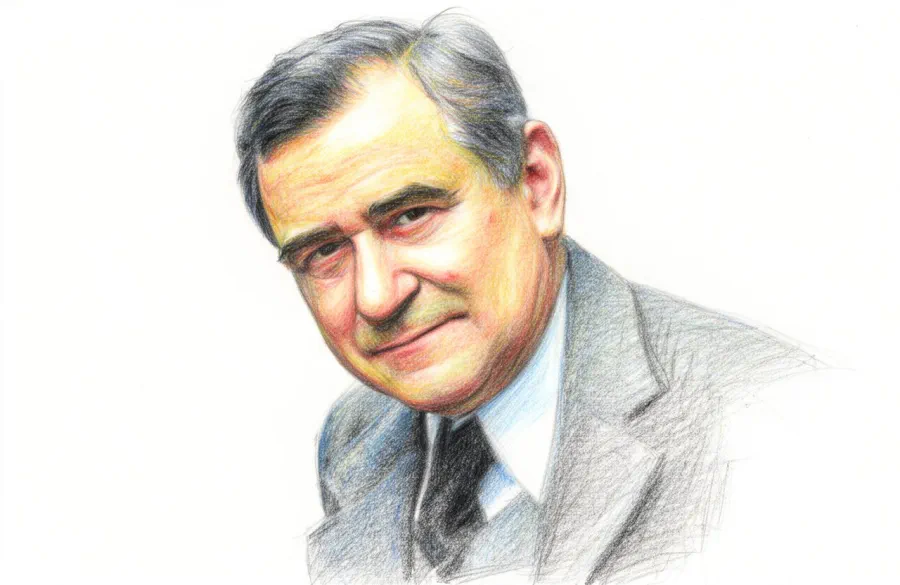
Early Life
George Baker's story begins not in the heart of England, but on the shores of the Black Sea. He was born on April 1, 1931, in Varna, Bulgaria, into a life of international diplomacy and service. His father was an English businessman who served as honorary vice consul, while his mother was an Irish Red Cross nurse. This cosmopolitan beginning was soon overshadowed by the gathering clouds of war.
As World War II intensified, the family relocated to the safety of England. Baker's education continued at Lancing College in Sussex, where the first sparks of his interest in acting were kindled. His path, however, first led him to national service. He joined the 3rd Royal Tank Regiment and was posted to Hong Kong, a long way from the Sussex Downs.
His military career was cut short by illness, leading to a period of convalescence and completion of his service in the quieter landscapes of Pembrokeshire, Wales. With the war behind him and his health restored, a teenage Baker made a decisive turn towards the stage, joining the Deal repertory company in Kent at the age of fifteen, setting the course for a remarkable life in performance.
Early Career & First Roles
George Baker started out in post-war British cinema and theatre. His film debut came in "The Intruder" in 1953. He starred alongside Richard Attenborough in "The Ship That Died of Shame" (1955) and appeared in the war film "The Dam Busters" the same year.
Television soon called, with his first small-screen appearance in the anthology series "Adventure Theater" in 1956. A significant early lead role arrived in 1959 with "Nick of the River," a crime series based on a real-life detective. He went on to play both heroic and difficult parts for decades.
Major Roles
George Baker worked for more than half a century, but two roles matter most. One made him the British detective for a generation of television viewers. The other showed what he could do in a historical drama.
Detective Chief Inspector Reg Wexford, The Ruth Rendell Mysteries (1987-2000)
For many, George Baker is Inspector Reg Wexford. He played Ruth Rendell's detective in the television adaptations from 1987 to 2000, and his Wexford was thoughtful, kind, and short-tempered by turns. He solved cases by understanding people, not by flashy deduction.
Baker's Wexford was a family man, grounded by his relationship with his wife Dora (played by Baker's real-life wife, Louie Ramsay, from 1993). This domestic anchor provided a crucial counterpoint to the darkness of the crimes he investigated. Baker excelled at conveying the weight of the job—the bureaucratic frustrations, the moral quandaries, and the personal toll of confronting evil. His performance was a slow burn of intelligence and empathy.
He captured Wexford's essential decency without making him a saint, his occasional stubbornness and flashes of temper making him thoroughly believable. Baker understood that Wexford's method was conversational, psychological. He solved crimes by listening, by observing the nuances of behaviour and class in the fictional town of Kingsmarkham. This was not action-hero policing. It was patient, watchful work.
The role demanded a sustained subtlety over more than a decade, and Baker delivered with unwavering consistency. He made Wexford's thought process visible, his growing certainty palpable. In doing so, he created one of the best-loved detectives on British television, a character who felt like a real public servant rather than a fictional one.
Emperor Tiberius, I, Claudius (1976)
Long before Wexford, George Baker played the Emperor Tiberius in "I, Claudius." His Tiberius was a capable soldier and a reluctant ruler, worn down by paranoia, by the people scheming around him, and by the desires he kept hidden.
Baker took Tiberius from a grimly competent heir, tired of his mother Livia's scheming, to a bitter old man who retreated to the debaucheries of Capri. He played the cynicism and the disgust with the flattery and treachery of the Roman court. His scenes made the slide into tyranny and suspicion believable, and hard to watch.
His Tiberius was more restrained than the villains around him, menacing because of how smart he was and how far his morals had slipped. The part needed enormous control and the ability to suggest years of disappointment and resentment he never spoke about, and Baker managed it. It remains one of the best performances on television, a long way from the detective genre.
Other Notable Work
Baker turned up in a long list of British productions. He played the duplicitous "Number Two" in the first episode of "The Prisoner" (1967). He brought aristocratic poise to another detective, Inspector Roderick Alleyn, in four 1977 adaptations of Ngaio Marsh's novels.
He demonstrated a deft comic touch as the Chief Beefeater in an episode of "The Goodies," and even entered the world of James Bond, playing the ill-fated Captain Benson in "The Spy Who Loved Me" (1977). On stage he worked at the Old Vic and the Royal Shakespeare Company, playing Claudius in "Hamlet" and Bolingbroke in "Richard II."
Acting Style
George Baker's acting style was intelligent, authoritative, and free of pretension. He had a commanding, resonant voice that could convey reassurance and threat just as easily. He never used it to declaim; he used it to deliver a cutting remark or a quiet line of wisdom with weight.
His skill was playing complex inner lives. As the decent, dogged Wexford or the morally bankrupt Tiberius, Baker built his characters from the inside out, so their motives and conflicts felt real. He was a master of reactive acting, his face showing thought or suppressed feeling. That made him convincing as both a leading man and a villain.
He moved between classical theatre and contemporary television, bringing theatrical depth to screen roles without ever seeming stagey. His performances were grounded and carefully built. He could lift any material and he kept choosing parts with substance, playing characters whose inner lives felt real.
Personal Life
George Baker's life away from work centred on family. He was married three times: first to Julia Squire from 1950 to 1974, with whom he had four daughters; then to actress Sally Home from 1974 to 1992, with whom he had a fifth daughter; and finally to actress Louie Ramsay from 1993 until her death in 2011. She played his on-screen wife Dora in "The Ruth Rendell Mysteries."
Baker had varied interests and gave a lot of time to charity. He wrote an autobiography, "The Way to Wexford" (2002), and even a cookery book, "A Cook for All Seasons" (1989). His charity work, particularly for the Musicians' Benevolent Fund and as a trustee of the Savage Club, was recognised in 2007 when he was appointed a Member of the Order of the British Empire (MBE).
In closing...
George Baker worked steadily for over fifty years and was good in almost everything he did. From ancient Rome to the quiet streets of Kingsmarkham, he created characters with depth and authority. For anyone who loves mystery drama, his Reg Wexford is still the version to beat.