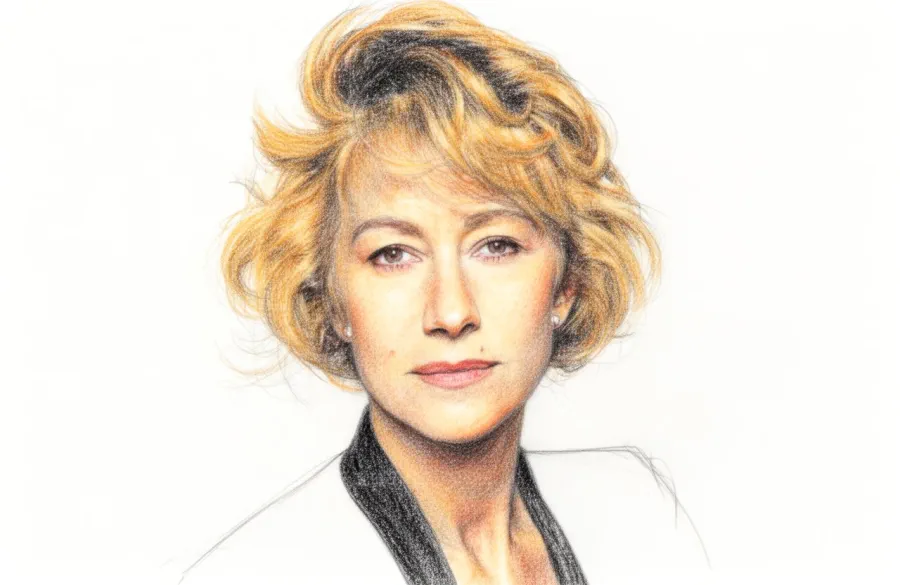
Early Life
Helen Mirren was born Ilyena Lydia Mironoff on July 26, 1945, in Hammersmith, London. Her mother was from a large English family, and her father came from an exiled Russian aristocratic line dating back centuries. That mixed background gave her the sense of being an outsider looking in, which she later drew on in her characters.
She took up performing at the Queen's School in London, and at 18 she joined the National Youth Theatre and started treating it as a career.
She learned her classical technique there, playing early roles in Shakespeare, including 'Antony and Cleopatra' and 'Macbeth'. In 1967 she joined the Royal Shakespeare Company, where the stage work demanded precision and stamina.
Early Career & First Roles
Her move to screen was gradual. She had a small part in 'Herostratus' (1967), then broke through as a young artist's muse in Michael Powell's 'Age of Consent' (1969). Through the 1970s and 80s she built a filmography full of difficult women.
She appeared in Lindsay Anderson's satire 'O Lucky Man!' (1973), took a role in the notorious 'Caligula' (1979), and played Victoria, the gangster's wife, in the British crime film 'The Long Good Friday' (1980), where she is the female co-lead alongside Bob Hoskins.
She played the sorceress Morgana le Fay in 'Excalibur' (1981), and in Peter Greenaway's 'The Cook, the Thief, His Wife & Her Lover' (1989) she played Georgina Spica, a wife who takes her revenge. Those parts made her a formidable screen presence.
Major Roles
Helen Mirren has worked across a huge range of parts. Her crime and mystery work is what she is best known for.
Detective Chief Inspector Jane Tennison in Prime Suspect (1991-2006)
Any account of the modern police procedural has to include Helen Mirren's Detective Chief Inspector Jane Tennison in Prime Suspect. It was more than a role. Over seven series and fifteen years, Mirren played a professional woman fighting for her footing in a police force built by and for men.
Tennison was brilliant, flawed, ambitious and worn down by the job. Mirren played her as a professional whose hardest battles were inside the station rather than on the streets. The cost showed in the loneliness, the chain-smoking, the failed relationships, and the need to prove her authority again and again to male colleagues who resented her.
Mirren learned the technical jargon and the procedural habits, and she gave every scene emotional weight. In the first series, her hunt for a serial killer runs alongside her fight against the sexism that holds the investigation back.
Tennison grew wearier and wiser as the years went on, and her wins were usually bittersweet. Mirren never softened her into someone easy to like. The toughness was the armour, and it was necessary. The part moved the female detective in crime drama from supportive sidekick to the centre of the story, and the rank rises from DCI to Detective Superintendent across the later instalments.
The performance won her three consecutive BAFTA Awards and two Emmys, and it set the template that later female investigators in the genre were built on.
Georgina Spica in The Cook, the Thief, His Wife & Her Lover (1989)
Before she ever commanded an incident room as Tennison, Helen Mirren gave a fierce performance in Peter Greenaway's brutal, highly stylised film. As Georgina Spica, the wife of a monstrous and vulgar gangster, she goes from prisoner to avenger.
Trapped inside her husband's restaurant, Georgina starts out silent and despairing. Mirren carries it in posture and gaze, her composure a contrast to the barbarism around her. Her affair with a quiet bookshop owner becomes an act of rebellion and a reclaiming of her own autonomy.
The film's extremity needed an actor with nerve and control, and Mirren is its moral centre. Her story ends in a finale of shocking revenge that is both horrifying and cathartic, and Mirren plays it as retribution rather than as violence for its own sake.
The role announced that Mirren would take on anything. She worked with the film's theatrical style while keeping Georgina recognisable as a person, held the frame with quiet intensity, and showed she could carry a demanding lead part.
Other Notable Work
Mirren's mystery and psychological drama work runs well past television. As Annie Marsh in The Hawk (1993), she plays the wife of a man suspected of being a serial killer, and she shows the fear of doubting someone inside your own home.
In the thriller Pascali's Island (1988), she plays Lydia Neuman, an artist caught up in espionage, a supporting part next to the leads. Different sizes of role, but Mirren takes each one seriously, and the run of parts built a solid body of work in the genre.
Acting Style
Helen Mirren's approach is disciplined work plus room to improvise. She believes in groundwork: research, script analysis, and close collaboration with hair, makeup and costume to build a character from the outside in.
Her stage training, especially with the RSC, gave her a respect for technique and text. She argues that performance only begins once the technique is mastered and can be forgotten, so that imagination and spontaneity take over. She also understands the camera, and how small a performance for the lens needs to be.
The result is performances that feel lived-in. Whether she plays a monarch or a detective, the characters are not imitations. They have histories, motives and contradictions, and she builds them from life without simply playing a biography.
Personal Life
Mirren was in a long relationship with actor Liam Neeson in the early 1980s. She met the film director Taylor Hackford on the set of White Nights (1985), and they married in 1997 in Scotland.
She has spoken about choosing not to have children, and her stepson Rio Hackford died in 2022. She gardens seriously, and describes it as a practice in patience that keeps the ego out of the way.
She campaigns on feminist issues and has pushed back on both ageism and sexism in Hollywood. In 2003 she was made a Dame Commander of the Order of the British Empire for services to drama.
In closing...
Dame Helen Mirren is one of the most skilled actors working. Through Jane Tennison she permanently changed what a television crime drama could do.
Her record over six decades is unusual. For viewers who like mystery and character work, she is a standard to measure others against.