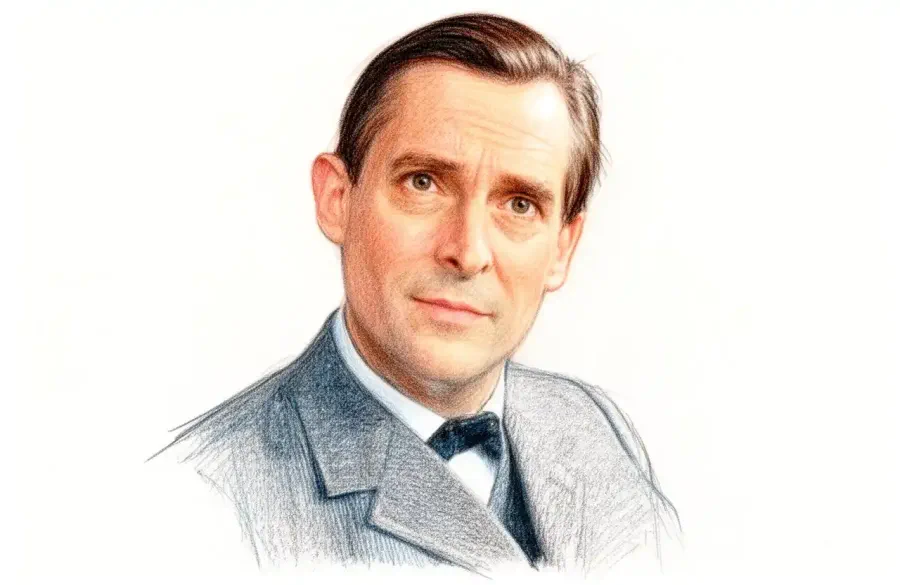
Early Life
Jeremy Brett was born Peter Jeremy William Huggins on November 3, 1933, in Berkswell, Warwickshire. Some sources give 1935. His father was a Lieutenant Colonel and his mother, Elizabeth Edith Cadbury, came from the confectionery family. It was a strict, comfortable upbringing.
Brett went to Eton College, where he sang in the college choir. That was an outlet for a boy who also dealt with dyslexia and rhotacism, a speech impediment. Corrective surgery and a lot of practice got him past both and gave him the precise, resonant voice he was known for.
He trained at the Central School of Speech and Drama and graduated in 1954. At his father's request he took the stage name Jeremy Brett to keep the family name out of it. He kept to the work from there.
Early Career & First Roles
He started working in 1954 at the Library Theatre in Manchester and soon joined the Old Vic company in London. Early roles included Patroclus in 'Troilus and Cressida' and Paris in 'Romeo and Juliet'.
His Broadway debut came in 'Richard II', and he played the romantic lead in the West End musical 'Marigold'. On screen he played Freddy Eynsford-Hill in the 1964 film 'My Fair Lady'. He held his own opposite Audrey Hepburn.
Major Roles
Sherlock Holmes (Granada Television Series, 1984-1994)
Brett played Sherlock Holmes for Granada Television from 1984 to 1994, in 41 episodes across four series plus feature-length films (the Independent counted 40 tales). He came to the part as a scholar and a fan, and called himself the reported "caretaker" of Holmes's legacy. He did not just play the detective. He built him from the hawk-like profile and piercing gaze to the restless physicality.
He went back to Conan Doyle's stories for it. He rejected the cold reasoning machine of earlier versions and played the mercurial, often tortured man under the deerstalker. His Holmes was full of controlled oddity: fluttering hands, sudden explosive movements, collapses onto the sofa, all of it over a brittle intelligence.
He played the arrogance and the impatience, and also the unspoken loyalty to Watson and the dark stretches of Holmes's manic-depressive temperament. Brett was later diagnosed with bipolar disorder himself, which fed into the performance.
He kept "Baker Street File" notebooks analyzing every clue to Holmes's behaviour, from his diet to his violin playing. For a generation, his voice is the voice of Sherlock Holmes.
Edward Ashburnham (The Good Soldier, 1981)
Before Baker Street, Brett played Edward Ashburnham in Granada's adaptation of Ford Madox Ford's "The Good Soldier" (1981). Ashburnham is the perfect English gentleman whose life is a lie. The role needed a charming, aristocratic surface to crumble slowly over passion and despair underneath, which suited Brett's style.
His Ashburnham is a man trapped by the conventions of his era and by his own emotions. Brett does it with a glance, a tremor in the hand, the flatness in his voice, and makes the character's self-destruction look inevitable.
Other Notable Work
He worked steadily outside Holmes. On stage he played Hamlet in 1961, Captain Absolute in Sheridan's "The Rivals," and Bassanio in "The Merchant of Venice."
On television he played d'Artagnan in a 1966 "Three Musketeers" adaptation and John Middleton Murry in "A Picture of Katherine Mansfield" (1973).
Acting Style
Brett worked from theatrical flourish on the outside and Stanislavsky-style internal work underneath. He believed in finding the "underbelly" of a character and drew on his own experience to do it. Every pause and gesture looked deliberate and grew out of the character.
He knew how to use his baritone, moving from sarcasm to reverie to fury, and he was expressive in stillness as much as in motion. He researched and kept notes to build a complete person.
Personal Life
Brett married twice: first to actress Anna Massey, with whom he had a son, David, and later to Joan Sullivan Wilson, whose death from cancer in 1985 devastated him. He had long-term relationships with actor Gary Bond and, later, Paul Shenar, and he never discussed his sexuality in public.
Later in life he was diagnosed with manic depression (bipolar disorder), which he managed with medication. He spoke of finding solace in meditation and yoga. He passed away in 1995.
In closing...
Brett's Holmes tends to overshadow the rest of a long career. He was a careful, intelligent actor who brought theatre training and psychological truth to every part. He is remembered for Holmes, and for a lot more than Holmes.