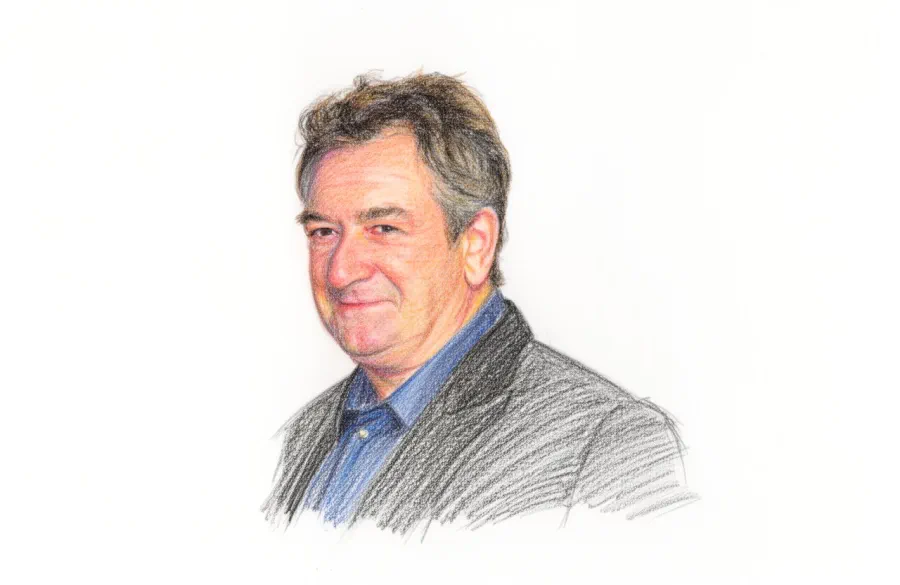
Early Life
Ken Stott was born on October 19, 1954, in Edinburgh, Scotland (some sources give 1955), into a household rich with intellectual and cultural diversity. His father, David Stott, was a teacher and later an educational administrator at George Heriot's School, where Ken would eventually become a pupil. His mother, Antonia Sansica, was a Sicilian lecturer in Italian literature at Edinburgh University, imparting a Mediterranean heritage that contrasted with his Scottish upbringing. The family was Roman Catholic, a faith in which Stott was raised.
His school years at George Heriot's were not solely academic; a youthful passion for music saw him spend three years as a member of a band called Keyhole, a group that later had members find fame as part of the Bay City Rollers. This early foray into performance hinted at a creative path, one he would soon pursue with singular focus by studying acting at the Mountview Academy of Theatre Arts in London.
Early Career & First Roles
After graduating, Stott joined the Royal Shakespeare Company in 1975. The late 1970s and early 1980s were lean years, with roles scarce enough that he worked as a double glazing salesman to make ends meet. His television debut came in 1977 on the BBC series 'Secret Army'.
Throughout the 1980s, he built a steady run of television performances. He appeared in 'Taggart' (1985) and played Uncle John in Dennis Potter's 'The Singing Detective' (1986). These parts left an impression with limited screen time.
Major Roles
Ken Stott built a large body of work through his choice of roles. He has worked on stage and in blockbuster cinema, but his strongest parts have come on television, mostly in the mystery and crime genre.
Detective Inspector John Rebus, Rebus (2000–2007)
For many, Ken Stott is the face of Ian Rankin's Edinburgh detective, John Rebus. Stott took over the role in 2006, from John Hannah, in the ITV series that ran from 2000 to 2007. He played Rebus as world-weary and entirely convincing. His Rebus was not a glamorous sleuth; he was a man worn down by the city, his personal life a shambles, his methods unorthodox, and his dedication to justice an almost pathological compulsion. Stott captured the detective's contradictions: the cynicism battling a stubborn moral core, the intelligence clouded by self-destructive tendencies.
Stott’s Rebus moved away from the more genteel detectives who came before him. He played a man who was palpably real, flawed, and emotionally complex. His fit with Edinburgh was plain; he didn't just work there, he was of it, a product of its dark closes and its history. The performance gave the police procedural a new level of psychological depth.
Stott made a difficult, often unlikeable character profoundly sympathetic. We understood his rage and his disappointments because Stott never asked for our approval, only our understanding. From 2006 to 2007 he owned the role, and his reading of Rebus remains the one later versions are measured against.
Balin, The Hobbit Film Trilogy (2012–2014)
Away from the modern realism of Rebus, Stott played the dwarf Balin in Peter Jackson's The Hobbit trilogy. It was a supporting role in a large ensemble, and Stott's Balin became the moral compass of Thorin Oakenshield's company. He played him as a wise counselor and a loyal friend, and as the keeper of the group's history.
Stott gave the character a gentle, avuncular quality that grounded the story. Balin's kindness towards Bilbo Baggins, his loyalty to Thorin, and his fate in the mines of Moria (foreshadowed for readers of The Lord of the Rings ) all carried real emotional weight.
The part showed his range. He carried his natural acting style into a high-fantasy epic and made it resonate just as powerfully. He didn't play a dwarf so much as a person, honourable, brave and flawed, who happened to be a dwarf.
Other Notable Work
Stott's breakthrough came as the manic-depressive DJ Eddie McKenna in the BBC drama Takin' Over the Asylum (1994), which established him as a leading actor.
He played Adolf Hitler in the 2005 ITV drama Uncle Adolf , which looked at the dictator's private life. He also played DCI Red Metcalfe across four series of Messiah (2001-2005).
Acting Style
Ken Stott's acting has a rugged authenticity. He has a grounded presence that draws the audience's focus, built not on theatricality but on a deep internal life. He never seems to be "acting," but rather inhabiting.
He specializes in complex, morally ambiguous men, burdened by history, failure or a sense of duty. There is weight to his performances, and a vulnerability he lets surface at the right moments. He moves easily between tragic drama and subtle comedy.
Personal Life
Stott keeps his private life out of the public spotlight. He was first married to Elizabeth Maxwell in 1984, with whom he has a son, David. Following their divorce, he married the artist Nina Gehl in 2016. Away from the camera he is a bagpiper, a collector of vintage vinyl records, and a painter who has exhibited his work.
He supports animal welfare charities. He keeps a house near Perugia in Italy, his mother's homeland, and a base in a Shoreditch penthouse in London, far removed from the troubled figures he portrays.
In closing...
Ken Stott has been one of the most respected actors of his generation, and his career rests on integrity and good choices. Whether as John Rebus, the heart of a dwarven company, or any number of complex souls in between, he brings depth and emotional weight to every role.