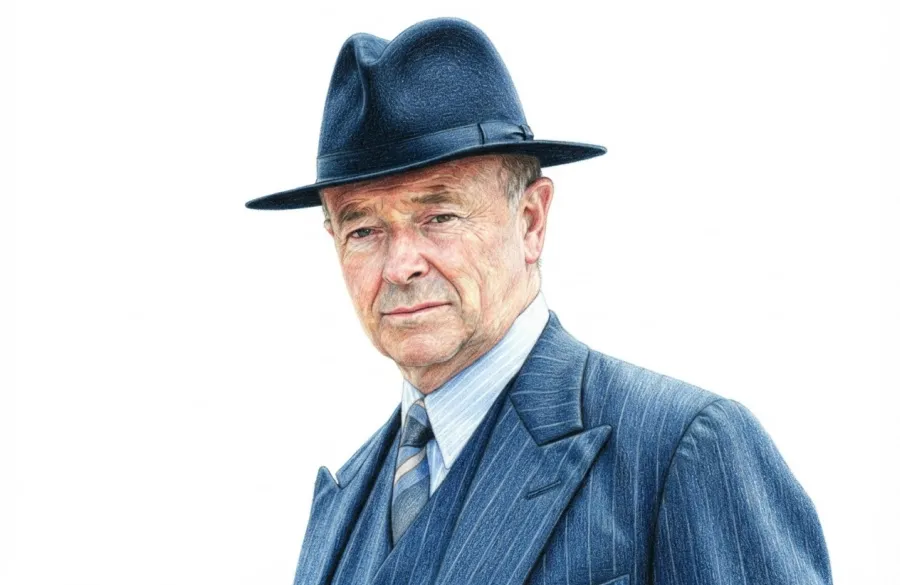
Christopher Foyle opens a case file, reads it, and says almost nothing. That silence, sustained over twenty-eight episodes of Foyle's War across nine series between 2002 and 2015, made Michael Kitchen the detective of British television's post-war nostalgia, the actor other actors describe when they mean quiet authority. He was fifty-three when ITV cast him in Anthony Horowitz's wartime Hastings, after three decades of exactly the kind of supporting work that gets an actor remembered only by people who read credits. The result is a strange kind of career: one of the most respected screen actors in the country, and one of the least famous, entirely by his own arrangement.
Foyle
The premise of Foyle's War sounds like a BBC commissioning memo and played like one of ITV's best series. Hastings, the Second World War, a detective chief superintendent too principled for promotion, kept out of the front line by a country that needs its home front policed. Black markets, profiteering, murdered land girls, blackmailers sheltering behind badges and ranks: Horowitz's cases are usually solvable, and the criminal is usually respectable. The drama comes not from who did it but from what it costs to prove it, against people whose war service, social position or plain shamelessness is meant to be protection.
Kitchen's performance is the reason the show outlived its gimmick. Foyle speaks slowly, never raises his voice, and wins arguments by waiting longer than the other man. It is an acting style built on omission, and it flatters neither the character nor the audience: Foyle's patience reads as stubbornness as often as virtue, and his mildness lets the show's anger land harder when it comes. Honeysuckle Weeks, as his driver Samantha Stewart, and Anthony Howell, as the damaged Milner, filled the screen around him, but the series was Kitchen's pace. The wartime series ran to four, in feature-length stories; ITV cancelled it; the audience complained; it came back in 2010 and ran five more series, the war ended, and Foyle moved into the first years of the Cold War, where the crimes became espionage and the enemies became the state's own. Kitchen was a producer of the show through those later years, which is worth knowing: the actor held the thing together commercially as well as dramatically.
Horowitz wrote the part with Kitchen in mind, an admission that appears in his interviews around the series, and the fit is visible. Kitchen had spent his career playing the intelligent, institutionally trusted man who notices everything; Horowitz simply gave that man a war and a badge. Critical reception across the run was warm, with BAFTA nominations for the series and a standing audience; the show is a covered programme on this site, and its revival run holds up on rewatch better than most of its contemporaries.
The decade of crime cameos
Before Foyle, Kitchen was one of those actors British crime television used the way the theatre used a good rep player: a single episode, a week of filming, and a name in the credits that made the hour feel worth watching. He was Russell Clark in Inspector Morse's "The Death of the Self" (1992), Jonathan Meyerbridge in A Touch of Frost's "The Things We Do for Love" (1996), Philip Swain in Dalziel and Pascoe's "Bones and Silence" (1998), Dudley Hooperman in Pie in the Sky, Maltese Tony in Minder, Roman in Chancer, a guest in Between the Lines, and Lord Bruce Roddam in Second Sight. Going further back, at the very start, he was Duffy, a renegade former organised-crime figure, in an episode of The Professionals in 1979. This is the movement the genre has always made possible: twenty years of guest roles across the great detective franchises, then the leading role itself.
Dandelion Dead (1994) is the one to seek out. Kitchen played Major Herbert Rowse Armstrong in ITV's account of the Hereford solicitor who poisoned his wife with arsenic and then killed a rival, the only British solicitor ever hanged for murder. It is a true-crime performance played from the inside: Armstrong's armchair politeness, his persecution mania, the arsenic parcels he signed for at the depot, all of it held in that same restrained register that Foyle would later use for decency. Watch the two back to back and the range is obvious. The same stillness, used for a murderer and then for the man who catches one.
Before Hastings
Kitchen was born in Leicester in 1948, a butcher's son from Wilberforce Road who sang as a head chorister, acted in Cymbeline at the City of Leicester Boys' Grammar School, and took a Leicester council grant to RADA at a time when grants did such things. He graduated in 1969. The Belgrade Theatre in Coventry gave him his first professional stage, Ptolemy in Caesar and Cleopatra at eighteen, and the 1970s gave him the television play culture that no longer exists: Dennis Potter's Brimstone and Treacle (the original 1976 broadcast, as Martin), Poliakoff's Caught on a Train, King Lear and The Comedy of Errors for the BBC Shakespeare, Fall of Eagles as Trotsky, Bamforth in The Long and the Short and the Tall.
The film work is scattered through it and better than the reputation of the films he is remembered for. Berkeley Cole in Out of Africa, the dying friend whose face comes back to you in the funeral scene. Peter Walsh in Mrs Dalloway, the one role where the restraint is openly desperate. George Briggs in Enchanted April. Two turns as Bill Tanner, M's chief of staff, in the Bond films GoldenEye and The World Is Not Enough, wedged between a Morse episode and a Frost episode in the credit list. The King in To Play the King, the second instalment of Michael Dobbs' House of Cards trilogy, for which he was BAFTA-nominated: a decent monarch fighting an unscrupulous prime minister, and the character type, authority with a conscience, that Foyle would complete.
On stage he has been Iago at the Young Vic, Mercutio for the RSC, and the manservant in Stoppard's On the Razzle, and he appeared in Peter Hall's production of No Man's Land opposite Ralph Richardson and John Gielgud, which tells you where the profession placed him early.
How he works
Kitchen is a stillness actor. The technique is to give away nothing and then, in one line or one look, give away everything the scene has been waiting for. Critics reach for the word "understated" so reliably that it has stopped meaning much; the concrete description is that he plays reactions rather than intentions, so the audience watches him think. It is a method that only functions when the camera is on him, which is why his career has so many supporting parts that outlast the leads, and why Foyle, a series built around a man who listens, was the role of his life. It flattered nothing. The comedy work, John Farrow in Brian Pern's rock-doc parodies, is the same deadpan used as a joke, and it is funnier than it has any right to be.
His other quality is refusal. He does not do celebrity, gives almost no interviews, and has never narrated his own career in public. The press has kept his personal life his own. In an industry that monetises personality, he has run a five-decade career on the work alone, and the work has been consistently better than the noise around it.
The pattern
Kitchen's record inside the genre is unusually complete. A rep decade of guest roles across Morse, Frost, Dalziel and Pascoe, Pie in the Sky, Between the Lines, Minder and The Professionals; a true-crime lead in Dandelion Dead; and then the definitive detective part, Foyle, played for thirteen years and produced by him as well. He has played both sides of the genre's central line, the murderer and the detective, with the same face. He is also the rare actor who became a household name in his fifties, and the part he is known for is the least showy thing he does. Foyle's War is the covered show on this site, and Kitchen is its reason. Everything else is context; the case file is the man.