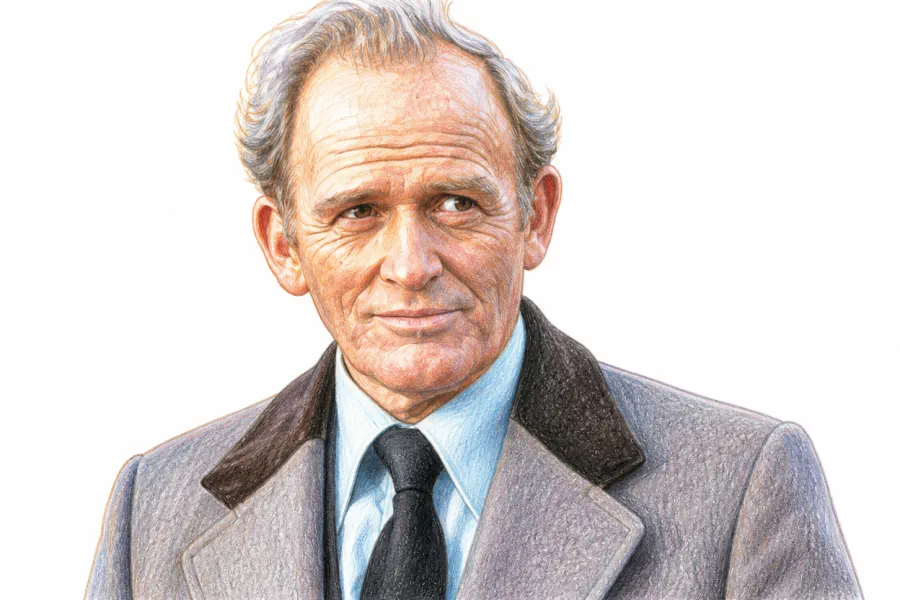
The opposite of everything CI5 stood for
George Cowley was the opposite of the man who played him. Everyone who worked with Gordon Jackson described the same person: gentle, self-effacing, and convinced he was about to be out of work. He played the sternest authority figure in British television drama of the late 1970s, the founder of a government unit that broke the rules to fight terrorism, and he played it so completely that later shows kept copying him. Forty years on, when British television wants a spymaster who believes in the establishment and will sacrifice anything to protect his people, it still builds on what Jackson made.
The jobbing actor
He was born in Glasgow on 19 December 1923, the youngest of five children, and discovered acting early, through school productions and teenage radio work for the BBC in Glasgow, including, at one point, playing a young Robert Burns. But he was not headed for the stage. At fifteen he left school and became an apprentice engineering draughtsman at the Rolls-Royce factory, a reserved occupation that kept him out of the armed forces during the war. Acting found him anyway: when Ealing Studios needed a young Scot for The Foreman Went to France (1942), the BBC recommended him, and he was cast. He kept the day job at first. The offers kept coming, and eventually the day job lost.
What followed was one of the most solid film careers in British cinema: more than sixty film credits across nearly half a century. The titles read like a syllabus of postwar British film. Millions Like Us (1943), Whisky Galore! (1949), Tunes of Glory (1960), Mutiny on the Bounty (1962, opposite Marlon Brando), The Great Escape (1963), The Ipcress File (1965, opposite Michael Caine), Those Magnificent Men in Their Flying Machines (1965), The Prime of Miss Jean Brodie (1969, opposite Maggie Smith). He worked with Bette Davis in Madame Sin (1972) and with Orson Welles on stage in Moby Dick at the Duke of York’s in 1955. Rarely was he the name above the title, and he was never out of work. So unnerved was he by the rushes of Tunes of Glory that he never watched another of his own performances.
None of it made him famous. He was the working definition of a familiar face, and by his own account he expected to stay that way. His BFI biography records a man “insecure, fearful of unemployment, shaking when handling props, forgetting his lines”. It is the self-image of someone who never quite believed the work would last.
Hudson: the butler who changed everything
In 1971, aged 47, he was offered the part of Angus Hudson, the butler in Upstairs, Downstairs, London Weekend Television’s portrait of an Edwardian townhouse at 165 Eaton Place. He accepted it for a reason entirely in character: it guaranteed six months’ work. The role, offered to him after it was decided that the Londoner George Cole was not suitable to play a Scotsman, made him a star at an age when most actors are winding down. Sixty episodes over five series, an Emmy in 1976, the Royal Television Society’s best-actor award in 1975, and a fame that followed him everywhere.
Hudson was the perfect butler: controlled, dignified, the stern middleman between the Bellamys upstairs and the servants downstairs. It was a magnificent performance and a cage. When The Professionals came calling in 1977, the public could not reconcile the two. Contemporary commentary records that some “refused to accept that Jackson, still firmly associated in their minds with the stuffy Mr Hudson, could ever be convincing as a tough anti-terrorist chief, notwithstanding his early experience in the Ealing war films”. He was 54 years old, playing a desk-bound boss to two action leads young enough to be his sons, and the odds said it would not work.
Cowley: the father who would sacrifice
It worked beyond anyone’s expectation. The Professionals, created by Brian Clemens and screened on ITV from December 1977, made Jackson’s George Cowley the third point of the most successful crime-action triangle British television has produced. Cowley was the founder and head of CI5, a government unit empowered to fight terrorism and serious crime by unconventional means: “Fight fire with fire!”, as he put it. The character’s backstory, as written, is a life lived at the sharp end: a volunteer in the Spanish Civil War, an army officer who reached the rank of major, a man with a war-wounded leg who had served in intelligence before he was handed CI5, and who is unafraid to clash with Special Branch and MI5 when his unit’s work demands it.
He commanded two brilliant, insubordinate field agents, Ray Doyle, Martin Shaw’s compassionate ex-copper, and William Bodie, Lewis Collins’s ex-paratrooper, whose loyalty to him was beyond question and whose obedience was not. The dynamic was the engine of the show: the controlled, disciplined patriarch trying to hold the line while his two sons of chaos did the job their own way. The role had a reach beyond Britain: in West Germany the series became a cult hit under the title Die Profis, and its imagery has been referenced and parodied in British television ever since, from The Two Ronnies to Ashes to Ashes.
Jackson made Cowley a man of conviction rather than a cardboard authoritarian. As written and played, the character reads as a believer: in the institution, in the democratic values CI5 exists to defend, and above all in the people under his command. Cowley is the father-protector, the man willing to bend any rule and spend any capital to keep his agents safe, and Jackson carries the weight of those decisions in his stillness. It is a performance of complete control at the centre of a very loud show, and it is the reason the series still works. He played Cowley in all 57 episodes, filmed between 1977 and 1981, and the show made him internationally famous for a second time. In 1979 he was appointed OBE.
By his own testimony he was not a man anyone would cast as a hard man. He described himself, in a New York Times interview, in terms no CI5 chief would recognise: “My trouble is that I’m underconfident and I’m too tentative. I’m not a go-getter and I never have been.” His Upstairs, Downstairs co-star John Alderton called him “the sweetest, gentlest man I have ever met”. That a man that mild could conjure Cowley, and make audiences believe him, says most of what there is to say about Jackson.
The archetype
Cowley’s afterlife is the strongest evidence of what Jackson built. The character established a template British television has used ever since: the senior intelligence chief utterly committed to the institution and its values, personally devoted to the people under his command, and willing to bend or break any rule, and ultimately to sacrifice himself, to keep them safe. Watch Harry Pearce in Spooks, the MI5 chief who ran the grid and mourned every agent he lost, and the lineage is hard to miss. It is a reading, not a documented inheritance, but it is the reading the genre itself keeps confirming.
There is a domestic footnote to the Cowley years that the Professionals production history enjoys: Jackson’s wife, the actress Rona Anderson, guest-starred in the series herself, appearing in the 1983 episode “Cry Wolf” alongside her husband. Few shows can claim to have employed both halves of a marriage that had already lasted three decades.
A life in the genre’s margins
The crime and mystery work around the great roles shows how thoroughly the genre ran through him. As early as the 1950s and 1960s he had been a guest in the police and espionage shows of the day: Dial 999 (1959), Ghost Squad (1962), Gideon’s Way (1965), The Avengers (1965), Detective (1969) — a slow accumulation of genre credit that makes his later casting as Cowley feel less like a leap than a promotion. After The Professionals he played Inspector Alec MacDonald of Scotland Yard in The Masks of Death (1984), the film that persuaded a retired Sherlock Holmes, Peter Cushing’s last Holmes, back onto a case, and Professor Gardner Cairey in the ITV detective series Campion (1989), in the serial “Look to the Lady”. Occasional guest spots in Hart to Hart (1983) and the film The Whistle Blower (1986), opposite Michael Caine, kept the transatlantic flag flying, and A Town Like Alice (1981) won him an Australian Logie Award. On stage he played Superintendent Battle in the Agatha Christie adaptation Cards on the Table (1981) and took the lead in the thriller Deathtrap (1981). The genre ran through his late career like a spine.
The end
In December 1989 he was diagnosed with bone cancer. The illness took hold quickly, and he died in January 1990, on the 14th by most accounts though some sources give the 15th, aged 66, in London, with his wife Rona at his side; he was cremated at Golders Green. His last filmed work, Effie’s Burning, was broadcast posthumously in 1991. When the 1990s revival CI5: The New Professionals was assembled, Cowley was not recast; a new chief, Harry Malone, was created for Edward Woodward instead. Some roles are too owned to be inherited.
British crime drama owes Gordon Jackson a specific debt. He proved that authority on screen did not need to shout, that the man in the chair could be more commanding than the men with the guns, and that a jobbing actor could be handed, at 54, the boss role of the genre’s action age. He spent thirty years in the trade and died one of the most recognisable men in British television. The man who never watched his own work spent his last great role convincing the world he was someone else entirely, and the world has believed him for forty years.