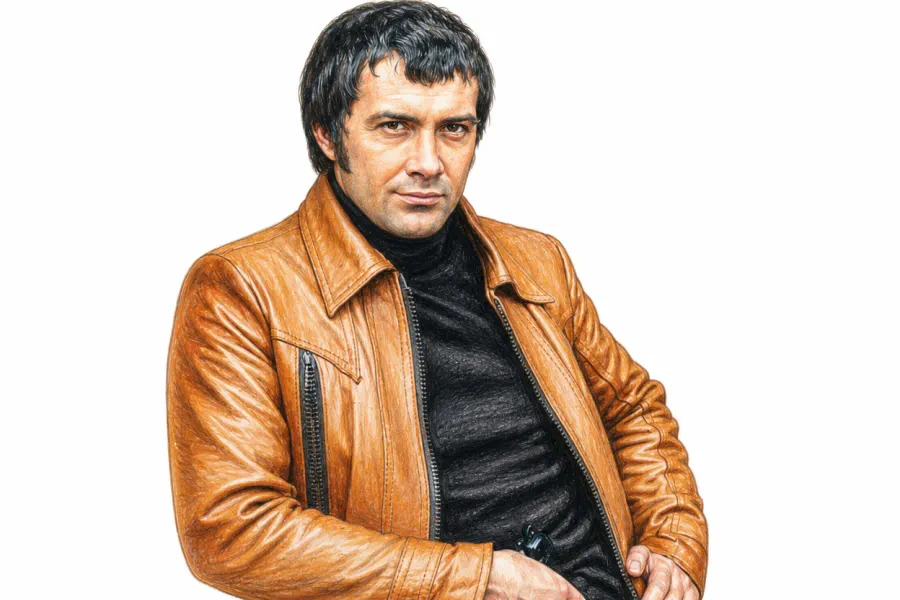
Television’s own action hero
British television did not make action heroes. It imported them, dubbed them, and ran them on Saturday nights. For one stretch in the late 1970s and early 1980s it made its own, and his name was Lewis Collins. As William Bodie in The Professionals he gave ITV a home-grown answer to the American tough guys, a character the reruns still play forty years on, and a template that still shows up in British crime drama. That he was, in large part, playing himself — a Territorial Army paratrooper who applied to the SAS and was turned down only because he was famous — is the fact that shapes the whole story.
The drummer who nearly joined the Beatles
He came to it from a direction no one would have predicted. Born in Birkenhead on 27 May 1946, the third child of Bill Collins, a shipyard worker and part-time musician who led dance bands, he grew up in a household where music was the family trade. His parents separated when he was eleven; he stayed with his father, who bought him a drum kit. By his early teens he was drumming in his father’s band and playing in Merseyside beat groups at the start of the Merseybeat era, and at fifteen he left school.
The Beatles connection is the stuff of alternate history. Working as an apprentice hairdresser at the Andre Bernard salon in Liverpool alongside Mike McCartney, Paul’s brother, he is reported to have been suggested as a candidate to replace Pete Best when the Beatles sacked their drummer in 1962. He declined, and the moment passed. In late 1964 he gave up hairdressing to play bass with The Mojos, a Liverpool band his father Bill road-managed, and he played on their charting singles “Goodbye Dolly Gray” and “Until My Baby Comes Home” before the band stalled and folded. The pop career died by degrees, through window-cleaning, waiting tables and selling encyclopedias, until he heard a play on the radio and decided, against all the evidence available to him, that he would act. “Everyone laughed in the pop business but I really felt I could do it,” he said later.
The actor emerges
He trained at LAMDA from 1968, alongside David Suchet and Patricia Hodge, and one contemporary remembered his Romeo as “a remarkable, rough-and-ready Romeo, almost pre-empting his role in The Professionals”. Repertory at Chesterfield followed, then the Citizens Theatre in Glasgow under Giles Havergal, where he played Tamburlaine at twenty-five, and where he taught drama to deaf children, learning sign language. He called that work the most satisfying of his life. Back in London there was the Royal Court and the West End, and the Prospect Theatre Company at the Old Vic, before television found him.
His television debut came in 1974 in Z-Cars, the BBC police series, as Derek Cunningham in the episode “Waste”. Further guest work in Crown Court and Warship followed. Then came the role that made his name, in a comedy: The Cuckoo Waltz (ITV, 1975–1980), in which he played Gavin Rumsey, the well-off, skirt-chasing lodger who moves in with the impoverished newlyweds Chris and Fliss Hawthorne, played by David Roper and Diane Keen. The Guardian later noted that Gavin, “a self-regarding Lothario”, was “not a million miles away from Bodie”. He appeared in the first three series before leaving; the sitcom ran one further series without him.
Bodie: the making of an icon
The Professionals began on ITV on 30 December 1977. Created by Brian Clemens, of The Avengers, it told of CI5, a fictional government unit fighting terrorism and serious crime by whatever means worked, and it was built on the partnership of two agents and their chief, Gordon Jackson’s George Cowley. Anthony Andrews had originally been contracted as Bodie, but after four days of filming his partnership with Martin Shaw’s Doyle lacked the friction Clemens wanted. Clemens remembered an episode of The New Avengers in which Collins and Shaw had both appeared as villains, screen-tested Collins, and cast him.
The on-screen chemistry was instant and abrasive. Shaw, who had not got on with Collins on the New Avengers set and opposed his casting, made a friendly approach on Collins’s first day and was rebuffed; the pair’s off-screen relationship was difficult through production. On screen it worked. Bodie was the ruthless ex-paratrooper, ex-mercenary and ex-SAS sergeant, the wisecracking hardman to Doyle’s hot-headed ex-copper, and audiences took to them at once. At its height the series drew around twelve million viewers a week; director Ian Sharp compared location filming to Beatlemania. Bodie and Doyle were parodied by the Comic Strip in The Bullshitters, name-checked by John Simm as the template for Sam Tyler in Life on Mars, and rerun almost continuously ever since. All 57 episodes were made between 1977 and 1981, and Collins played Bodie in every one.
The man and the part fed each other. Collins had joined the Territorial Army’s 10th Battalion, Parachute Regiment around 1979, gained his red beret, and took up parachuting with the same intensity he brought to the gym; Clemens called him “a method actor in a sense”. On his first parachute jump, in November 1978, he broke an ankle, halting filming on the second series for months. In 1983 he applied to join the Territorial SAS, passed the entrance tests, and was turned down because his celebrity profile made him too recognisable. He trained with the real SAS at Hereford for his film work, and his weapons instructor was, by Ian Sharp’s account, astounded at his ability with a gun.
The end of the series was not dramatic, and it was not hostile. No episodes were filmed after May 1981; Collins and Shaw both felt the show had grown stale, and neither renewed his contract. The final episodes were broadcast region by region into early 1983. He was not fired. The distinction matters, because the myth of a fall from grace attached itself to him early and never quite let go.
The Bond that never was
After The Professionals, Collins was the obvious British action lead of his generation, and the film industry came calling in the way that matters most. In 1982 he starred in Who Dares Wins (released in the US as The Final Option), as SAS Captain Peter Skellern, an undercover officer who infiltrates an anti-nuclear terrorist group; he had trained for it at Hereford. The film was a commercial success in Britain and critically derided, and it did not launch the international career it was meant to.
Then came the near-miss that defined him. In the early 1980s he met Bond producer Albert R. “Cubby” Broccoli, who was weighing a successor to Roger Moore, and was rejected as “too aggressive”. Collins’s own account: “I was in his office for about five minutes, but it was really over for me in seconds... He found me too aggressive.” Clemens thought they were wrong: “I thought he would have made a marvellous Bond.” Ian Sharp called him “a Daniel Craig in a Roger Moore era”. The rejection became the fixed point of his career story, the role that got away.
George Godley: the detective in Jack the Ripper
One later piece of work stands apart. In 1988 Collins played Sergeant George Godley in Jack the Ripper, the two-part ITV drama produced for the centenary of the murders. He came to the part late — a stroke of luck, as the production’s chroniclers record it. He was second lead to Michael Caine’s Chief Inspector Frederick Abberline, playing the real historical detective who worked the case at the sergeant’s end, and the production took the subject with a seriousness rare in the genre. More than fourteen million viewers watched it in Britain.
It is the one role after CI5 that asked him to act rather than to be. Godley is a working detective, subordinate, patient, professional, with none of Bodie’s wisecracking armour. Collins plays him straight and steady, and the performance demonstrates, in case anyone had forgotten, that the range was always there. The Independent’s obituary noted the shadow Bodie cast over his career; Godley is the evidence that the shadow was the industry’s making, not his.
The shadow
The problem was that nothing else ever matched Bodie. The Independent’s obituary headline put it plainly: he “found that Bodie cast a shadow over his career”. The Mirror said he was “frozen in time as Bodie”. The European mercenary films that filled the years after Who Dares Wins — Code Name: Wild Geese (1984), Kommando Leopard (1985), Der Commander (1988) — were cheap actioners made for the international video trade, and they traded on the very image that was trapping him. He had taken screenwriting and directing courses at UCLA in the early 1990s; after relocating the family to Los Angeles around 1995 he eventually ran a computer business: an unglamorous second life, a long way from the man twelve million viewers had watched each week. A proposed return in the 1990s revival, CI5: The New Professionals, collapsed after five months of negotiation, and Edward Woodward took the role of the new chief instead. He lampooned his own image in the comedy The Grimleys (1999), playing a hard-man commando father, and his final screen appearance was in The Bill in 2002.
The obituaries reached for the same word, “curse”, but the record is more complicated. He was not a failed actor who caught one lucky break; he was a genuinely good one who played a role so perfectly that the industry could not see past it. Ian Sharp was baffled too: “It’s a mystery to all of us... These days people would grab him with both hands.” He was the action man who could act, and the industry cast him anyway as the action man.
The real thing
Off screen he was what he appeared to be, which is rarer than it sounds: a private pilot’s licence, a black belt in jujitsu, a champion rifle shot, motorbikes, parachuting. The Guardian called him “the most unremittingly macho” of the decade’s television hardmen, and Lord Grade, who launched The Professionals, remembered him fondly: “He was just a big, hunky, macho character with a lovely innocence about him.” Clemens credited him with “a ‘Bond-ian quality’... He was tough and he could fight, he looked good, he was handsome and he had this nice sense of humour.” The machismo was real, but so was the skill: Ian Sharp, who worked with him closest, described him as word-perfect, quick and funny, and rejected the difficult reputation: “Like a lot of actors described as difficult, they’re the ones who really care and he did.” He married Michelle Larrett, a schoolteacher, in 1992, and they had three sons.
He was diagnosed with cancer in 2008. He died on 27 November 2013 at his home in Los Angeles, aged 67, surrounded by his family. Martin Shaw, who had fought against his casting and ended as his friend, said: “We spent a very tough four years together... He will be remembered as part of the childhood of so many people, and mourned by his fans.” British crime drama has never quite replaced him. For a decade he was the most recognisable action hero British television had produced. The role’s shadow followed him to the end. Forty years on, Bodie is still the reason anyone says his name.