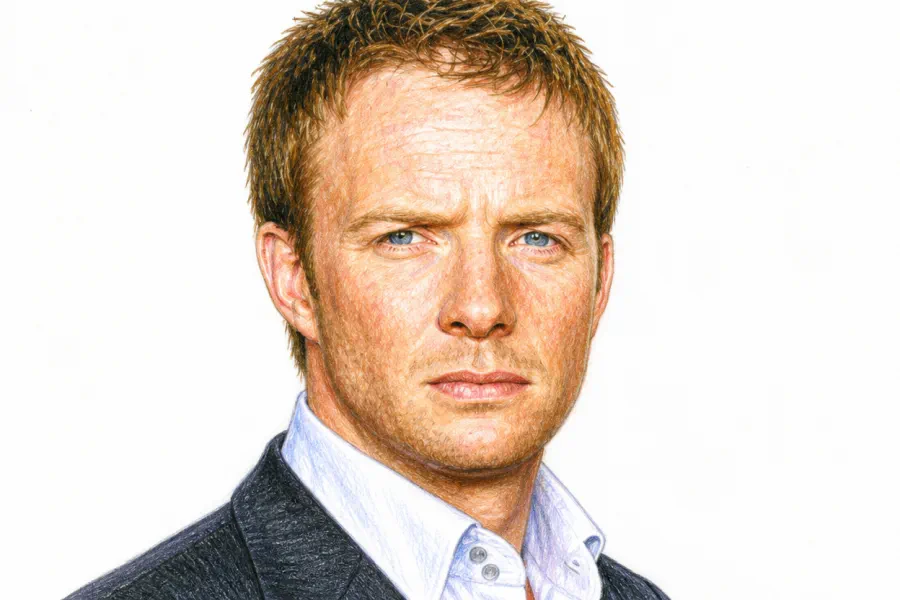
Authority, and what leaks through it
Rupert Penry-Jones is tall, fair and upright, and he has spent most of his television career playing men in suits who are supposed to know what to do: an MI5 section chief, a fast-tracked detective inspector, a competitive barrister. Often he then shows those men not knowing what to do.
He is best known in the genre for three leading roles: Adam Carter in the BBC’s espionage series Spooks (2004–2008), DI Joseph Chandler in ITV’s Whitechapel (2009–2013), and Clive Reader in the BBC legal drama Silk (2011–2014). Spy, policeman, barrister: three establishment figures, each played with a slightly different balance of confidence and unease.
Early life and route into acting
Penry-Jones was born in London on 22 September 1970 into acting. His father was Welsh actor Peter Penry-Jones, his mother English actress Angela Thorne, familiar from To the Manor Born and much stage work. His younger brother Laurence also acted before leaving the profession. He did his homework backstage in theatres.
He was educated at Dulwich College in south London. Dyslexic and, by his own account, academically adrift, he found direction at 13 playing Caliban in a school Tempest. After Dulwich he went to the Bristol Old Vic Theatre School. He did not finish the course. In 2012 he said he was thrown out of Bristol Old Vic “for having a bad attitude”. Two years followed with no agent and no work beyond background parts; he took jobs as a barman and a cloakroom attendant at a Covent Garden nightclub. His mother helped him find an agent.
The stage gave him his first foothold. In 1995 he made his London debut as Fortinbras to Ralph Fiennes’s Hamlet in Jonathan Kent’s Almeida production at the Hackney Empire, which transferred to Broadway, where he also understudied Hamlet. There followed Stephen Poliakoff’s Sweet Panic at Hampstead in 1996, Arnold Wesker’s Chips with Everything at the National in 1997 as the upper-class Pip Thompson, and Edward Albee’s The Play About the Baby at the Almeida in 1998. The breakthrough stage role came in 1999 with the Royal Shakespeare Company: the title role in Schiller’s Don Carlos, directed by Sean Holmes, which transferred to the Barbican in 2000. His performance won the 1999 Ian Charleson Award. In 2001 he played Robert Caplan in J.B. Priestley’s Dangerous Corner at West Yorkshire Playhouse and then the Garrick in the West End — the production on which he met his future wife, Irish actress Dervla Kirwan. They married in August 2007 and have two children.
Establishing a career
Television came early — in 1995 he appeared with his mother in Cold Comfort Farm — but the roles that established him came in ensemble drama around the turn of the century. In Channel 4’s ten-part North Square (2000), an early Peter Moffat chambers drama, he played young barrister Alex Hay. In the BBC’s Cambridge Spies (2003) he played Donald Maclean, and in Russell T Davies’s Casanova (2005) he played Grimani. Film work included Piers du Pré in Hilary and Jackie (1998), a British officer in The Four Feathers (2002), and Henry, the tennis-playing brother-in-law, in Woody Allen’s Match Point (2005). It marked him as a classically trained leading man. Spooks changed the scale.
Adam Carter in Spooks (2004–2008)
Penry-Jones joined Kudos’s BAFTA-winning espionage series in Series 3, replacing Matthew Macfadyen’s Tom Quinn as head of Section D. Carter was different by design: ex-MI6 rather than home-grown MI5, married to Fiona Carter, with a son, Wes, and a home life that carried into counter-terrorism work.
Over four series he became the centre of the Grid: calm under briefing-room pressure, plausible in undercover aliases, and given the show’s hardest emotional plots, including Fiona’s death and the hostage torture of Jo Portman at the end of Series 6. Penry-Jones left during Series 7. After several near-deaths, the producers gave him what the cast all wanted: a proper killing. Adam died in the Series 7 premiere, “New Allegiances”, driving a car bomb away from a crowded square.
He won Best Actor at the ITV3 Crime Thriller Awards in 2008 for the role. He has spoken warmly about the exit: “I did nearly cry on my last sequence... It was sad leaving. It was like leaving a school that you’ve had a really good time at, where you’ve been head boy.” And, more bluntly, about why he went: “I didn’t become an actor to have a nine to five job, and Spooks was starting to feel a bit like that. It was relentless, day in, day out, six days a week... I was still fired up when I left but it was time to move on. I was in danger of getting lazy, I think.”
DI Joseph Chandler in Whitechapel (2009–2013)
If Adam Carter saved London, Joseph Chandler was frightened by it. When Penry-Jones took the lead in Carnival Films’ Whitechapel in February 2009 — initially a three-part thriller about a Jack the Ripper copycat — he stressed the contrast: “He doesn’t have all the answers. He doesn’t know how to fix everything. He doesn’t kill the bad guy and save London like Adam in Spooks. He’s a bit less of an action man and a bit more cerebral. He doesn’t really like the sight of blood. Chandler is the total opposite to Adam in that way; he finds the whole thing quite scary.”
Chandler is introduced as a fast-track “plastic”: Oxford-polished, ambitious, posted to Whitechapel for his first murder investigation, which his superiors expect to be a simple domestic. It becomes a Ripper replication. Paired with DS Ray Miles (Phil Davis), a near-retirement East End detective who embodies everything Chandler is not, and aided — to Miles’s irritation — by obsessive Ripperologist Edward Buchan (Steve Pemberton), Chandler has to learn to police rather than administer. The original run was ITV’s highest-performing new drama of 2009. It returned for three further series: a Kray twins story in Series 2 (autumn 2010), further historical-murder cases in Series 3 (January 2012), and a final run in September 2013.
Across them Chandler loosens: obsessive, compulsive, private to the point of asexuality in Series 1, then developing mutual respect with Miles and a friendship with Buchan. The partnership with Davis mattered to the casting. The two had worked together on North Square, and Penry-Jones cited the Chandler–Miles relationship and Davis’s involvement as a reason for taking the part, alongside a script he described as “a real page turner”.
Clive Reader in Silk (2011–2014)
Peter Moffat’s Shoe Lane chambers drama reunited Penry-Jones with the legal world of North Square, now as Clive Reader, competing with Martha Costello (Maxine Peake) for silk and, later, operating as a silk himself. Where Martha is emotionally entangled with clients, Clive is about winning. In Penry-Jones’s own summary: “Clive Reader doesn’t really care about the people he’s representing, he just cares about winning. It’s his job and he’s less interested in whether they’re guilty or not.”
That made Clive funny, and his public-school charm could tip into ruthlessness when a case or a chambers vote required it. Over three series Penry-Jones played Clive’s attempt, in his words, “to be a grown-up”, less the chambers cad and more a plausible head of chambers, while keeping the long, unresolved pull towards Martha. Court scenes, he noted, invert normal acting rewards: “it’s the people in the dock that get to do the good acting, the fun stuff. We are just professionals asking questions.”
Shorter thriller leads and the guest circuit he skipped
Two shorter thriller leads sit alongside the big three. At Christmas 2008 he played Buchan’s Richard Hannay in the BBC’s The 39 Steps. Earlier that year he led BBC Two’s two-part climate-conspiracy thriller Burn Up as oil executive Tom McConnell, opposite Bradley Whitford and Neve Campbell. In 2022 he starred opposite Martin Compston and Tuppence Middleton in ITV’s property-noir Our House as Mike/Toby. No major franchise guest role has turned up in his checked filmography — no Morse, Frost, Midsomer or Vera one-offs. His crime career has been built on leading roles in long-running originals rather than guest slots in franchises.
Acting style
Penry-Jones reads on screen as natural authority: stillness, clear diction from classical training, and a watchfulness that lets him play intelligence without explaining it. Spooks played him as a hero — decisive, physical, paternal. Whitechapel deliberately undercut it — the same posture made awkward, squeamish, overly formal, then slowly humanised. Silk played on the charm — fluent, amused, competitive. Critics and interviewers often note the constraint this handsomeness imposes: noble hero or charming cad, with less call for grotesques. He has joked about it himself — “Maybe I need to stop riding my bike and get very fat and eat loads of sweets and get spots and get punched in the face” — while adding “Maybe I’m only getting work because of the way I look.”
What distinguishes him within that type is restraint. He rarely pushes. As Chandler, fear shows as over-precision. As Clive, cruelty shows as smoothness. As Adam, grief shows as continued competence. His work repeatedly pairs him with strong female co-leads — Olga Sosnovska and later Gemma Jones and Miranda Raison in Spooks, Maxine Peake in Silk — where his characters’ control is tested by less controlled counterparts. He moved, unusually, from spy hero to police lead to legal lead within five years, covering the three main institutional arms of British crime drama, all as a series lead rather than a guest.
Beyond crime drama
The non-crime career is mainly period and stage work. Television includes Captain Wentworth in ITV’s Persuasion (2007). Film includes A Little Chaos (2014) as Antoine, directed by Alan Rickman. American television includes 29 episodes as Mr Quinlan in Guillermo del Toro’s The Strain (FX, 2014–2017), a vampire-human hybrid requiring heavy prosthetics — a job he later said he would not repeat. In 2022 he appeared briefly as Gotham mayoral candidate Don Mitchell Jr in The Batman. Theatre has remained continuous: Louis XIV in Nick Dear’s Power at the National’s Cottesloe (2003), Carl in Michael Wynne’s The Priory at the Royal Court (2009–2010), and Duncan Grant in BBC Two’s Bloomsbury drama Life in Squares (2015). His award wins are the Ian Charleson Award (1999) for Don Carlos and the ITV3 Crime Thriller Award for Best Actor (2008) for Spooks.
Penry-Jones never became a character actor, and never really tried to. Adam Carter let him be the hero; Joseph Chandler let him be frightened; Clive Reader let him be selfish. Together they show a performer who understands institutions from the inside — how they speak, how they promote, how they protect themselves — and who does his best work when the character’s polish cracks. If you know him only as the man who died in Spooks, Whitechapel and Silk are the ones to watch next.