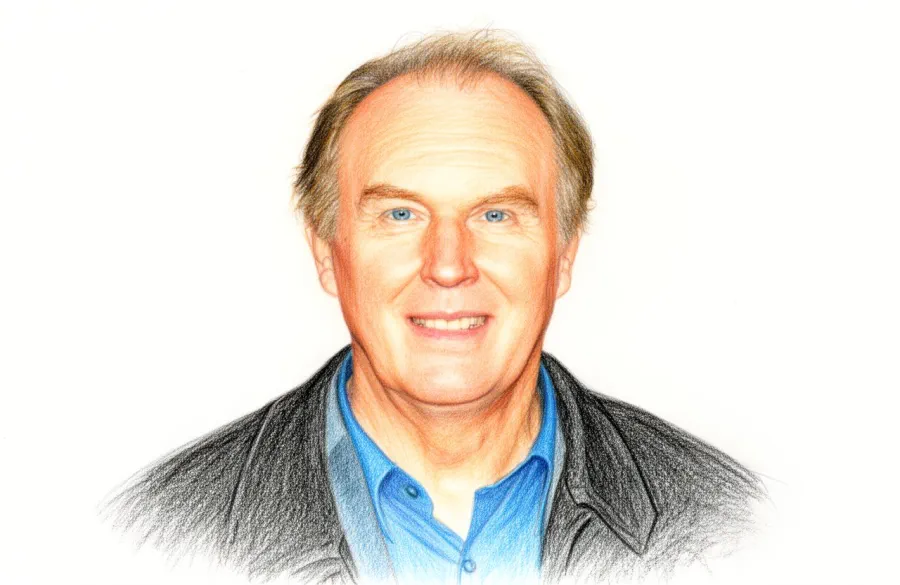
Early Life
Tim Pigott-Smith was born on May 13, 1946, in Rugby, Warwickshire, England. His father, Harry Thomas Pigott-Smith, was a journalist, and his mother was Margaret Muriel (née Goodman). His education took him to Wyggeston Boys' School in Leicester and later to King Edward VI School in Stratford-upon-Avon.
He studied at the University of Bristol, graduating in 1967 with a degree in Drama, French and English. He then trained at the Bristol Old Vic Theatre School in classical technique, where he was a contemporary of Jeremy Irons.
Early Career & First Roles
Pigott-Smith made his professional debut in 1969 with the Bristol Old Vic Theatre Company. His West End debut followed in 1971 as Laertes in "Hamlet," a role that led him to the Royal Shakespeare Company. With the RSC he played Shakespearean and Greek roles, including Posthumus in "Cymbeline" in 1974.
He also built a screen career. Early television appearances included two roles as different characters in "Doctor Who" (1971, 1976). He played Frederick Hale in the 1975 BBC series "North and South," and the historical figure Brendan Bracken in "Winston Churchill: The Wilderness Years" (1981).
Major Roles
Two roles stand out in Tim Pigott-Smith's career: the one that made him a household name, and the later one that returned him to his classical roots.
Lt. Col. Ronald Merrick, The Jewel in the Crown (1984)
In Granada Television's adaptation of Paul Scott's "The Raj Quartet," he played Lt. Col. Ronald Merrick, a police officer in British India. This was not a simple villain: beneath Merrick's rigid, imperial exterior lay profound insecurity, social resentment, and corrosive racism.
Merrick was ambitious and cruel, aware of his own lowly social origins and overcompensating for them with brutal authority. The menace was constant, his clipped line delivery loaded with latent violence and sexual frustration. The performance earned him the BAFTA Television Award for Best Actor in 1985.
For audiences of mystery and crime drama, Merrick remains a striking "detective" figure: an investigator whose methods reveal a sickness in the system he represents.
Charles, Prince of Wales, King Charles III (2017)
Decades after "The Jewel in the Crown," Pigott-Smith returned to his Shakespearean roots. In the BBC film adaptation of Mike Bartlett's future-history play, he played Charles, Prince of Wales, navigating a constitutional crisis following the Queen's death.
Bartlett's script was written in blank verse, which suited his classical training. He played the often-caricatured public figure as a man grappling with destiny, principle, and political machination. His Charles was dignified, conflicted, and ultimately hubristic, with a regal bearing and a voice that could carry both weary introspection and royal command.
It earned him widespread critical acclaim and, posthumously, a BAFTA nomination. The role showed that his skill with the complexities of power and personality remained undimmed.
Other Notable Work
He played Major General Robert Ford in Paul Greengrass's docudrama "Bloody Sunday" (2002). For mystery fans, he was Chief Constable John Stafford in the ITV police series "The Chief" (1990-1993), and he appeared as Sir George Stubbs in the Agatha Christie adaptation "Dead Man's Folly" (1986).
His stage work continued with "Enron." He lent his voice to BBC Radio, playing Sherlock Holmes in the adaptation of "The Valley of Fear." The long-running BBC Radio 4 Sherlock Holmes series (1989–1998) starred Clive Merrison as Holmes and Michael Williams as Watson; Pigott-Smith was not in that series.
Acting Style
Tim Pigott-Smith had a commanding presence and a deep, resonant voice that could convey steel or sorrow. His background in classical theatre gave him a respect for text and subtext. He was known for thorough preparation, which allowed him to play complex, often unlikeable characters with psychological truth and nuance.
His specialty was men of rank and power—officers, officials, aristocrats—but he always looked for the human flaws and vulnerabilities within the uniform. He moved between sympathetic figures and antagonists, never one-dimensional. His work was controlled and precise.
Personal Life
A notably private man, Pigott-Smith was married to actress Pamela Miles for over four decades. Their son is Tom Pigott-Smith, a concert violinist. Colleagues described him as generous and supportive, far removed from the arrogant characters he often played. He enjoyed gardening, literature, and classical music.
His knighthood seemed a certainty to many, but in 2017 he was appointed an Officer of the Order of the British Empire (OBE) for services to drama. He died suddenly on April 7, 2017, at the age of 70, shortly after completing "King Charles III." His death was met with an outpouring of respect from the acting profession.
In closing...
Pigott-Smith specialized in men who wielded power, for better or worse, and showed the human cost beneath—from Ronald Merrick to King Charles III. For lovers of character-driven mystery and drama, his body of work remains a record of controlled power and intelligence.