Principal Characters & Performances
Police Sergeant David Budd
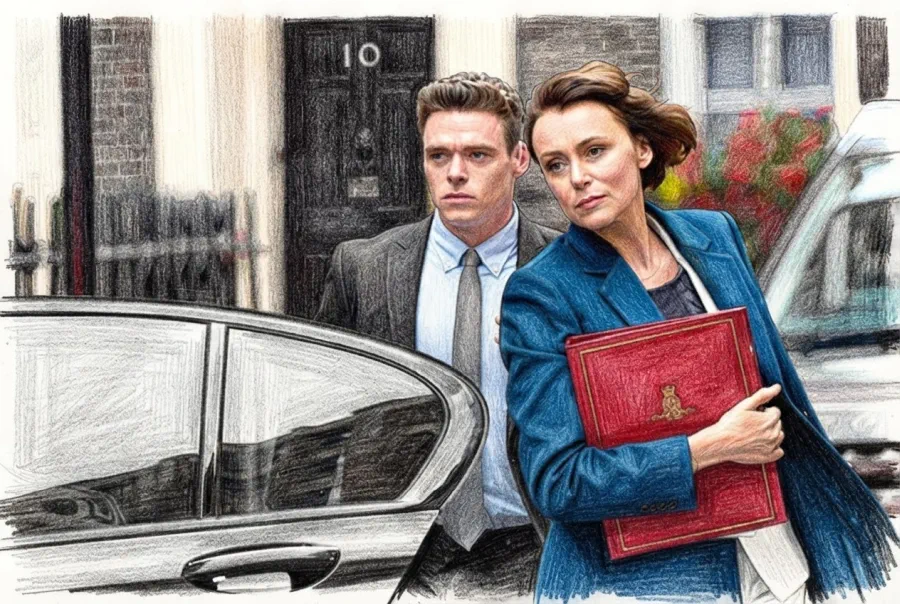
Richard Madden anchors the entire series as David Budd, a Metropolitan Police officer in the Royalty and Specialist Protection branch. Budd is a complex, layered character defined by his past as a British Army veteran of the Afghanistan War. The role demands a tightrope walk between steely professional competence and profound psychological vulnerability.
Madden portrays Budd's post-traumatic stress with a quiet, internalised intensity, manifesting in panic attacks and flashbacks that threaten his focus during critical protection details. His performance is physically commanding during action sequences, yet deeply fragile in private moments, particularly those with his estranged wife and children.
The character's central conflict is his ideological opposition to the hawkish policies of the politician he is sworn to protect. Madden masterfully conveys this tension through subtle glances and restrained dialogue, making Budd's journey from dutiful officer to a man questioning entire institutions utterly compelling and believable.
Home Secretary Julia Montague
Keeley Hawes delivers a standout performance as Julia Montague, the ambitious and politically divisive Home Secretary. Hawes avoids easy caricature, presenting Montague as fiercely intelligent, strategically ruthless, yet occasionally revealing glimpses of vulnerability. Her chemistry with Madden is electric, driving the series' central relationship.
Julia is a master of political manoeuvring, pushing for expansive new surveillance powers that put her at odds with colleagues and security services. Hawes captures her calculated charm and relentless drive, making her a figure you simultaneously admire and distrust. The character's presence looms large over the entire series, shaping the narrative even beyond her physical time on screen.
Her dynamic with Budd forms the core of the show's early episodes, exploring the dangerous blurring of professional and personal boundaries within the high-stakes world of close protection.
Notable Support and Guest Stars
The series is bolstered by a strong ensemble cast who flesh out its intricate world. Gina McKee is excellent as Commander Anne Sampson, head of the Metropolitan Police Counter Terrorism Command. She embodies institutional authority and ambiguity, often serving as a formidable obstacle to Budd.
Sophie Rundle brings grounded emotional weight as Vicky Budd, David's estranged wife, portraying the collateral damage of his trauma with empathy. Vincent Franklin is perfectly cast as the sidelined Minister of State for Counter-Terrorism, Mike Travis, his frustration providing a political counterpoint.
Pippa Haywood as Chief Superintendent Lorraine Craddock and Paul Ready as special adviser Rob MacDonald add further layers of bureaucracy and intrigue. Nina Toussaint-White appears as Detective Sergeant Louise Rayburn, while Stuart Bowman plays Security Service chief Stephen Hunter-Dunn, each representing different facets of the sprawling security state the narrative interrogates.
The World of Bodyguard
Bodyguard is firmly rooted in a contemporary, recognisable London. The show meticulously builds its environment from the corridors of power to the modest flats on housing estates. We see the stark contrast between David Budd's personal life in a flat on the Whittington Estate and the opulent, secure spaces inhabited by politicians like Julia Montague in Battersea.
The series centres on the Metropolitan Police's Protection Command, depicting its procedures with a convincing level of detail. Motorcades, threat assessments, and security sweeps are shown not as glamorous action but as meticulous, high-pressure work. This extends to the Counter Terrorism Command offices and government briefing rooms, creating a fully realised ecosystem of state security.
This world feels immediate and authentic because it leverages real anxieties and settings. The transport infrastructure, public events, and government districts are not just backdrops but active elements of the plot, making the threats feel plausible and the stakes tangibly high.
Origin Story
Bodyguard is the creation of writer Jed Mercurio, commissioned by the BBC in 2016. It was produced by World Productions for BBC One, with filming taking place primarily on location across London. Directors Thomas Vincent and John Strickland helmed the episodes, establishing its distinct visual style.
The production team, including producer Priscilla Parish and cinematographer John Lee, worked to create the series' grounded, tense atmosphere. Composers Ruth Barrett and Ruskin Williamson developed the score that heightens the suspense. From its inception, it was conceived as a six-part serialised drama, designed to blend political intrigue with personal trauma.
Narrative Style & Tone
The series is a tightly wound political thriller that uses the grammar of a police procedural. Its style is defined by a restless, often handheld camera that stays close to David Budd, immersing the viewer in his psychological point of view. The editing, by Steve Singleton and Andrew John McClelland, is sharp, driving the pace.
The tone is one of sustained paranoia and institutional realism. It avoids melodrama, instead building tension through procedural detail, bureaucratic dialogue, and the constant threat of violence. Flashbacks are used sparingly to illuminate Budd's trauma. The narrative trusts the audience to follow complex political and security machinations, balancing conspiracy plotting with raw character drama.
How is Bodyguard remembered?
Bodyguard is remembered as a cultural phenomenon that achieved rare crossover success. It broke BBC viewing records, becoming the most-watched drama in a decade, and sparked widespread media discussion and spoiler anxiety. Its blend of explosive thriller set-pieces and sophisticated political conspiracy captured the public mood.
The series earned critical acclaim and awards, including a Golden Globe for Richard Madden and a National Television Award. It prompted conversations about the portrayal of trauma, state surveillance, and terrorism in drama. While it faced some criticism regarding its depiction of a suicide bomber, creator Jed Mercurio defended its narrative choices as reflecting contemporary threat landscapes.
Ultimately, it is recalled as a benchmark for British television thrillers. Its impact lies in proving that a complex, politically charged narrative could achieve mass appeal through impeccable execution, compelling characters, and masterful control of tension.
In Closing
Bodyguard stands as a high-water mark for the British television thriller. It combines a career-defining performance from Richard Madden with Jed Mercurio's intricate plotting and a palpable sense of contemporary anxiety. For anyone who appreciates drama where every detail matters and the tension never lets up, it remains essential viewing.