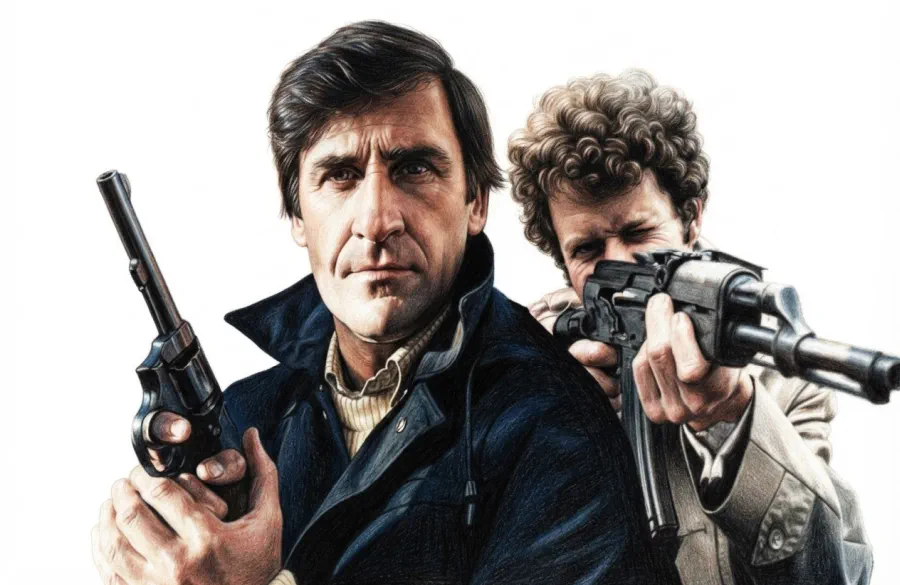
Principal Characters & Performances
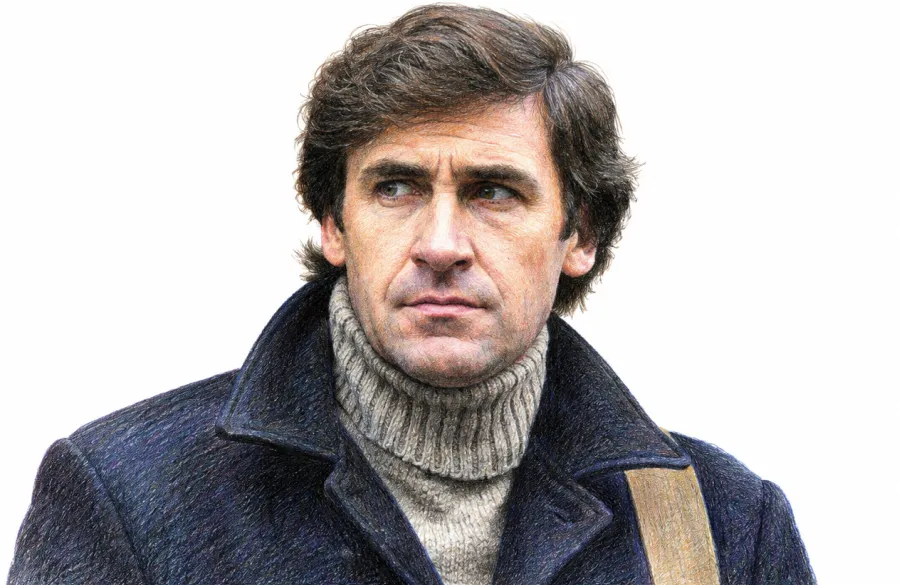
Captain Harry Brown
Harry Brown is a British Army captain, an Ulsterman who has done deep-cover work before, and he is sent into the Falls Road to find the man who shot a cabinet minister and kill him where he lives. He goes in as a merchant seaman called Harry McEvoy, with a scrapyard job and a lodging in a republican street.
The army is not told he exists. That single decision is what makes the character: he has no support, no extraction plan and nobody to talk to, and Ray Lonnen plays the isolation rather than the danger. His Harry is a professional doing a job he has been given, and the erosion is gradual.
Lonnen was the natural choice for it. Yorkshire Television had used him before, and viewers knew him from three series of The Sandbaggers as Willie Caine, the field agent whose decency was the counterweight to a cold service. Harry Brown is what happens when that decency is dropped into a real conflict with no institution behind it.
It is also the lead of his career. His page on this site lists it first among his notable roles, above The Sandbaggers and Yellowthread Street, and he is the reason the series still has a face forty years on.
Billy Downes
Billy Downes is the IRA gunman who kills the minister outside his London home in front of the man’s wife and children, then escapes to Belfast, where his own community hides him. He is arrested, interrogated and released. He is also given a wife, a house and a life, which is precisely what made the character contentious.
Derek Thompson plays him as an ordinary man in a war, and the casting story is worth keeping: the director found Thompson and Sam Dale in a Regent’s Park theatre club production about young soldiers. Shortly after filming, Thompson was cast as Charlie Fairhead in Casualty and stayed for decades.
The series turns on him twice. First he is the quarry, then — once the IRA works out that an informer is on his trail — he is brought back to hunt Harry. It is Downes’s wife who fires the last shot of the serial, standing over the wounded British officer with his own revolver.
Notable Support and Guest Stars
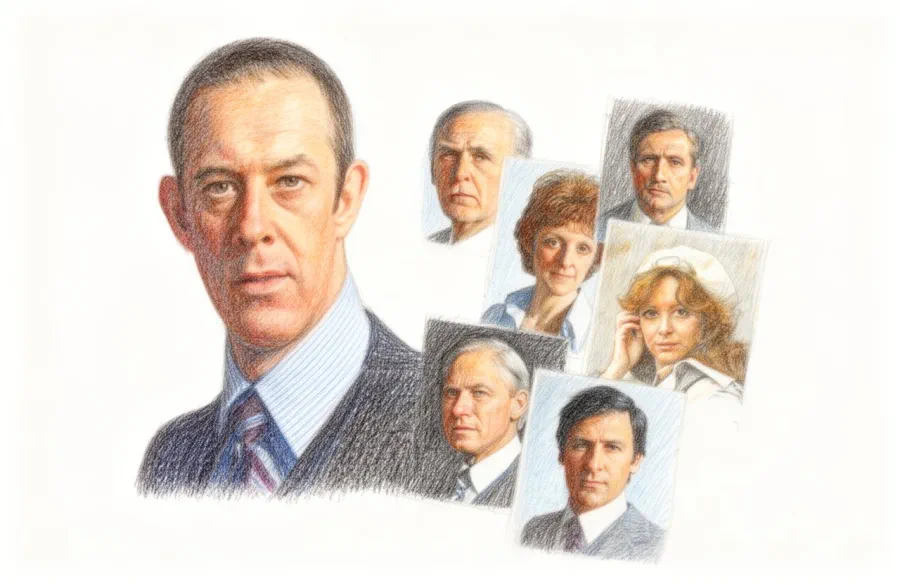
Sean Caffrey’s Inspector Howard Rennie is the series’ most damaging figure, because he is not a villain. He interrogates Theresa McCorrigan, the girl who knows Downes’s name, and she hangs herself in prison rather than face what the IRA would do if she talked. Seymour later reused Rennie in two novels.
Benjamin Whitrow plays Davidson, Harry’s controller and the only voice of the institution on the other end of the operation; Geoffrey Chater is Colonel George Frost, Nicholas Day is Bannen, and Tony Rohr is the IRA brigade commander who shelters Downes in Belfast.
Around them the smaller parts carry the cost of the operation. Gil Brailey’s Josephine Laverty is the Catholic woman whose relationship with Harry is destroyed by what he is doing, Linda Robson plays the girl who dies in custody, and Maggie Shevlin’s Mrs Downes drew the highest praise from the director, who called her performance stellar. Charles Lawson, later of Coronation Street, plays the Provo Harry shoots at the climax.
The World of Harry's Game
The series runs from a London street, where a minister is shot in front of his family, to the Falls Road in Belfast, and it stays in the second place. Harry lodges in a republican street, works in a scrapyard and drinks in the clubs the IRA uses, which is the whole method of the story.
It was filmed largely in Leeds, where derelict nineteenth-century terraces stood in for Belfast, and partly in Belfast itself over three weeks with a volunteer crew. The army refused to supply vehicles or assistance; armoured cars were hired and the riot sequences staged on cleared ground in Leeds. The budget was £250,000 an episode.
What makes the setting more than a backdrop is that nobody in it is safe. The British operation kills an innocent girl and then shoots its own officer, because the soldiers watching Downes’s house take Harry for a gunman. The serial ends with a poem written by the daughter of a magistrate murdered in Belfast in 1973.
Origin Story
Gerald Seymour wrote the novel in 1975 while he was still a reporter for ITN, where he had covered the Troubles, Vietnam, Munich and the Red Brigades. It was his first book, it made him a full-time novelist, and he adapted it himself for television.
The production nearly went nowhere. The director, Lawrence Gordon Clark, read the book on holiday and spent years chasing the rights, only to find Thames Television held them and had dropped the project — because they believed Seymour had based it on the assassination of Airey Neave, which in fact came four years after he wrote it. Paul Fox of Yorkshire Television took it up instead, and David Cunliffe commissioned the scripts.
Yorkshire’s choice of leading man was unanimous: Lonnen had already worked for the company and was everyone’s pick for Harry. The serial went out on three consecutive nights in October 1982, with Seymour’s own dialogue and Clark directing all three parts.
Narrative Style & Tone
Three parts of about fifty minutes on consecutive nights, one writer and one director, playing as a single continuous film. The first half is a manhunt; the second half reverses it, once the IRA realises there is an informer in its streets.
The method is tradecraft rather than action — a scrapyard, a lodging, a photograph, a conversation overheard by a waiter. The look is deliberately close to the news footage its audience watched every night, which is why the production borrowed real derelict streets and staged its riots with hired armoured cars.
Mike Moran wrote the incidental music, but the sound the serial is remembered for arrives at the end of each part: Clannad’s theme, sung in Irish, over the closing images. The final minutes give the argument away, with two dead professionals and a child’s poem about what the fighting leaves behind.
How is Harry's Game remembered?
It was received as a serious piece of television and added to Yorkshire’s reputation for making them. It was also studied as one, appearing in the standard academic account of how political violence was handled on British screens.
Its afterlife, though, belongs to its music. Clannad’s theme reached number five in Britain and number two in Ireland, won an Ivor Novello, and remains the only British hit single sung entirely in Irish; it was later used in Patriot Games and sampled for Chicane’s Saltwater. The serial is remembered first for a piece of music written in a week in a house in Dublin.
There is no verified awards record beyond the director’s own account, which claims a prize at Locarno and a BAFTA nomination for the theme, and the novel’s author spent years being told he had been dancing on graves. A UK DVD of the unedited three-part serial appeared in 2005; there has been no restoration and there is no streaming release.
In Closing
Harry’s Game put a British soldier into the Falls Road and refused him a clean victory: he kills his man, is shot by his own army, and dies in front of a widow. The theme outlived the argument; the argument is still the point.