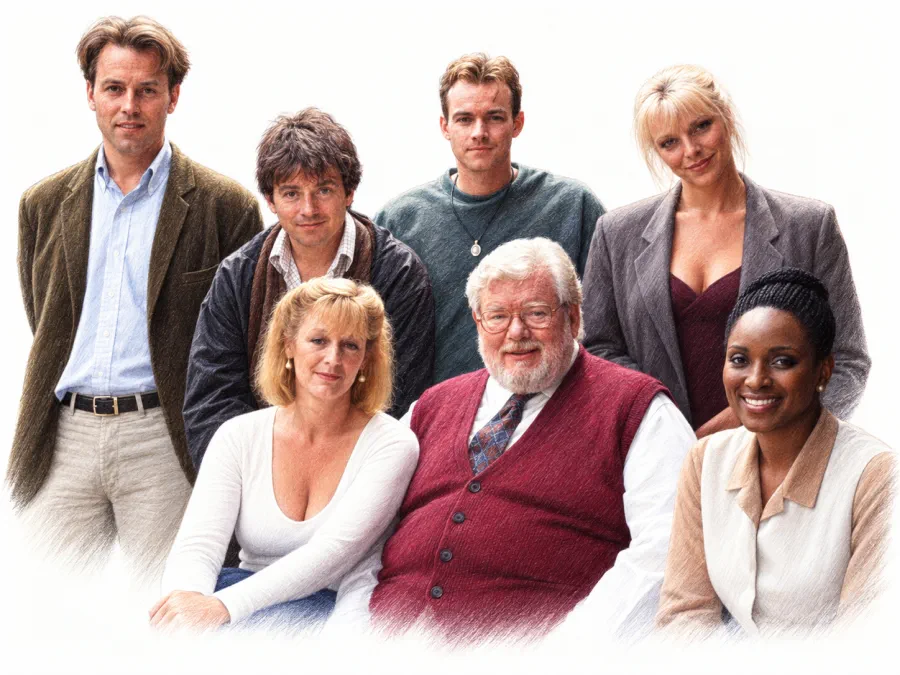
Principal Characters & Performances
Detective Inspector Henry Crabbe
Henry Crabbe has served twenty-five years in the Westershire force and wants out, to run a restaurant. During the arrest that should have ended his career he is shot in the leg by the thief Dudley Hooperman, who escapes. His chief refuses to let him go, and when a corrupt officer frames Crabbe for taking a bribe, Fisher uses it to keep him in uniform.
He is an astute detective, a lover of food and a very good cook, and the show does the characterisation with one prop: the portrait of Alexis Soyer, the Victorian chef and reformer, on the kitchen wall of a man who would rather be anywhere else.
The series rests entirely on Richard Griffiths’s warmth and precision. The Guardian’s obituary described him as an actor “defined by his largeness of spirit, his comic instinct and his empathy with outsiders”, and Crabbe is the purest television version of that: a man of huge appetites who is quietly decent. Both obituaries single the role out: the Guardian names Pie in the Sky among his defining credits, and the BBC’s opens its television summary with it.
Margaret Crabbe and the Restaurant
Margaret is the accountant. She cares little for good food herself, works in the restaurant and supports her husband’s venture on one condition: that it makes a profit. That is the marriage in a sentence: a working partnership with a balance sheet rather than a romance. Maggie Steed’s comic timing opposite Griffiths is the reason the show’s two-plotline structure never splits it in half.
The restaurant staff are the ensemble the police cast never quite becomes: chefs Steve Turner and Gary Palmer, both ex-criminals respectfully rehabilitated, played by Joe Duttine and Nicholas Lamont in succession, plus Leon Henderson, the supplier and odd-job man, played by Nick Raggett.
The waitresses turn over as the years pass: Alison McKenna, Samantha Janus and Marsha Thomason, with the kitchen’s supporting cast changing with them. It is a nice piece of production honesty, a restaurant whose staff behave like a restaurant’s staff.
Notable Support and Guest Stars
Malcolm Sinclair plays ACC Freddy Fisher, the chief who is most concerned with his own career and knows exactly how good Crabbe is. He is the mechanism that turns a police case into a personal obligation every week, and Sinclair plays him as a bureaucrat rather than a villain, the same trick A Touch of Frost plays with Mullett, and the reason the comedy lands without tipping into farce.
On the police side, Bella Enahoro’s Sofiya Cambridge is Crabbe’s usual partner through the first four series, with Mary Woodvine’s WPC Jane Morton and Derren Litten’s PC Ed Guthrie replacing her for the last one. Robert Putt recurs as Chief Constable Braithwaite and Caroline Loncq as the force’s PR officer, Jenny Drabble.
The best piece of casting trivia is a guest. Michael Kitchen plays Dudley Hooperman, the thief who shoots Crabbe in the opening minutes and gets away with it, and who is therefore the reason the series exists at all; eight years later Kitchen would lead Foyle’s War.
The World of Pie in the Sky
The show is set in Middleton, in the county of Westershire, which does not exist. That is the point: the police work is generic and the cooking is specific, and the invented county signals which half of the series the makers cared about.
The restaurant is the real setting, from the kitchen and dining room to the supplier’s van and the staff, while police stations, interview rooms and colleagues appear as interruptions to it. A police series whose home base is a restaurant is the show’s formal joke, and it is why two plotlines fit into fifty minutes without either feeling short-changed.
Nothing about where it was shot is documented, and it never needs to be. The county is invented and the restaurant is constant, which gives the series an unusually settled geography for a 1990s crime show: there is no city to tour and no force to research, and its pleasures are domestic and cumulative rather than procedural.
Origin Story
Andrew Payne created the series and wrote or co-wrote every episode of the forty, a level of single authorship almost unheard of across a four-year run. It was produced by WitzEnd Productions for the BBC, with Nicework on series 3 to 5 and Chrissy Skinns as producer.
By 1994 Richard Griffiths was an established character actor, with Chariots of Fire, A Private Function and Withnail and I behind him. His previous television lead had been the 1982 BBC serial Birds of Prey, and this gave him a four-year one as his film career was about to make him famous to two generations at once.
A pleasing loop in the credits: Malcolm Mowbray directed Griffiths in A Private Function in 1984 and again in “Devils on Horseback” nine years later, and Colin Gregg, director of the opening episodes, also shot two Inspector Morse films.
It finished after five series, on 17 August 1997, and no source records why: no cancellation story, no statement from Payne.
Narrative Style & Tone
Every episode carries two interleaved plotlines: one case for Crabbe, one crisis in the restaurant. Most crime-comedy hybrids subordinate the comedy to the mystery; this one gives the restaurant equal weight and equal screen time, and refuses to let either story resolve the other.
Crabbe investigates like a man who would rather be elsewhere, using interviews, food and a refusal to take police politics seriously. There is very little forensic content and almost no violence: the threat in this series is professional inconvenience rather than physical danger.
The tone is warm, gentle and unhurried, and the comedy comes out of character rather than gags, which is why it plays as a comfort watch rather than a dated one. Even the episode titles commit to the bit: Hard Cheese, Brown Bread, Black Pudding, Lemon Twist, Coddled Eggs, Smelling of Roses.
How is Pie in the Sky remembered?
Contemporary reception is the biggest gap in the record. No review from the original 1994 to 1997 run was located in the archives searched, and neither significant praise nor significant attack survives. The idea that it was slated for being boring circulates in nostalgia forums without attribution and should not be treated as fact.
What is documented is affection, and it comes mostly through its star. Griffiths’s obituaries in 2013 both reach for Crabbe, and Acorn, which distributed the series in the United States, ran a marathon in his memory that April. It has been a long-standing catalogue title on Acorn TV ever since. No awards were traced for the series itself.
Its afterlife is as a type rather than a revival: one of the small set of British crime series built around food and a reluctant detective. There has been no remake and no continuation, but the line runs forward through Payne’s own Midsomer Murders work, which makes the comparison between the two shows exact rather than approximate.
In Closing
Forty episodes about a detective who would rather be cooking, written by one man from first to last. It is the most successful British attempt to give a detective a life more interesting than the crime, and it is remembered through the actor who made it look effortless.