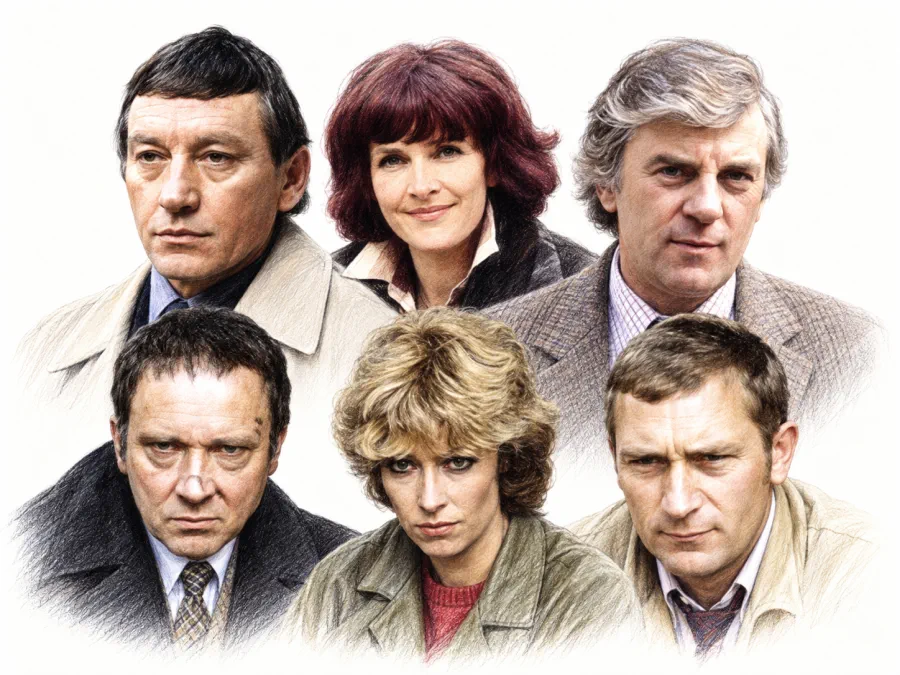
Principal Characters & Performances
George Bulman
George Bulman is the strangest detective Granada put on screen in the 1970s, and the series knows it. A serving officer posted to Manchester because nobody in the city’s underworld would recognise him, he works in gloves, carries an inhaler, keeps his belongings in plastic bags, quotes Shakespeare and keeps a hamster called Flash Gordon.
Don Henderson had played Bulman in support two years earlier in The XYY Man. Here he carries the show. Television Heaven wrote about the “gravel-like intensity and dry wit” he brought to it, and about how the eccentricities deepened rather than diluted the character: what began as a marker of outsider status “gradually took on a kind of quiet poetry”.
Early episodes call him a bent copper, though the example is benign: he earns a promotion by persuading down-and-outs to confess to old crimes in exchange for warm prison cells. That is the show’s moral outlook in one gesture, and Henderson plays it as pragmatism rather than graft.
It is also one of the longest lives any British television detective has had. Bulman runs from The XYY Man in 1976, through five series here, into Bulman in 1985, where the character is retired and working privately. Henderson appears elsewhere on this site in Cracker.
Derek Willis
Dennis Blanch’s Derek Willis is the second of the two characters Granada wanted to keep from The XYY Man, and he is the series’ fixed point. Where Bulman is mannerism and intuition, Willis is procedure and patience, and the partnership is the show’s spine.
Willis also carries the continuity. Partners, superiors and remits all turn over across five series, and he is the one constant, which is why the character returns in Bulman as well. Blanch has no page on this site.
Notable Support and Guest Stars
From the third series the show reorganises itself: Unit 23 becomes the Inter City Squad under DCS Jack Lambie, with a national remit in place of a north-western one. Mark McManus plays Lambie as a superior with a history, and the relationship with Bulman is charged with old respect and older friction. McManus already has a page here as Taggart’s Jim Taggart, which makes this the middle panel of a three-show picture of him.
Around him the unit keeps changing, which is the series’ quiet subject as much as any case. WDC Linda Doran, Frances Tomelty’s self-defence expert, partners Bulman through series 1 and is replaced in series 2 by Fiona Mollison’s WDC Vanessa Bennett. John Ronane’s David Singer provides local liaison before being promoted, and David Hargreaves’s DCI Rainbow, the unit’s first superior, departs after series 2.
Thorley Walters arrives in series 4 as William Dugdale, the Foreign Office and intelligence figure who gives the squad its political cases and turns a police series about impersonation into a low-key spy series. Television Heaven makes the sharpest production point: few episodes use the whole team, most give the weight to two or three regulars, and that economy gave the show an anthology’s range.
The World of Strangers
The premise is the geography. A squad is assembled from officers the local underworld has never seen, posted to Manchester so they can walk into a criminal world as nobodies. They are the strangers of the title, and the show gets its energy from the fact that being unknown is a professional advantage rather than a punishment.
This is Granada’s north-west, built out of a specific city rather than a generic north, and widening as the show goes on: Edinburgh in “The Flowers of Edinburgh”, Liverpool docks in “Tom Thumb and Other Stories”, Cambridge in “The Lost Chord”. Once Lambie’s Inter City Squad takes over, the remit is the whole country.
What the audience remembers is domestic: the gloves, the inhaler, the plastic bags, the pet hamster, the quotations deployed at the wrong moment. It is a lot of furniture for a police series, and it does the work that a backstory usually does.
Origin Story
Strangers began as a spin-off. Granada’s executives planned it in 1977 around Bulman and Willis, the two regulars they liked in The XYY Man, its adaptation of Kenneth Royce’s novels about the cat burglar Spider Scott. Murray Smith was brought in to create it and stayed to write most of it.
The production changed shape twice. Series 1 was shot mainly on videotape with location work on film; series 2 used far more film, including an opener shot entirely on film; and from series 3 the whole production moved to 16mm. It is the same transition The Sweeney made.
Smith’s grip on the scripts tightened: series 1 used a rotating group of writers, and from series 2 he wrote all but six of the remaining twenty-five episodes. When it ended, Henderson took the character into Bulman (1985–87), retired and working privately — a rare case of a character carried from one series into a spin-off of a spin-off.
Narrative Style & Tone
Sixty-minute self-contained episodes, with the occasional two-parter, and a method that is really a whole philosophy: impersonation. Bulman becomes a bookie to break a race-fixing ring, dresses as a tramp to work the Liverpool docks, and moves a colleague into lodgings to expose a bank robbery.
The tone is grim northern realism crossed with deliberate oddity, and from series 4 the intelligence material joins it. Television Heaven called the blend of “low-key espionage, grim northern realism, and moments of oddball levity” the thing that made it stand out among its peers.
Mike Moran wrote the theme, and the look is the story of British television in miniature: tape and film for two series, then all-film, at which point a show about unfamiliar faces starts to look like the decade it had moved into.
How is Strangers remembered?
It was never a ratings giant. No BARB figures have surfaced, and the surviving assessment is Television Heaven’s: a loyal following rather than a mass audience, carried largely by Henderson’s performance. There are no awards to point at for this series, and no enquiry has found any.
It finished on 20 October 1982 with the second half of a two-parter in which Bulman faces retirement while the squad closes on a smuggling gang: a resolution that doubles as a doorway, since he returns three years later in Bulman. All five series reached DVD as a Network box set in October 2009, now out of print with Network’s closure.
The afterlife is specialist. Strangers draws steady retrospective attention from 1970s television sites and almost no mainstream revival, which is the opposite of Shoestring’s walking tour. Its audience is people who already know the Granada chain, and it is worth remembering that for them Bulman is a three-series character, not a spin-off curiosity.
In Closing
Strangers solved cases by being someone else, which is a better idea than most police series have had before or since. It never found the audience its central performance deserved. It left behind a chain this site now holds complete: XYY Man, Strangers, Bulman.