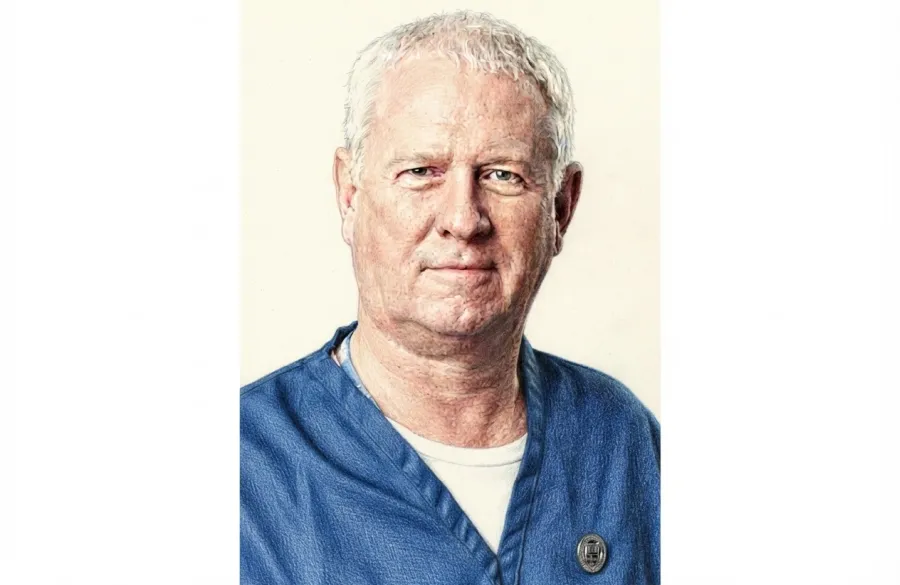
Most of the country knows Derek Thompson as Charlie Fairhead, the nurse at the centre of Casualty for thirty-eight years, and that is exactly the reason to look again. Before the hospital, Thompson was one of the most useful actors in British crime drama of the late 1970s and 1980s: Harold Shand's lieutenant in The Long Good Friday, the IRA gunman on the run in Harry's Game, a second gunman in The Price, a police regular in The Gentle Touch, and the frightening companion in Resurrection Man, Northern Ireland's most disturbing crime film. A Belfast-born actor who spent his first career playing the Troubles from the inside and his second playing the country's most trusted nurse, he is the rare British television story whose two halves make each other better.
The gangland debut
The Long Good Friday (1980) is a founding text of the British crime film, and Thompson's Jeff is in it from the beginning. John Mackenzie's film runs one weekend in Harold Shand's (Bob Hoskins) London: the East End boss about to close his Docklands regeneration deal with the Americans when his empire is attacked by forces he cannot name. Jeff is Harold's right-hand man, and Thompson plays him as the calm inside his boss's escalating panic, the lieutenant who does the checking while Harold does the shouting. The film was full of television rep players, Sweeney and Professionals faces, and Thompson, fresh from singing albums as a teenager and National Theatre stages, fits the mould: an actor who reads as genuine in a genre built on menace. It remains his best-known film work and one of the great British crime pictures.
The gunman, twice
Harry's Game (ITV, 1979) was his big break. Adapted from Gerald Seymour's novel and directed for television with the coldness of its source, it puts an undercover agent in Belfast after a government minister is assassinated, then follows the assassin, Billy Downes, on the run in London. Thompson played the gunman, and it is a lead part, three episodes, carrying the show's moral problem on his face: the killer as a working man with a cause, filmed with sympathy the era found uncomfortable. The series is a covered show on this site. Six years later came The Price (1985), in which Thompson played Frank Crossan, another IRA hitman, and the repetition is worth naming rather than hiding: in the Troubles thriller cycle, the Belfast actor with the hard face was the obvious, and in his case very good, choice for the man with the gun. Wild Geese II (1985) kept him in the same casting lane, a mercenary among mercenaries.
Resurrection Man (1998) is the darkest of them. Marc Evans's film, from Eoin McNamee's novel about the Ulster serial killings of the 1970s, casts Thompson as Herbie Ferguson, the companion and enforcer who makes the killer's violence possible. It is a performance without any of the charm the genre usually lends its monsters, and it sits oddly against the same decade's Casualty episodes: the country's gentlest television presence playing one of its most frightening men, in the same years, on opposite channels.
The copper
The Gentle Touch (ITV, 1980–82) was his only sustained policing role: Detective Sergeant Jimmy Fenton in the first British police series built around a woman officer, Jill Gascoine's DI Maggie Forbes.
Twenty-five episodes across two years, and Thompson played Fenton with the same unglamorous competence he would later give the hospital: the working detective who is neither the lead nor the comic relief, just good at the job.
Guest slots followed in the great franchises of the day, Minder in 1980 and Bergerac in 1983, plus an early Softly, Softly: Task Force in 1976, the kind of credits that make his crime-drama record read like a tour of the genre's golden age.
Then came the second half of the symmetry. Blue Lights (BBC, 2024), the Belfast police drama that has become the best-reviewed new cop show on British television, brought Thompson back to his home city in its second series as Robin Graham, and Vera (ITV, 2025) gave him a substantial guest role, Gordon Spencer in "The Dark Wives", opposite Brenda Blethyn's Vera in her final series. Both are covered shows here. An actor who played the gunman in the Troubles's first great television thriller finished his crime career on the side of the institutions: the Belfast police, the North East incident room, the same genre, the other side of the mirror.
Charlie
Casualty (BBC, 1986–2024) is the reason for his fame and the measure of his standing. Charlie Fairhead, senior nurse and later clinical lead of the Holby emergency department, was the only character to appear from the first episode to Thompson's departure on 16 March 2024, after 903 episodes. The part is the inverse of his crime work in every particular: instead of the loyal lieutenant, the person in charge; instead of violence, care; instead of a Belfast gunman's wary stillness, an English nurse's patience. It made him, by the BBC's own pay disclosures in 2017, the corporation's highest-paid actor, a fact that lands strangely and lands honestly: the longest, quietest job in British television, done extremely well for thirty-eight years. His wife Dee Sadler was met on the show, as a guest actress playing a potholer; one of his sons appeared in it as a baby in 1990. He returns to the character for the show's fortieth anniversary in 2026.
The acting style that connects the halves is understatement. Thompson is an actor of the face rather than the gesture: the reaction shot doing the work, the quietness that makes other people's loudness register. It is why he was right for the genre's tough-guy roles, which in the 1970s depended on actors who seemed to know violence, and why he was right for Charlie, whose authority is service rather than rank. The National Theatre decade between the singing and the screen work, Serjeant Musgrave's Dance, The Cherry Orchard, School for Scandal at the Old Vic and the Garrick, is the training under all of it.
The pattern
The crime record is deep, the fame is in a hospital, and the combination is the profile's point. Thompson has played the Troubles from both sides — the gunman in Harry's Game and The Price, the pursuing institutions in Blue Lights and Vera; the loyal gangland lieutenant in The Long Good Friday and the frightening enforcer in Resurrection Man; the police regular in The Gentle Touch and the genre's guest list across Minder, Bergerac and beyond. Very few British actors have touched the genre at so many of its points and remained so invisible in the crime conversation. He is, for readers of this site, one of the great second men of British crime drama, and The Long Good Friday and Harry's Game remain the places to see why.