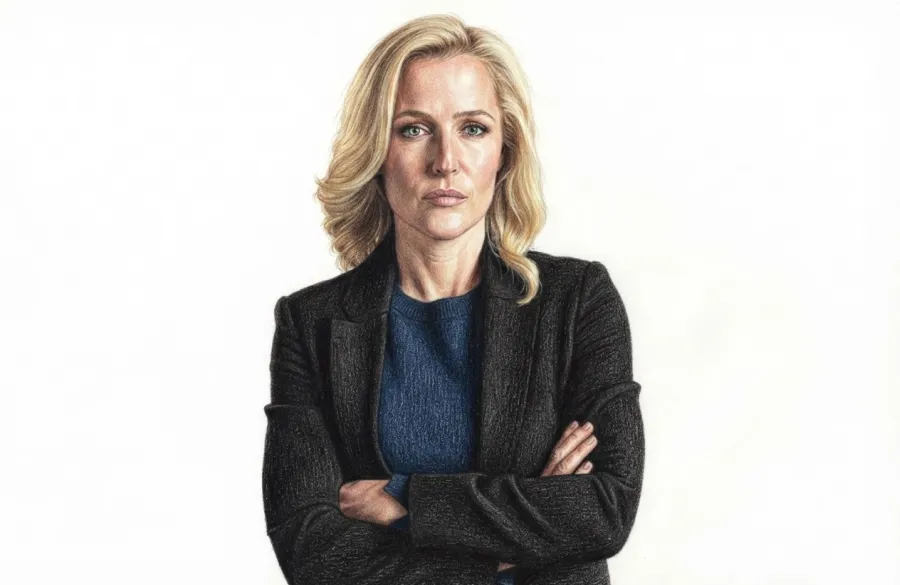
There is a version of Gillian Anderson most people carry with them: Scully, lab coat, scepticism, a torch beam in a dark hangar. That version is twenty years out of date, and Stella Gibson is what replaced it. Gibson is the Metropolitan Police detective superintendent Anderson played for three series of The Fall on BBC Two, and she is the reason a generation of British crime viewers now think of Anderson as one of their own, rather than an American import with good manners. The Fall is the entry point for crime audiences. Everything else in her career, from The X-Files to Blanche DuBois at the Young Vic, sits in its shadow or explains it.
The detective who arrived from America
The Fall began in May 2013, written by Allan Cubitt, produced by Artists Studio with BBC Northern Ireland, and shot entirely in Northern Ireland. Its opening series became BBC Two's biggest drama launch in eight years, and it did that with a premise that sounds simple and played out as anything but: a serial killer, Paul Spector (Jamie Dornan), works his way through professional women in Belfast while a detective, seconded from London, closes in on him at his own pace.
Anderson plays Stella Gibson as cold by temperament rather than by plot requirement. She is the smartest person in any room and lets you know it without raising her voice. Gibson arrives in Belfast as an Englishwoman carrying the full institutional weight of the Met, and Cubitt was careful to let that texture sit in the story rather than lecture about it. The series keeps both sides in view for its entire run: the killer's home life, the detective's hotel room, and the murders holding them together. Critics made much of the structure. The Guardian called it one of the best BBC dramas in years; Entertainment Weekly, reviewing series one, found a "deeply moral crime thriller... Anderson's performance is riveting"; Salon settled on "Anderson's performance is what makes The Fall worth watching."
What Anderson does with Gibson is built on restraint. The character says almost nothing about herself, and the actor plays that as a discipline. "She doesn't reveal much about herself, so the little bits she does feel quite large," Anderson said of her after a series two screening. The silk blouses became shorthand for the role, an unintended fashion marker that Anderson finds amusing more than flattering: "I don't look good in a silk shirt unless I'm wearing a silk shirt for Stella Gibson." The wardrobe, the posture and the voice together produce a woman who reads as dangerous in a way the killer's attractiveness was meant to unsettle. When the series was attacked in some quarters for glamorising violence against women, Anderson was blunt about what the scenes actually do: the posing of the victims, she argued, is not a fashion shoot but the killer's own turn-on, and saying so out loud was part of the point.
The Gibson–Spector relationship gives the series its engine, and Anderson describes it in terms of a chase rather than a duel. "They have an equal obsession for each other," she told the BBC. "It's very much a cat and mouse dynamic... One of them is always slightly on top." Over three series and seventeen episodes the lead tightens without slipping into melodrama, and Anderson's contribution to that is a refusal to soften the character as the case turns personal. Gibson stays exactly who she is. The series' final episodes divided viewers more than its first two had, but the performance was never the part under argument.
The role was written for her. Cubitt had Gibson in mind before casting, and Anderson has said that knowing so made the job attractive: "anytime you are told something was written with you in mind it adds to your ego." It also suits the kind of actor she has been since her twenties: someone who is good at holding a room quietly. Recognition followed: nominations at the Crime Thriller Awards, the Monte-Carlo festival and the Satellite Awards, an IFTA nomination, and a place on the site's covered show in the first place. She also executive produced The Fall, which puts her on the production side of one of the more discussed British crime dramas of its decade.
Before Belfast: the FBI years
You cannot get to Gibson without passing Scully. Dana Scully was the character that made Anderson's name on The X-Files between 1993 and 2002, and Chris Carter's casting of her remains one of television's small acts of stubbornness. Fox wanted someone with more conventional glamour. Carter wanted seriousness, and he won the argument. Scully was consciously modelled on Jodie Foster's Clarice Starling; "It's not a mistake that Dana Scully has red hair like Clarice Starling," Carter said. Anderson was twenty-four at the audition and is widely reported to have said she was older, on the sensible grounds that a network might not believe a twenty-four-year-old medical doctor and FBI agent. Treat that anecdote as reported rather than documented.
The part shaped her. In 1997 she became the first woman to win an Emmy, a Golden Globe and a Screen Actors Guild Award in the same year, and she took the role again for the 2016 and 2018 revivals. The Scully effect, the documented association between the character and women entering science and medicine, is now a standard paragraph in any article about her, and it belongs to the crime-procedural tradition as much as to science fiction: Scully performs the autopsies, debunks the theory, and is the most competent person in the room. That is also, structurally, who Stella Gibson is.
There is a nice circularity in the Lecter connection. Anderson's X-Files contract barred her from playing FBI agents elsewhere, which cost her the Clarice Starling role in the 2001 Hannibal film. A decade later Bryan Fuller put her in the NBC series Hannibal anyway, as Bedelia du Maurier, Lecter's former psychiatrist, an icy, self-preserving figure who may know exactly what her former patient is. Hannibal is American rather than British, so it belongs here only as a footnote to her crime-drama career, but the character's calm is the same calm that makes Gibson unsettling.
The route to the Met
Anderson was born in Chicago in 1968, moved to north London as an infant when her father took a place at the London Film School, and grew up in Crouch End and Haringey until her family returned to the United States when she was eleven. The family kept a London flat and spent summers in it, and she has said she always intended to come back. In Grand Rapids, Michigan she moved from an interest in marine biology to high school theatre, interned at the local civic theatre, and went on to DePaul University in Chicago for a fine arts degree. She was, by her own cheerful account, voted "most likely to be arrested" in high school, which is a better joke against a career playing law enforcement than anyone planned.
New York came next, and with it a waitress job and a proper stage debut: Alan Ayckbourn's Absent Friends at the Manhattan Theatre Club, opposite Brenda Blethyn, for which she won a Theatre World Award as best newcomer. Her career has kept both halves of the trade in view since. When The X-Files ended in 2002 she moved to London rather than Los Angeles, and the next decade was largely British work: Lady Dedlock in Bleak House (BBC, 2005), for which she won the Broadcasting Press Guild award and took BAFTA and Emmy nominations; Miss Havisham in Great Expectations (BBC, 2011); Wallis Simpson in Any Human Heart; a run of stage parts including Nora in A Doll's House at the Donmar (an Olivier nomination) and Blanche DuBois at the Young Vic (the Evening Standard theatre award, and the fastest-selling show in that theatre's history). The Bleak House role is worth a crime reader's attention on its own terms: a Dickens serial built around a contested death and a hidden past, with Anderson playing the withholding aristocrat as a person whose secret is killing her slowly.
Elsewhere in the genre
Shadow Dancer (2012) is the other title that matters. James Marsh directed this Troubles thriller from Tom Bradby's novel, with Clive Owen as an MI5 handler and Andrea Riseborough as the IRA operative turned informant. Anderson plays Kate Fletcher, the officer above Mac, and she plays her as a woman whose own files are not all readable. The part is small. RogerEbert.com noted that an actor "so indelibly sinister and elegant" was underused, which is fair, but the film earns its place in her record because it sits squarely in the genre: surveillance, coercion, Belfast, the price paid by families. Aidan Gillen, whose own crime-drama record deserves its own profile, plays Collette's brother in the same film. The pairing of Anderson and Gillen in the same intelligence-and-paramilitary thriller is the kind of connection regular viewers of both actors will notice.
The rest of her screen work does not belong in a crime context, but two titles anchor her wider reputation. Sex Education gave her Jean Milburn, a comic role on a global Netflix scale, and The Crown gave her Margaret Thatcher, which earned an Emmy nomination and required a technical and political accuracy she handled without caricature. Both are worth knowing because they show range that the Gibson performance deliberately withholds.
How she works
Anderson's screen presence is built on stillness and withholding. The characters she is most associated with, Scully, Gibson, Dedlock, du Maurier, are all described in the same terms by critics, cold, icy, glacial, and the repetition is not critical laziness; it reflects a specific technique. She lets the audience work to read the face. The theatre roles make the opposite argument: her Blanche DuBois is panic and appetite and decay, all the things Gibson will not show. Together the two halves suggest an actor who can do exposure and concealment, and who chooses concealment on screen because it suits the camera.
What she brought to Gibson specifically was authority that did not need to be performed. She arrives in a Belfast incident room and the room reorganises itself around her, and Anderson does it with posture and a dropped volume rather than a speech. Compare that with Scully, who argues her way into authority, and you can see a decade of craft used to close a character's distances.
The pattern
Look at the record as a whole and a shape appears. Anderson has spent much of her career inside investigation stories: a federal agent, a serial-killer hunter, an intelligence supervisor, a psychiatrist adjacent to a cannibal. She crosses the American and British traditions of the genre without either seeming like the borrowed one, because she genuinely belongs to both: a Chicago-born, north-London-raised actor who has made her home in the UK version of the form. Her Gibson is the character that British crime drama will remember her for, and it is a better part than the one she is globally famous for, which is a rarer thing in television than it should be.
She is not done with the stage, and the parts coming next, including Martha in Who's Afraid of Virginia Woolf opposite Billy Crudup at @sohoplace, directed by Marianne Elliott, sit outside the genre entirely. The crime-drama record is what it is: one great detective, one excellent underused MI5 officer, a Dickens secret, and the shadow of Scully over all of it. That is more than enough for the genre to claim her, and the fact that it gets to claim her at all comes down to a BBC writer who had her in mind.