Principal Characters & Performances
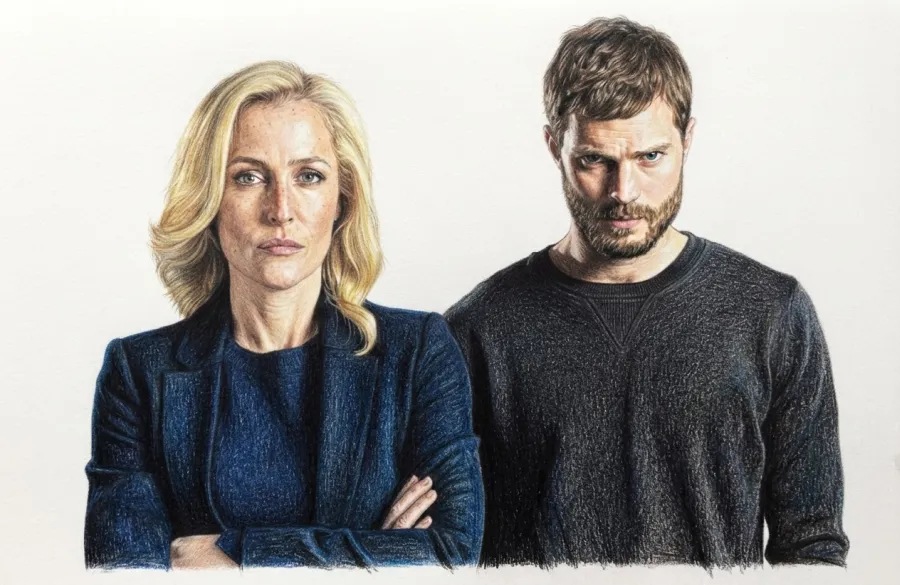
Detective Superintendent Stella Gibson
Stella Gibson is a Metropolitan Police Service detective superintendent, seconded to Belfast to conduct a 28-day review of an investigation that has gone nowhere. She links the dead woman in front of her to earlier killings, is made senior investigating officer, and gives the inquiry a name: Operation Musicman.
She is the series’ instrument rather than its heroine. Gillian Anderson plays her as a woman who says exactly what she means and gives away nothing else, and the series keeps its promise not to explain her. The one glimpse of a private life is a night with a junior officer, DS James Olson, who is murdered days later.
Anderson had spent a decade in British television and theatre after The X-Files, and Gibson gave her the first returning detective she had played on this side of it. She took an executive producer credit from the second series.
Critics argued about the performance for three series. One Guardian review said it “skidded across the line separating ‘glacial’ from simply ‘frozen stiff’”; another called her a study in control. Both readings describe the same choice.
Paul Spector
Paul Spector is a bereavement counsellor in a Belfast suburb with a wife, two children, and a cache of what he takes from the women he kills above his daughter’s bedroom ceiling. The series names him in its opening minutes and never hides him again.
Jamie Dornan was a Northern Irish actor then best known for Once Upon a Time. The part made him: within a year of the first series he was cast as Christian Grey in Fifty Shades of Grey, and he won best lead actor at the Irish Film and Television Awards in 2014 and a breakthrough award from the Broadcasting Press Guild.
What the performance does is hold two men in one body. Spector is patient, warm with his children and entirely plausible in company, and the audience is asked to watch a good father and a murderer at the same time.
Notable Support and Guest Stars
John Lynch plays Assistant Chief Constable Jim Burns, who brings Gibson in, leaks to the PSNI’s political fixer Morgan Monroe, drinks again and resigns. He is the second-billed name in the series and the clearest case of an institution failing from inside.
Niamh McGrady’s Constable Danielle Ferrington is the officer Gibson picks as her right hand and who is edged off the inquiry; Stuart Graham’s DCI Matt Eastwood runs the murder of Olson and becomes her deputy. Archie Panjabi’s Professor Reed Smith joins them at the first crime scene and is gone by the end of the second series.
Aisling Franciosi’s Katie Benedetto, the teenage babysitter who gives Spector an alibi and destroys evidence for him, won a supporting actress award at the Irish Film and Television Awards. Bronagh Waugh’s Sally Ann Spector lies for her husband, loses the baby she is carrying, and is prosecuted for it. Valene Kane’s Rose Stagg is abducted in the second series and buried in the boot of a car.
The third series deepens the bench: Krister Henriksson as the psychiatrist assessing Spector, Richard Coyle and Aisling Bea as the doctor and nurse keeping him alive, Ruth Bradley as his solicitor, Aidan McArdle as the defence lawyer, Denise Gough and Conor MacNeill inside the psychiatric unit, and Colin Morgan returning as Detective Sergeant Tom Anderson. None of them has a page on this site, so every cast row below carries a name and no link.
The World of The Fall
The series is set in Belfast and filmed in Belfast, which is unusual: the city plays itself. Gibson works out of a PSNI station and lives in a suite at the Merchant Hotel, and the airport, the Botanic Gardens, Victoria Park, the Waterfront Hall and a dozen ordinary streets are all the real things.
The institution is the second subject. A 28-day review becomes a standing inquiry, and the politics of the force run alongside it: a police board chaired by a man protecting his son, a detective inspector leaking to him, an assistant chief constable who relapses, and later an ombudsman and a prosecution the force would rather avoid.
The funding explains the setting. Northern Ireland Screen, Invest NI and the European Regional Development Fund part-financed the series, BBC Northern Ireland was a partner from the first commission, and the production stayed in the province throughout. The Troubles are not the plot. This is a city where the danger has moved indoors.
Origin Story
Allan Cubitt wrote all seventeen episodes as an original screenplay, from an idea he first pitched in 2009. He had been reading about the American serial killer Dennis Rader and was struck by a structure in which the killer is known from the start, and about the Canadian colonel Russell Williams, whose methods were close to what he had in mind for Spector.
BBC Two commissioned five episodes in February 2012, through the channel controller Janice Hadlow and the drama controller Ben Stephenson, from Artists Studio, the company set up by former BOX TV executives. Cubitt cast Gillian Anderson first and Jamie Dornan second, and filming began in Belfast that spring.
Two further runs followed, in 2014 and 2016, with Cubitt taking over direction from Jakob Verbruggen and Anderson joining the executive producers. Cubitt wrote towards the end of Spector’s story, and the series has never been formally closed: both have said since that they would go back.
Narrative Style & Tone
Five, six and six episodes, one continuous story, and no whodunnit: Spector is unmasked before the detective is introduced. That single decision is the series, and with the mystery gone the drama is spent on two people hunting each other from opposite ends of the same problem.
The method is procedural and patient: a partial fingerprint on a weapon, hours of CCTV between a house and an airport, cameras and microphones planted in a suspect’s home, and interview after interview. Jakob Verbruggen directed the first series and Cubitt the rest; the look is film, low light and long takes.
The theme and score are David Holmes’s, written with Keefus Ciancia, and the closing theme is performed by their band Unloved. The music is used sparingly, mostly under scenes with no dialogue. Cubitt kept the killings few and mostly out of frame; what is asked of the viewer is the company.
How is The Fall remembered?
It was the most talked-about British crime serial of its years. The Guardian called it one of the best BBC dramas in a decade and placed it tenth in its television of 2013. Rotten Tomatoes holds 95% for the first series against 64% for the third, and the BBC said the second averaged 3.3 million viewers.
It also drew a sustained argument about violence against women that has not gone away. Rachel Cooke wrote in the Guardian that it offered “misogyny in a veil of classiness”; the actress Doon Mackichan called it part of an industry of “crime porn”; Cubitt replied that he had shown the death of one woman in eleven episodes.
Its awards were modest for a series this discussed: a BAFTA for editing, an Edgar for Cubitt’s first episode, and Irish film and television awards for Dornan and Aisling Franciosi. It has an afterlife in odd places, including a French remake and Fiona Apple naming an album after a line from it.
In Closing
The Fall gives a serial killer equal time with the detective hunting him, then refuses them both a clean ending: Spector dies by his own hand, Gibson goes home alone. The argument about watching violence against women is still the argument about this show.