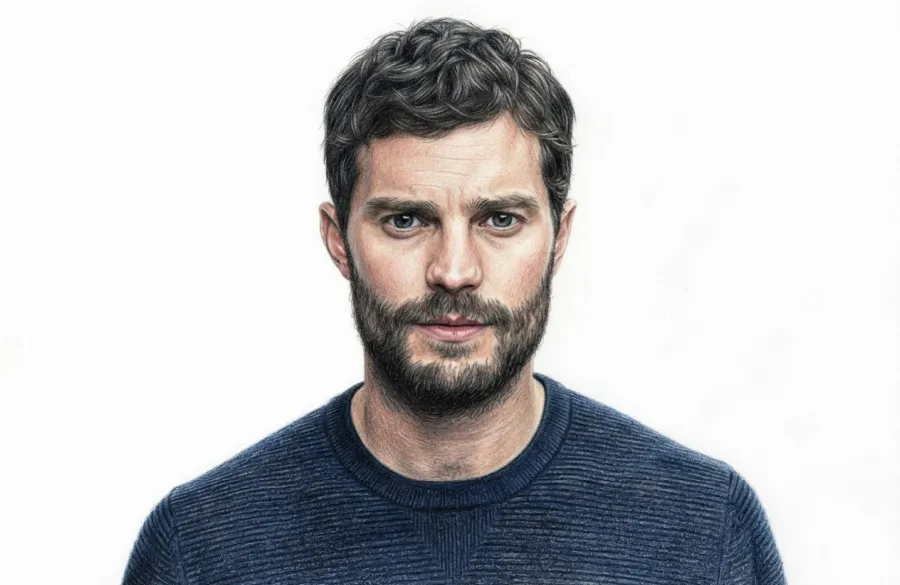
Paul Spector stands in a Belfast kitchen doing the ordinary things any father does of an evening, and the horror of The Fall is that the audience knows what he does after the children are in bed. Jamie Dornan played that part for three series on BBC Two, and it remains the measure of him: a performance in which charm and menace share the same face and neither apologises for the other. He came to it from an unlikely direction, a decade as one of the most photographed male models in the world, and he has spent the years since proving that the modelling is the least interesting thing about him.
The killer in the family
The Fall was Allan Cubitt's three-series study of two obsessions: a serial killer working in Belfast and the Metropolitan Police detective, Stella Gibson (Gillian Anderson), sent to catch him. Dornan's Spector is a bereavement counsellor, a husband, a father of two, and a predator who stages the bodies of the professional women he kills. Series one, broadcast in 2013, became BBC Two's most popular new drama in twenty years, and its final episode drew nearly four million viewers.
The performance works by domesticity. Spector's double life is presented without any tell, no theatrical moment in which the mask slips for the camera's benefit, and Dornan plays the counselling sessions as seriously as the murders, which is precisely the trick: the man who helps other people through loss is spending his nights taking lives. Cubitt wrote the series as a dissection of a certain kind of male view, in his own words, an exploration of misogyny, and the controversy that followed the broadcast, over whether the show glamorised violence against women, was aimed in part at the casting itself. A newspaper critic called the series "an invitation to share an extended rape fantasy"; the Observer accused it of equating violence with sexual attractiveness; The Atlantic, defending it, called it a "remarkable achievement". Cubitt said he had cast Dornan against type, as "an interesting-looking guy", and few reviewers believed him. The debate became part of the programme's history, and it is worth stating plainly: the argument existed because the performance made the killer believable as a man women might trust.
Dornan took something away from the part that he has been unusually willing to discuss. "You can't fail but be left slightly scarred by inhabiting somebody like that. I carry elements of him with me in a worrying way," he said at the series two launch in 2014, adding that Spector "had such distaste for everything" and that some of that contempt stayed with him during the months of filming. The series earned him a BAFTA Television Award nomination for Best Actor and an IFTA win, and by his own account reset his career: "I feel this job has totally transformed my professional horizons. It totally changed my life."
The third series, in 2016, ended the story in a hospital bed. Spector, wounded at the close of series two, claims amnesia, and the drama becomes a struggle to keep him alive long enough for a trial that he then denies everyone by killing himself. The ending divided viewers, and Dornan's restraint in it, playing a man whose performance of victimhood may itself be a performance, is easy to misread as flatness. It is not. The character's last power over the story is the power to be unreadable.
After Belfast: the man with no memory
The Tourist (BBC One, 2022–2024) gave Dornan the other leading television role of his career, and it is a clever inversion of The Fall. Created by Harry and Jack Williams, the brothers behind The Missing and Baptiste, it opens with a man driving through the Australian outback singing along to 'Bette Davis Eyes' before a lorry runs him off the road. He survives with no memory of who he is, which is a problem, because several people are trying to kill him. The mystery of who Elliot Stanley was drives both series, the second moving to Ireland and a Sixties crime backstory. The show was streamed thirty-two million times in the UK in its first three months and sold around the world.
Where Spector was all concealed surface, Elliot has none: the role asks Dornan to play bewilderment, fear and comic panic, and the reviews for the first series treated it as his best work yet. Dornan himself, asked whether he had known the show would be a hit, answered: "Am I allowed to say no?" It is worth knowing that he keeps a critical scar as well. The same reviewer who praised The Tourist had written of his 2018 BBC drama Death and Nightingales: "To be fair to Dornan, he can't act, but he does at least seem to realise this." Dornan quoted the line to The Times with the air of a man who has looked at it many times. Death and Nightingales, an adaptation of Eugene McCabe's novel set in 1885 Fermanagh, is not a detective story, but its territory, land, betrayal and the armed Irish past, sits close enough to the genre to interest crime viewers, and the mixed reception of his performance in it is part of an honest account of his television record.
The route in: a pub in Knightsbridge and a torso
Dornan was born in Holywood, County Down, in 1982 and grew up in the Belfast suburbs. His mother died of pancreatic cancer when he was sixteen; at seventeen, four of his friends were killed in a car crash; he has spoken about both in interviews and about the therapy that followed. His father, an obstetrician, had once thought about acting himself, and there is amateur theatre in Dornan's teens, including a Cherry Orchard tour, before the detour. He dropped out of Teesside University, moved to London at twenty, worked in a Knightsbridge pub, and entered the industry through a Channel 4 modelling reality show, Model Behaviour, in 2001. He was eliminated. Select Model Management signed him anyway.
What followed was the decade of Calvin Klein, Dior Homme, Abercrombie & Fitch, a fragrance campaign with Kate Moss, another with Eva Mendes, the New York Times dubbing him "The Golden Torso" and GQ's creative director calling him "the male Kate Moss". Sofia Coppola cast him as Count Axel Fersen in Marie Antoinette in 2006, and the years after that were the usual round of failed auditions. He has described the stigma of the "model turned actor" label without much sentiment. The Huntsman in Once Upon a Time gave him steady American television work from 2011, and then Cubitt's scripts arrived.
Fifty Shades and the rest
The Fifty Shades films (2015–2018) made him a global star and are, professionally, the odd one out: huge box office, critical drubbing, a role he discusses with deadpan discomfort. Belfast, Kenneth Branagh's 2021 film about his own childhood, gave him a warmer industry standing as Buddy, the father of the boy at the centre of the story. There have been soldiers (The Siege of Jadotville, Anthropoid), a frock comedy turn in Barb & Star Go to Vista Del Mar, and a folk-music past, Sons of Jim, from his student days. He sings on the Belfast and The Tourist soundtracks, which in both cases is a plot point rather than decoration.
How he works
Dornan's screen asset is a stillness that reads two ways. Played against the audience's knowledge, it is menace; played against the character's own ignorance, as in The Tourist, it is bewilderment, and the same quiet face carries both. His comic timing, underused by thriller casting, surfaces in Barb & Star and repeatedly in The Tourist. His weakness, when it has been argued, is a tendency to underplay to the point of blankness, and the Death and Nightingales criticism is the sharpest statement of that case. The counter-case is Spector, where blankness is the whole point, and The Tourist, where he is asked to be open rather than guarded and is better than anyone expected.
The pattern
The pattern in the television work is specific: Northern Irish actor, Irish and Belfast-set material, and roles that turn on a hidden self. His Spector is the reason the "charming predator" became a contested figure in 2010s British crime drama, with the glamourisation debate that followed it still attached to the genre wherever an attractive actor plays a killer. His Elliot Stanley is the corrective, the same amnesia premise played for humanity instead of dread. He has not often strayed far from the type, and when he has, the reviews have let him know. Within it, he is one of the best British television has, and The Fall, a covered show on this site, is where that is proved.