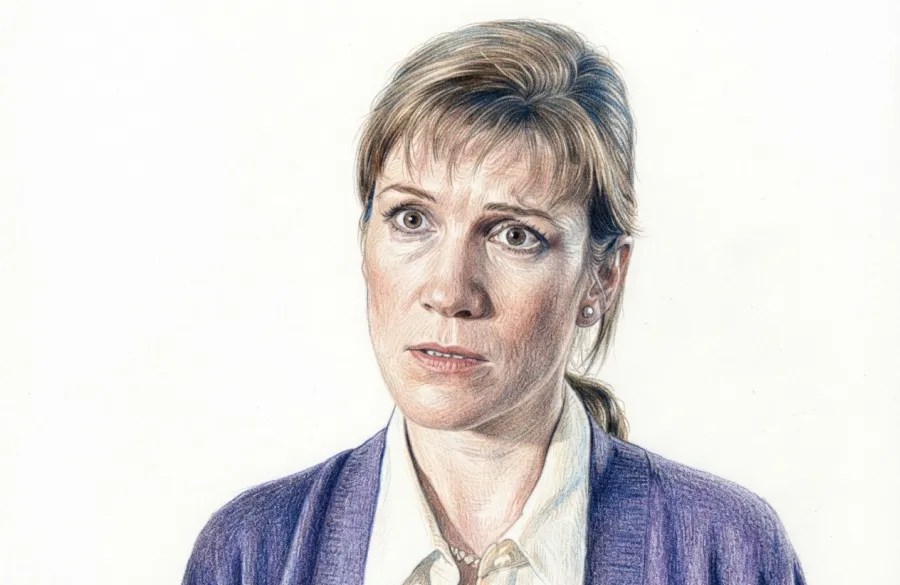
Harriet Walter has been the senior woman in the room for most of British crime television's recent history: the detective chief inspector running the murder squad in Law & Order: UK, the judge in Trial & Retribution, the assistant chief constable in Five Days, the retired Russian in Killing Eve, and, going back to 1987, Harriet Vane, Dorothy L. Sayers's crime novelist, in the BBC's Wimsey serials. She is also one of the great Shakespeare actors of her generation, an associate artist of the RSC who has played Brutus, Henry IV and Prospero, and a dame whose stage career is the spine of everything she does on screen. The crime work is not the whole career. It is, unusually, the part of her career that spans its whole width: the classic detective school and the modern procedural, the victim's sister and the assassin, across five decades. Her earlier crime drama work also includes The Price.
Vane
The place to start is 1987, because A Dorothy L. Sayers Mystery is the role crime-fiction readers were most nervous about. Walter played Harriet Vane across ten episodes adapting four Lord Peter Wimsey novels — Strong Poison, Have His Carcase, Gaudy Night and Busman's Honeymoon — opposite Edward Petherbridge as Lord Peter. Vane is a hard part: the detective fiction heroine who is also a wrongfully accused murder suspect, then the detective's intellectual equal and finally his conscience, and Sayers's readers have strong feelings about her. Walter plays her as the books write her, a woman of judgement and armour, and the serial remains the standard against which the Wimsey adaptations are held. For this site's purposes it is the classic school's lead performance, the 1980s counterpart to the Granada Sherlock Holmes: detective fiction played straight, with the detective's partner allowed to be the more interesting person.
Chandler
Law & Order: UK (ITV, 2009–2014) is her longest screen commitment to the genre: forty episodes as DI and later DCI Natalie Chandler, the senior investigating officer anchoring the police half of a series built on the American format's police-and-prosecutors split. The role has none of Vane's literary standing; its virtues are procedural. Chandler is the SIO who moves the case, tells the detectives what to do next, and absorbs the pressure from above without performing it, and Walter plays exactly that: dry, unhurried, allergic to drama, the institution's competent centre. It is the least glamorous leading part in the genre, and it is why the series worked: someone has to make the machine look real, and Walter made it look real for five series.
Around that anchor sits the widest franchise spread of any actor on this list.
Dr Esther Martin in Inspector Morse's "The Day of the Devil" (1993).
Two different killers-adjacent characters in two Midsomer Murders episodes a decade apart, Margaret Winstanley in "Orchis Fatalis" (2005) and Diana Davenport in "Death and the Divas" (2013).
Miss Bulstrode in Poirot's "Cat Among the Pigeons" (2008) and a role in Marple's "Sleeping Murder" (2006) — the Christie pair.
Other guest roles included Mary Waddell in Dalziel and Pascoe (1999), Annie Keel in Waking the Dead (2001) and Madeline in New Tricks (2005).
She also played Professor Robb in Messiah (2005), "Deep Throat" in Spooks (2005) and the judge in Trial & Retribution (2007).
It is the full tour of the British crime guest list, from the classic school to the forensics era, delivered by a performer whose day job was the RSC.
The Five Days and Hunter serials (2007, 2009) gave the guest work a through-line: assistant chief constable Jennie Griffin, the senior officer in Peter Bowker's pair of BBC thrillers, a role that asks Walter to play institutional authority under public scrutiny, the police as an organisation rather than an individual. She is very good at it, and it leads directly to what Killing Eve (2020) did next: Dasha, the ex-KGB trainer pulled out of a suburban retirement to clean up after Villanelle, played by Walter as a professional assassin with a pension and a family she has damaged beyond repair. It is a comic part, a chilling part, and the only time the genre has let her be the criminal, which given her casting history is nearly the joke: the judge, the ACC, the detective chief inspector, and now the woman who teaches people to kill.
The other career
Everything else is context for the technique. Born in London in 1950, niece of Christopher Lee and great-great-granddaughter of the Australian opera singer Marie Carandini on her mother's side, descended from John Walter, the founder of The Times, on her father's, she was rejected by five drama schools before LAMDA took her. The RSC followed from 1979, an associate artist's chair from 1987, and the performance history now reads as an argument: Viola and Masha in 1988, for the Olivier Award; Lady Macbeth in 1999; Cleopatra in 2006; Elizabeth I in Mary Stuart at the Donmar in 2005, for the Evening Standard award and a Tony nomination on Broadway; then Phyllida Lloyd's all-female Shakespeare trilogy, Brutus in Julius Caesar (2012), the title role in Henry IV (2014), Prospero in The Tempest (2016). She has written about all of it — Clamorous Voices, Other People's Shoes, Brutus and Other Heroines — and she speaks about the profession as a political place: a feminist from twenty, she accepted her damehood, in her own account, as a slightly political gesture, on the argument that too few women survive the career long enough to be named one.
The screen fame came late and sideways: Fanny Dashwood in Sense and Sensibility, Lady Shackleton in Downton Abbey, Clementine Churchill in The Crown, and above all Lady Caroline Collingwood in Succession (2018–2023), Logan Roy's ex-wife, Emmy-nominated twice, a performance of aristocratic damage that gives the series its coldest scenes. Silo, Ted Lasso, Brian and Maggie as Margaret Thatcher (2025): a working screen career built on the same foundation, the educated authority figure who can freeze a room with a sentence.
How she works
The acting is in the voice. Walter delivers dialogue as finished thought, no hesitation, no decoration, and the effect on screen is authority without effort: the character is believed because the sentence is complete. It is stage training applied with discipline to the camera, and it is why her crime roles work. A detective chief inspector is believable when the orders sound like conclusions. Dasha is frightening because the threat is administrative, delivered quietly. Vane's intelligence is in the phrasing. Against the genre's habit of letting its senior women be comic dragons, Walter's version is always first a professional, and the dryness is discipline rather than camp.
The pattern
Her crime record has no single defining role, and that is the finding. Instead there is a spread: the classic-school lead (Vane), the modern procedural lead (Chandler, forty episodes), the judge, the ACC twice, the assassin, and the guest bench across Morse, Midsomer twice, Poirot, Marple, Dalziel and Pascoe, Waking the Dead, New Tricks, Spooks and Messiah — every covered franchise on this site's roster at least once, most of them in a single episode that lifts the hour. Add the family's own intelligence history, her mother having run the naval intelligence team behind D-Day planning, and the pattern closes: Harriet Walter is the actor the genre calls when it needs its institutions to seem real, and it has been calling her for forty years.