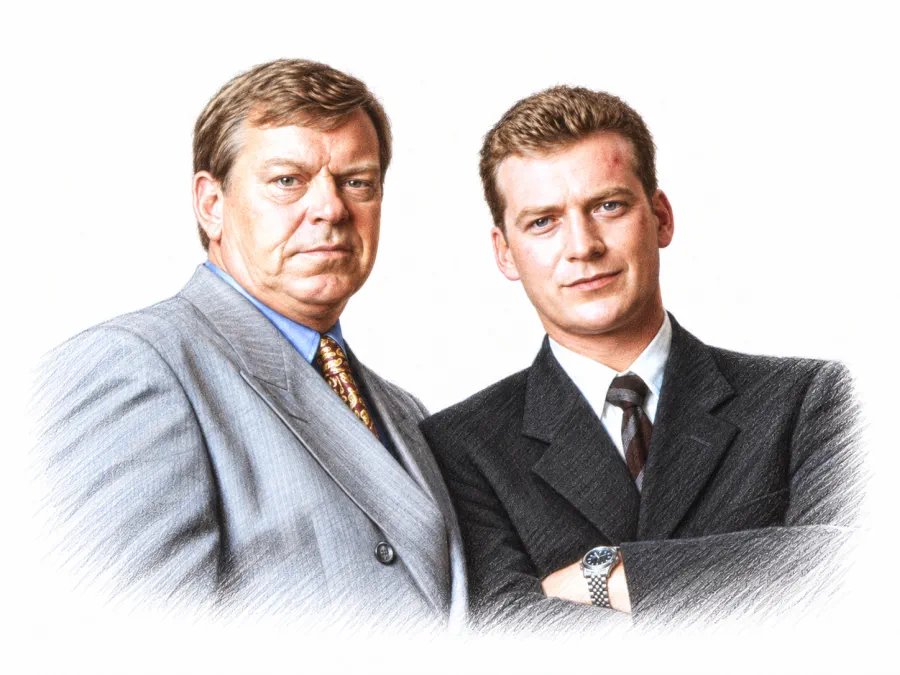
Principal Characters & Performances
Detective Superintendent Andy Dalziel
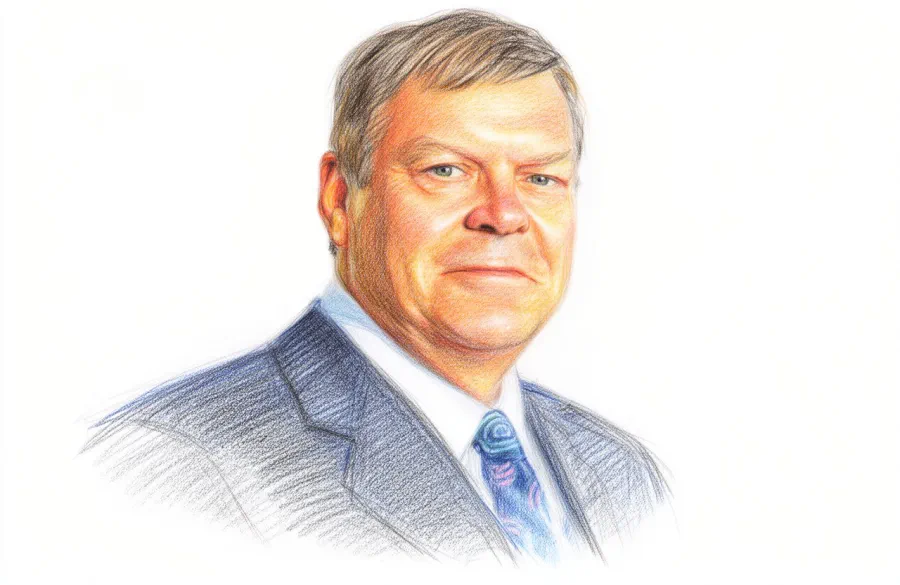
Andy Dalziel is the blunt, earthy, politically incorrect copper of Reginald Hill’s novels, and Warren Clarke makes him the engine of the show’s comedy as well as its authority. He is a gloriously vulgar savant: a fat, rude, unembarrassable detective who is usually right, and who knows it before anyone else in the room does.
Clarke does not match the novels physically, and Television Heaven’s assessment is that it did not matter: what he lacked in the book’s build he “more than made up for in his effortless and engaging performance, bringing depth, complexity, and charisma to the character”. The casting was also what got Hill’s cooperation with the BBC.
Clarke had been a character actor for decades, with A Clockwork Orange on the filmography, and Dalziel made him a television lead for twelve years. He also directed two of the stories himself: “For Love Nor Money”, the best-rated episode of series 7, and the two-part “Wrong Place, Wrong Time” eight years later.
Detective Inspector Peter Pascoe
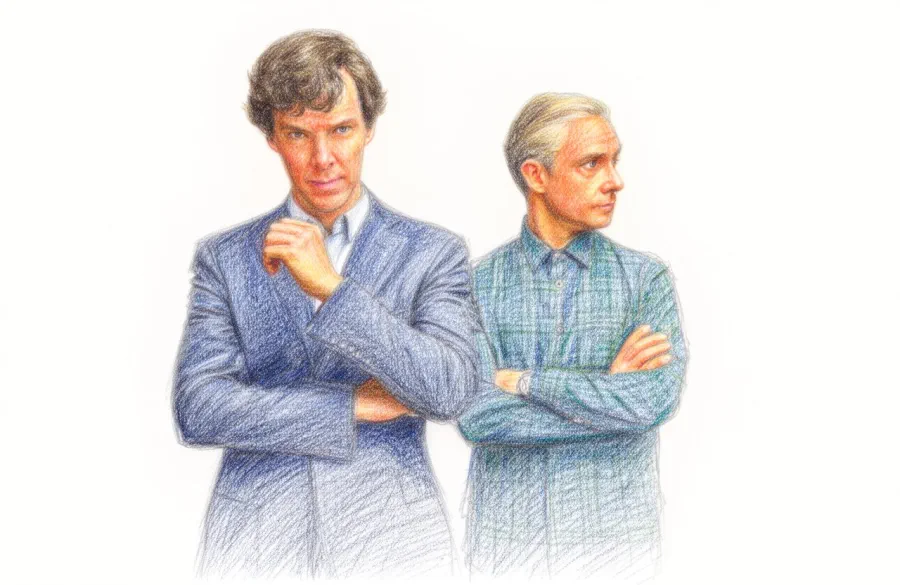
Colin Buchanan’s Peter Pascoe is the university-educated fast-track graduate set against him: a family man with a mortgage and a sense of proportion, who spends twelve series being embarrassed by his own superior. In the novels his wife Ellie has a narrative voice of her own, and the television version keeps her, with Susannah Corbett recurring through series 1 to 5 and returning as a guest in series 9.
Buchanan’s own summary of the production doubles as a description of its casting strategy: “It’s quality drama and this in turn attracts great talent to come and appear in the series.” He directed two stories as well, “Great Escapes” and the two-part “Glory Days”.
Wield and the Wetherton Bench
David Royle’s DS Edgar Wield is the third leg of the original triangle: reliable, procedural, the man who produces the evidence that convicts, and by common consent the only person involved who does not share either detective’s sense of humour. Royle played him from series 1 to series 7 and then left, and nobody replaced him. The later series are visibly thinner without him.
The bench around the pair turns over constantly, which is where the show keeps its institutional comedy: pathologists in sequence (Fred Pearson’s Dr Vickery, then James Puddephatt’s Dr Ashurst, then Joe Savino’s Dr Mason) and a chief constable’s office that changes hands every couple of years (Malcolm Tierney, Marian McLoughlin, Diana Quick, and Pippa Haywood’s Rebecca Fenning in series 5).
The constables turn over with them: Jo-Anne Stockham, Katy Cavanagh, Navin Chowdhry and Wayne Perrey. It is a station where careers are made and ended off-screen, and the churn does as much for the sense of a working institution as any script does.
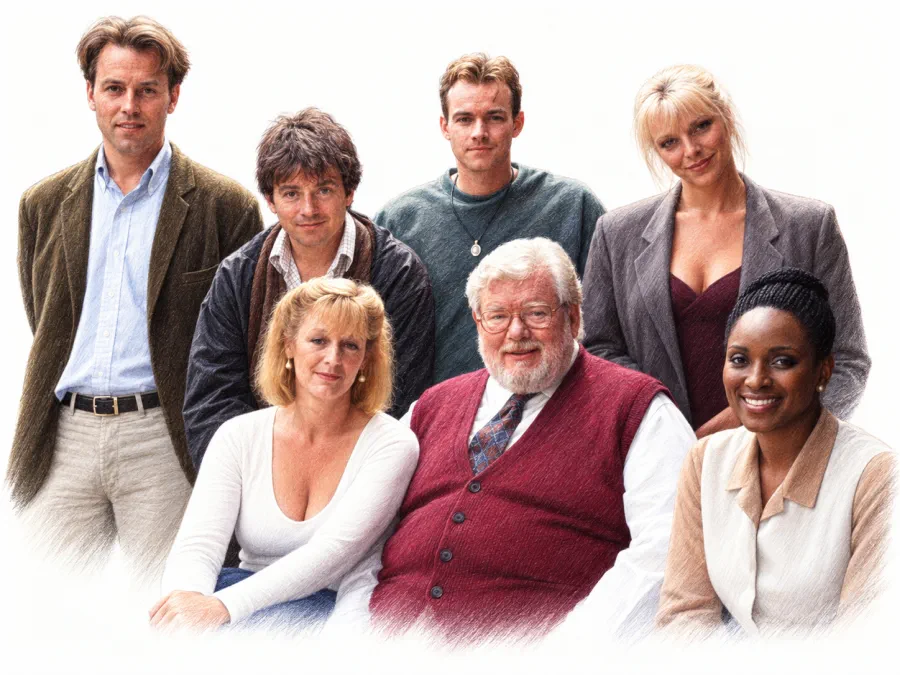
The guest bench is unusually starry for a regional BBC drama, and Television Heaven names Christopher Cazenove, Richard E. Grant, Bill Maynard, Robert Powell, Miriam Karlin and a pre-Downton Michelle Dockery among them. Celia Imrie is the one to watch for readers of this site: she appears here as well as in Bergerac and in Shoestring’s Christmas finale.
The World of Dalziel and Pascoe
Wetherton is a fictional Yorkshire town, and the show’s visual identity is moorland, market square and police-issue architecture, shot for weather and atmosphere. It is a county town close enough to the countryside that a body can be found in a field and close enough to the station that the paperwork still matters.
The premise carries an argument about class and generation that the scripts never have to state. A Bengali-descended sergeant, a graduate inspector and a dinosaur superintendent sit in the same office, and the friction between them is the show’s subject as much as any murder.
Around them the institution changes more than they do. Chief constables come and go, careers are made and ended off-screen, and police politics run as a standing joke: in Wetherton the cover-up is frequently more dangerous than the crime that prompted it.
Origin Story
This series exists because an earlier attempt to film the same books went wrong. ITV approached Hill in 1993, fifteen novels in, and made A Pinch of Snuff in 1994 with the comedians Gareth Hale and Norman Pace as Dalziel and Pascoe.
Hill’s response was decisive: Television Heaven reports that he was so unhappy with the casting, the treatment of the characters and Robin Chapman’s adaptation that he stopped ITV making any more. The Independent called the leads “breathtakingly miscast”.
The rescue came from the other broadcaster. In 1995 BBC Worldwide offered to make a series, and in 1996 three films went out with scripts by Alan Plater and Malcolm Bradbury and Warren Clarke and Colin Buchanan in the leads. Hill approved.
Fidelity was the point for a while: the first three series, eleven episodes, came from the novels, as did the opening two of series 4. After that only “Dialogues of the Dead” came from a book.
Narrative Style & Tone
For most of its run the show made feature-length films of 90 to 100 minutes. From series 9 it switched to two-part stories, each part an hour long, which moved the rhythm from novelistic to serialised and gave the schedulers four or five weeks of drama instead of two.
The method is conventional investigation — pathologists, forensic reports, interviews, station politics — with Dalziel’s improvised instincts as the disruptive ingredient. He is the reason a procedural can be funny without the procedure becoming a joke.
Comedy and menace share scenes, and that is the tone the show is remembered for. The plots were well built and often complex, and the partnership’s comedy did the tonal work that would otherwise have made a grim case relentless.
How is Dalziel and Pascoe remembered?
It was a hit and then it was a problem. By 2007 the BBC was reviewing its long-running dramas, and in July the Guardian reported that BBC1 controller Peter Fincham had already axed The Chase and New Street Law and was considering the future of Dalziel and Pascoe. One unnamed source gave the reason: the stars had accumulated increases until they were “pricing themselves out of the market”.
The last episode went out on 22 June 2007; the axe fell in 2008, with falling viewing figures cited, as part of Fincham’s cull of long-running drama. It was recognised by the Royal Television Society during its run, including for the Christmas special “Dialogues of the Dead”, though that rests on a single secondary source.
It has stayed available and liked on the strength of Clarke’s Dalziel. Clarke died in 2014, and the show has settled as a fondly remembered example of the form rather than a revival candidate — and as the bridge between novel adaptation and the modern multi-series procedural.
In Closing
Twelve series, sixty-one films, and a detective who is genuinely funny without ever being the joke. What makes the show unusual is that it exists at all: the same characters had been filmed badly two years earlier, by someone else, and it took an author’s refusal to get them right.