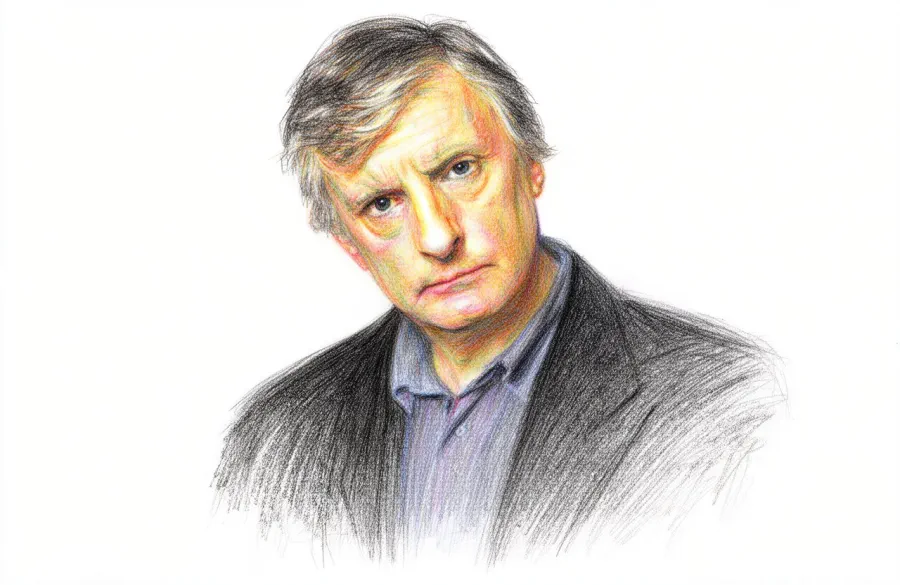
Early Life
Jack Shepherd was born on October 29, 1940, in Leeds, a city in the West Riding of Yorkshire, England. He started out in the visual arts, not on the stage. He studied fine art at King's College, Newcastle University, and took a BA. Newcastle is where his path shifted.
He painted and drew, and acted amateur parts at the People's Theatre. The two interests ran side by side for the rest of his working life. He trained further at the Central School of Speech and Drama in London.
He was a founding student at Drama Centre London, which put actors through a demanding, psychology-heavy training. Music ran alongside drama and painting. Shepherd played alto saxophone in a jazz ensemble with Jon Lord, another student at the time.
Lord later found fame with Deep Purple and Whitesnake. He rated Shepherd one of the best alto players he knew, and introduced him to the music of Charles Mingus. Fine art, jazz and a long acting training together shaped how Shepherd worked.
Early Career & First Roles
Shepherd's professional career began in 1962, with the small, uncredited role of a night receptionist in the film 'Two and Two Make Six.' Through the late 1960s and early 1970s he worked steadily, mostly small character parts. He appeared as Dwyer in 'All Neat in Black Stockings' (1969) and Sergeant Wellbeloved in 'The Virgin Soldiers' (1969).
Television work came alongside it, with early appearances in 'Special Branch' (1969) and 'Budgie' (1971). Many of the parts were in crime drama or social realism. They taught him the trade that later made him a lead.
Major Roles
A handful of roles carried his reputation. Between them he covered radical idealism, patient police procedure, madness, and history.
Detective Superintendent Charles Wycliffe – 'Wycliffe' (1993–1998)
For many viewers, Jack Shepherd is Detective Superintendent Charles Wycliffe, the lead in the ITV series that ran for five series and 36 episodes between 1993 and 1998. Wycliffe was not the eccentric genius or the troubled maverick. Shepherd played him as a thorough, thoughtful senior officer.
Wycliffe has been transferred to Cornwall, where he works as an outsider among closed communities. Shepherd played him as a listener. Cases get solved through patient procedure and reading people, not deduction tricks. The intelligence shows in a long look or a pause.
Shepherd played the job as a weight. You see the pressure from above and the cost of spending your working life among murders. He let warmth through too, in his dealings with his team, particularly DS Doug Kersey.
The series worked because Shepherd could make decency interesting. The cop he plays is professional, sometimes stubborn, and fair. That performance won him a loyal audience and made the show a fixture of 1990s ITV drama.
Renfield – 'Count Dracula' (1977)
Long before 'Wycliffe,' Shepherd played Renfield in the 1977 BBC adaptation of 'Count Dracula,' with Louis Jourdan as the Count. Renfield is the solicitor's clerk who becomes Dracula's devoted, insane follower. Shepherd played the decline straight rather than as scenery-chewing.
He starts as an ordinary, rather earnest young man sent to the Count's castle on business. Shepherd tracks the change step by step, from reasonable fear to insect-eating fanaticism. He uses twitches, whispers and sudden bursts of clear terror.
Even at his most deranged, pleading for flies and spiders, you can see the frightened man still in there. His last scenes mix pathetic loyalty with a final moment of clarity. It is a supporting part, but he holds his ground against a powerful central character.
Other Notable Work
In the 1977 ITV series 'Bill Brand' he played the radical Labour MP of the title. The role brought him two Royal Television Society Awards and a BAFTA nomination. He played Thomas Becket in 'The Devil's Crown' (1978).
On stage he played Shelley Levene in the original 1983 London production of David Mamet's 'Glengarry Glen Ross.' He won the Society of London Theatre Award for Actor of the Year in a New Play for it. Later television included a dry turn as the Butler in the miniseries 'Over Here' (1996).
Acting Style
Shepherd worked in a naturalistic style, built on heavy preparation and the training he got at the Drama Centre. He could hold an audience while doing very little. The work was internal, carried by small gestures and the way he used his voice.
His jazz training showed in his timing and sense of pace. He listened the way a musician waits for his cue, so his reactions carry as much as his lines. That served him in classical theatre and in contemporary screen work alike.
He was not a showy star and not a blank slate either. He was a character actor who could carry a series or take a scene, and he moved from Renfield's madness to Wycliffe's decency without vanity.
Personal Life
Away from the cameras, Jack Shepherd kept his private life private. He married twice: first to Judith Harland in 1965, with whom he had two children, Jan and Jake, and then, after their divorce, to the film and television producer Ann Scott in 1975. They had three children: Victoria, Catherine, and Ben.
His daughter Catherine Shepherd also became an actor. Colleagues describe him as thoughtful, professional and unpretentious. Jack Shepherd died in hospital on 24 November 2025, aged 85, after a short illness.
In closing...
Jack Shepherd never chased the spotlight. He earned respect through steady, intelligent work. Wycliffe, Renfield, the Labour MP in 'Bill Brand' — he gave each the same care.
For anyone who likes character-driven mystery and drama, the work holds up. He was a serious actor, and it shows.