Principal Characters & Performances
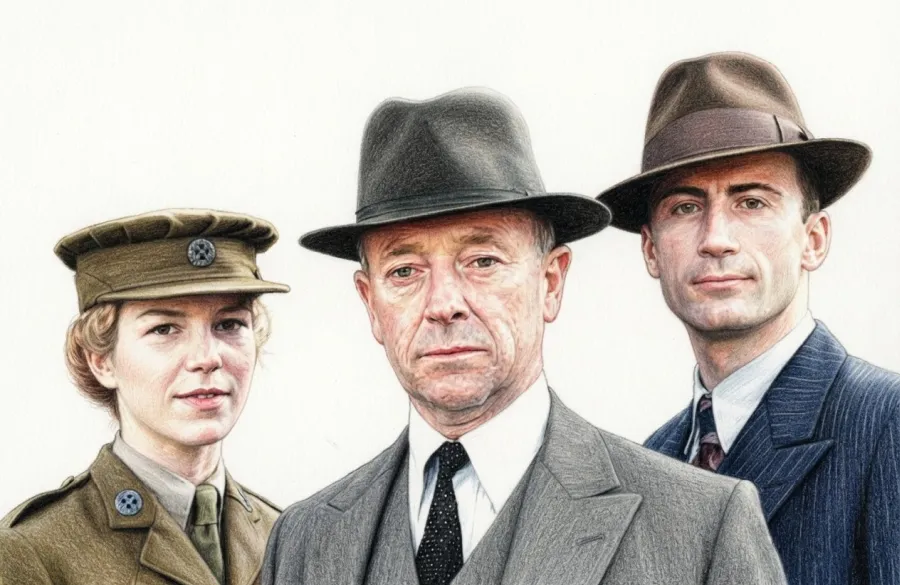
Detective Chief Superintendent Christopher Foyle
Christopher Foyle is a widowed detective chief superintendent in Hastings who asked to be transferred to the war effort and was refused. He spends the Second World War investigating murders, profiteering and black-market crime on the Sussex coast while the fighting happens fifty miles away, and that refusal is what shapes him.
Michael Kitchen plays him without display. His Foyle is quiet, dry and slow to move, and he keeps his authority by refusing to be hurried or flattered. The performance rests on small things: a pause, a raised eyebrow, the decision not to answer.
His method is patience. Foyle asks ordinary questions and follows the paperwork until a senior officer decides he has asked too many, and his cases usually put him against a soldier, a ministry man or an intelligence officer who would prefer the truth left alone.
Across eight series he is refused a transfer, then repeatedly tries to resign. He finally leaves Hastings police at the end of series six, is recruited into MI5 on his return from America, and ends the programme working in post-war London. He never gets to fight.
Samantha Stewart & Paul Milner
Sam is a driver in the Mechanised Transport Corps, assigned to Foyle in the first episode. She is brisk, cheerful and curious, and apart from Foyle she is the only character who appears in all twenty-eight episodes.
Honeysuckle Weeks plays her with a lightness that has sometimes been mistaken for nostalgia. Sam is the programme’s warmth and most of its comedy, and the jokes are usually at the expense of her innocence rather than her intelligence.
Paul Milner is a former policeman who lost a leg in Norway and is persuaded by Foyle to return to the force as his sergeant. Anthony Howell plays him as a man rebuilding a life: his first marriage fails over the amputation, and he is later promoted and moved to Brighton.
Horowitz wrote both out of the abortive 2008 ending, Milner promoted and posted to Brighton. Both came back when the programme was revived: Milner as a detective inspector in the 2010 series, and Sam to the end, where she is married to an MP and pregnant.
Notable Support and Guest Stars
Julian Ovenden’s Andrew Foyle, an RAF pilot and Foyle’s son, is the running thread of the war years. Ellie Haddington’s Hilda Pierce links the Home Front to MI5 and becomes Foyle’s handler in the post-war run.
The recurring ranks around them include Corin Redgrave’s Assistant Chief Constable Rose, Geoffrey Freshwater’s Sergeant Eric Rivers, Rupert Vansittart’s Sir Alec Meyerson and Tim McMullan’s Arthur Valentine. They are the officials Foyle works against, and occasionally with.
The guest roll-call is the series’ best-known feature. James McAvoy, Rosamund Pike, Charles Dance, Danny Dyer and David Tennant all take single episodes in the first series alone, and Emily Blunt, Laurence Fox, Samuel West, Bill Paterson, Peter Capaldi, Andrew Scott and Tamzin Outhwaite follow later.
Ian Hogg, Roger Allam, Roy Marsden and Tim Pigott-Smith each appear once and each already has a page on A Cup of Crime. The programme’s habit of casting future leads in small parts has become part of how it is watched.
The World of Foyle's War
The series is set in Hastings and on the Sussex coast, and it stays there for six series. Foyle’s home is a real house on Croft Road, the Old Town stands in for itself, and the war is audible even when it is not visible.
It was filmed largely where it is set. Squerryes Court in Kent is the Beaumont house in the first episode, Gaddesden Place stands for a manor in A Lesson in Murder, and Bawdsey Manor in Suffolk, a real radar station, appears in Eagle Day.
The last two series move to London, played largely by Liverpool, and the change of place is the change of the programme. Post-war streets are bomb-damaged and rationed, and the seaside light of the early series is gone.
Origin Story
Anthony Horowitz created the series in 2001, and it was ITV’s answer to the end of Inspector Morse. He wanted to test whether a detective story could carry something larger than itself.
His aim, in his own words, was to put the detective series against something as large as the Second World War, so that the murder became almost the least interesting thing going on. He set it in Hastings because that was as close to the real war as it was possible to get.
Foyle’s War ran to twenty-eight episodes, twenty-four of them written by Horowitz. ITV cancelled it in 2007 under its director of programmes, Simon Shaps, and revived it under his successor, Peter Fincham, after viewers’ letters and steady ratings. It ended deliberately in 2015.
Narrative Style & Tone
Each episode is a self-contained case running to feature length, with a handful of threads carried between them: Foyle’s attempts to resign, his son’s war, and the profiteer Howard Paige, who escapes him and is pursued to America.
The investigations are legwork. Foyle interviews, reads files and waits, and the solution usually depends on an ordinary detail: a letter, a receipt, a witness who has been overlooked. Violence is present but not dwelt on.
The programme is less a whodunnit than a moral drama with a mystery attached, and Foyle is repeatedly asked to let a guilty person go because the war needs them. Jim Parker’s brass theme sets the tone: marching, orderly, and slightly sad.
The post-war series grows bleaker. London replaces Hastings, Milner is gone, and the certainty of Foyle’s line that murder is murder gives way to questions the programme declines to answer.
How is Foyle's War remembered?
It was a popular success throughout. Episodes drew between seven and ten million viewers in the war years, and the series was sold to about thirty countries.
Its honours are modest for a programme of this length: the Radio Times Lew Grade Audience Award at the 2003 BAFTAs, a production-design nomination the same year and a drama-series nomination in 2004.
The retrospective writing is warmer than the trophy shelf. Reviewers now call Michael Kitchen’s Foyle the best detective performance in British television this side of John Thaw’s Morse, and treat the daytime reputation as comfort television as misleading.
The counterpoint is the ending. The final two series, with Foyle in MI5 and Hastings abandoned, divide viewers, and one notable rewatch calls them shockingly bleak and less compelling than the war years.
In Closing
Foyle’s War used a detective who could not get to the fighting to walk Britain through the war year by year, and kept his sense of justice steady while the institutions around him bent. It outlasted the series it was made to replace.