Principal Characters & Performances
Nigel “Nidge” Delaney
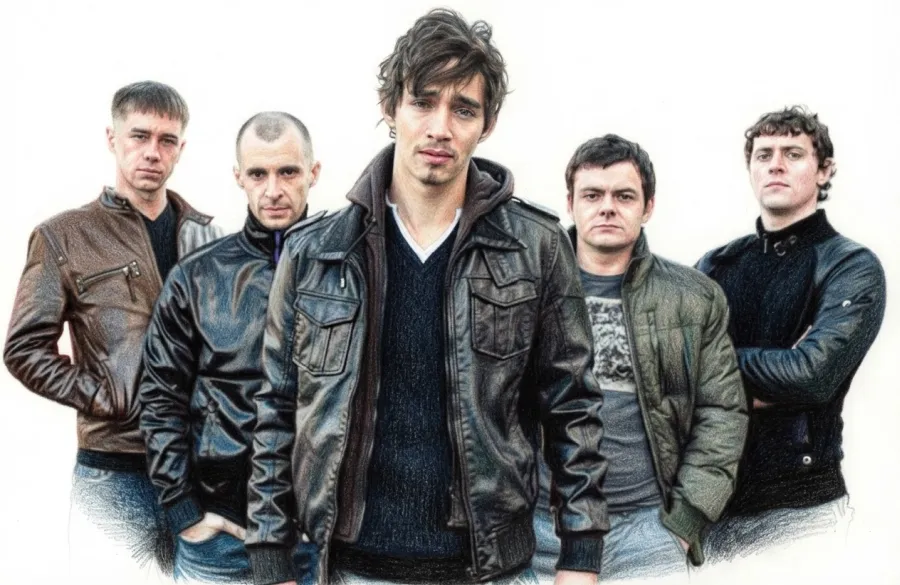
When Love/Hate begins, Nidge carries the guns and does what John Boy tells him. By the end of the second series he has had his boss shot and taken the gang for himself, and the remaining three series are the story of a man defending a position he was never meant to hold.
Tom Vaughan-Lawlor plays him across all twenty-eight episodes, and the part made him a lead. The performance is surface calm and sudden heat: Nidge talks his way out of a crisis in a flat Dublin drawl, then does something appalling without changing his tone. He won the Irish Film & Television Award for actor in television in 2013.
The character shows how ordinary the machinery of violence looks from inside. Nidge is a husband and a father, minds his mother and worries about money, and orders killings between errands. The series never asks you to like him and never lets you dismiss him, which is why his death in his own garden lands as an ending rather than a punishment.
Darren Treacy
Darren is the way in. He returns to Dublin from Spain in the first episode for his brother’s release from prison, and by the end of that hour the brother is dead and Darren is being drawn back into the trade he had left. Robert Sheehan played the first three series as a study in damage: a young man who keeps trying to leave and keeps being pulled back by debt and guilt.
His story ends in the third series, when Nidge sells him out and he is shot by Lizzie. Sheehan had become the show’s best-known face through Misfits, and his casting drew complaints that he was too handsome for the part.
Siobhán Delaney
Siobhán survives longest and changes most. She is under-age when she first appears, asking for a drink; she is raped in the third series; she becomes an informer for the Gardaí; and in the final episode she plants evidence in her uncle’s house and tells him to his face that she is the rat. Charlie Murphy won Irish Film & Television Awards for the third and fifth series.
She is killed in the last ambush, and she is the series’ answer to its own question about who pays for the men’s business. Murphy’s Siobhán is not written as a victim: she is the one character who ends the show having chosen what she does.
Notable Support and Guest Stars
Aidan Gillen arrives in the first series as John Boy Power, the boss Nidge inherits from. He had come from The Wire, and the casting gave a young RTÉ drama a seriousness it would otherwise have had to earn. He won the television actor’s award in 2012, the year John Boy is shot.
Around him: Killian Scott as Tommy, whose loyalty is repaid with a beating; Peter Coonan as the volatile Fran; Laurence Kinlan as Elmo; Mark Dunne as Ado; Aoibhinn McGinnity as Trish; Ruth Bradley as Mary and Ruth Negga as Rosie; and Brian Gleeson as the psychopathic Hughie.
The Gardaí arrive late and slowly. Brían F. O’Byrne is the drugs-unit detective Mick Moynihan, who beats Nidge at the roadside, and Kieran O’Reilly, who plays Detective Ciarán “Heggo” Madden, was himself a serving member of the Garda National Drug Unit, and the casting prompted an internal inquiry.
Barry Keoghan appears in the fourth series as Wayne, the teenager who shoots a cat in the opening episode, the moment that made his name and brought more complaints than anything else in the run. No member of this cast has a page on the site, so every row carries a name.
The World of Love/Hate
The series is set in Dublin’s criminal underworld, and its geography is deliberately vague: the city appears in docks, estates, motorway and pub rather than mapped street by street. What it depicts instead is an economy, and the early series are set in the wreckage of the Celtic Tiger.
The gang is the institution at the centre, and the show is as interested in its internal politics as in its crimes. Members buy drugs on credit, are paid in favours and settle debts with violence; promotion comes by elimination. The show also takes in the rituals around the trade: the brothel, the courtroom, the funeral, the family kitchen.
It was filmed mostly in Dublin, with some scenes shot in the surrounding counties, and it makes little attempt to soften the city. The Traveller community enters the story through the Loughmans and, later, Patrick Ward, and dissident republicanism through the Continuity IRA in the third series. From the fourth series the Gardaí get a proper share of the screen time, and the drugs squad’s surveillance becomes part of the story’s machinery.
Origin Story
Stuart Carolan wrote all twenty-eight episodes. He came from the theatre, where his play Defender of the Faith won the George Devine Award, and had written one episode of RTÉ’s Raw in 2008. He has said the idea came partly from the 1996 murder of the crime reporter Veronica Guerin and partly from his mother’s work as an emergency-department nurse.
RTÉ commissioned it and Octagon Films made it, with shooting on the first series beginning in October 2009. David Caffrey directed most of it; Anthony Byrne took the last three episodes of the second series. Simon Massey, Suzanne McAuley and James Flynn produced, with Jane Gogan commissioning for RTÉ.
The first series went out on RTÉ One on Sunday nights from 3 October 2010, and the show ran twenty-eight episodes across five series, ending on 9 November 2014. A sixth series was announced, postponed and abandoned when RTÉ said there were no plans in November 2015.
Narrative Style & Tone
It is a serial, not a case-of-the-week. Each series is one long story told across four or six episodes, and the audience is expected to carry the whole history in its head.
The show kills its leads. John Boy is shot at the end of the second series, Darren at the end of the third, and Nidge and Siobhán in the finale, and the willingness to remove a character the audience has invested in is the source of most of its tension. Torture, rape and murder happen on a Sunday evening.
It is shot single-camera on RED digital, which gives it a cleaner, more filmic look than most RTÉ drama of its time, and Ray Harman’s score runs under much of the dialogue. It is explicit in a way Irish primetime had not been, and it does not offer much comfort.
How is Love/Hate remembered?
The first series was not well received. The Irish Times called it “more Westlife than Westies”, and critics complained about the accents and about Robert Sheehan being too handsome for his part. The second series changed that: the same paper called it the best drama RTÉ had produced, and the Guardian, reviewing it in Britain, reached for The Wire and The Sopranos.
It won nineteen Irish Film & Television Awards. Carolan took the writer’s award five years running, Vaughan-Lawlor and Charlie Murphy won the leading acting prizes, and the third series set a record for nominations. The finale was watched by more than a million people.
The later series were the most criticised. The fourth was felt to resolve its stories too hurriedly, and an opening scene in which a cat is shot brought more than a hundred complaints; the fifth was seen as an improvement but a predictable one. The show is now treated as a high point of Irish television, and it streamed in Britain on ITVX.
In Closing
Love/Hate ends with Nidge face down in his own garden and Siobhán dead beside the plan that killed him. It is the ending five series have promised: a gang story that would not let its leading man walk away, and an Irish drama that would not look the other way.