Principal Characters & Performances
Detective Chief Inspector Tom Mathias
Richard Harrington played DCI Tom Mathias as a man exiled into a landscape: a London detective who arrives in Aberystwyth after ten years at the Met, living in a caravan on the cliffs and running to outlast his own grief. The BBC’s own character note calls him a man on a journey to recovery, flawed but brilliant.
His backstory is withheld by design. The death of a child, the collapse of his marriage to Meg and a case in London that went wrong are revealed slowly, and in the first series only the producers and Harrington knew the reason for the exile.
Harrington is Merthyr-born, with a stony face the critics decided could carry the show’s glowering; The Guardian found him just about getting away with it, and noted that he does not smirk once in six hours. BAFTA Cymru made him their actor of the year in 2015.
Detective Inspector Mared Rhys
Mali Harries plays DI Mared Rhys, the local detective and the counterweight to the outsider: intelligent, perceptive, bound to Aberystwyth for better or worse, and the source of the institutional knowledge Mathias lacks. She takes command of the station, and of the arson case, while he is under investigation.
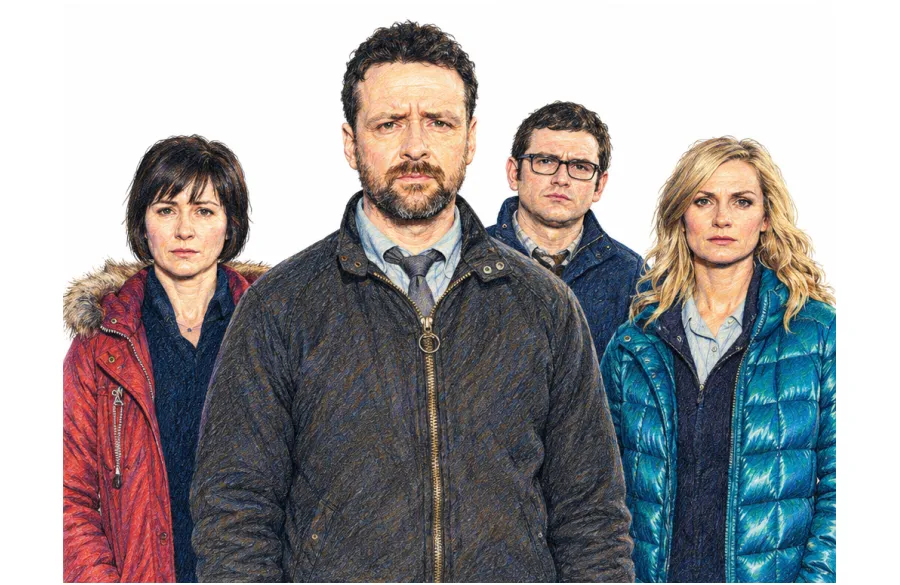
Her red parka became the character’s marker by design — the director wanted a parka, the cinematographer wanted a colour that would read against the greens and browns of the land, and the costume designer wanted fur. Harries won the BAFTA Cymru actress award in 2016.
The Guardian’s objection to the writing is worth recording: Mared is given far too many lines explaining what a maverick her boss is. She is a single mother whose home life the second series deliberately opened up.
Chief Superintendent Brian Prosser
Aneirin Hughes plays Chief Superintendent Brian Prosser, the institutional antagonist who becomes the series’ endgame: a man buried deep in the Aberystwyth elite who investigates Mathias, blocks him, protects his oldest friends, and is finally revealed as part of the cover-up at the children’s home.
Harrington said there was always going to be a showdown with Prosser, and that the character was slightly lost for much of the run before hindsight showed which pieces had been missing. The final series makes him the answer to the pilot’s question.
Notable Support and Guest Stars
Hannah Daniel plays DS Siân Owens, impulsive and ruthless, kept in the background in the first series and central to the third, in which she finds Iwan Thomas’s body and is drafted onto the independent investigation; Alex Harries plays DC Lloyd Elis, the young local constable who is usually first at the scene and carries the exposition.
The recurring cast is small and Welsh: Geraint Morgan’s Iwan Thomas, the father of the dead girl in The Girl in the Water and Mathias’s accuser; Anamaria Marinca as the estranged Meg; and Elen Rhys, Sian Reese-Williams, Richard Lynch and Siôn Alun Davies across the later series.
Guest casting draws on Welsh acting talent. Mark Lewis Jones joins the second series opener as an ex-con mechanic haunted by his war service, and other guests across series two and three include Tom Rhys Harries, Dafydd Hywel, William Thomas and Sara Gregory as the convicted killer whose suicide reopens the case.
The connections matter here: Daniel and Alex Harries went on to Keeping Faith, Reese-Williams and Siôn Alun Davies to Hidden, the series that succeeded Hinterland, and Thomas, Talfan, the director Gareth Bryn and Mali Harries had all worked together before on Fiction Factory’s Pen Talar.
The World of Hinterland
The setting is Aberystwyth and Ceredigion, filmed in autumn and winter, and the landscape is the series’ most discussed quality: the Devil’s Bridge ravine and its oak woods, the Borth marshes and dunes, the Cambrian mountains, the Rheidol and Ystwyth valleys, and the real village of Cwmsymlog standing in for the fictional Penwyllt.
The police station’s exterior is the former Ceredigion council offices on the Aberystwyth seafront; it is presented as a generic Aberystwyth CID office rather than a named force, and the producers admitted they were deliberately loose about procedure. The idea for the pilot came out of the location, not out of a plot.
Ceredigion functions as a character. The Guardian wrote that the county feels like a member of the cast, shaping its inhabitants and reminding the viewer how small a man is beside nature, and the producers called the series a love letter to a disappearing Wales of failing farms, old feuds and close-knit, land-bound communities.
Origin Story
Hinterland was created by Ed Thomas, a playwright, and Ed Talfan, and made by their Cardiff company Fiction Factory for S4C and BBC Cymru Wales with Tinopolis and All3Media International. The pitch was simple: every broadcaster needs a detective to call their own, and here was Wales’s, sold on landscape and language.
The idea predated the British vogue for Nordic noir — it was written when The Killing and The Bridge had not yet aired in the UK — but the financing was easier once they had, and the series was made twice, scene by scene, in Welsh and in English, because an English version was needed to sell it abroad.
It took two and a half years to raise £4.2 million and the project was dead more than once; European Union funding was, by the producers’ account, crucial to the first series. Thirteen feature-length stories were made before the chapter ended in 2016, and no fourth series followed.
Narrative Style & Tone
Each series is four self-contained feature-length films, split by S4C into two parts each, with a serialised thread beneath them: Mathias’s past, and the children’s home whose former residents and abusers come to dominate the final series.
Investigations proceed by interview and re-interview, forensic detail and paper trails rather than procedure. Visually it is wide, slow and wintry, the figures dwarfed by the landscape, the dark interiors lit by torchlight, and the killings almost always discovered rather than shown.
John Hardy’s score is character-led and builds across the run, incorporating the hymn Blodau’r Iesu in the title theme and, by the third series, a reconstructed Canu Pwnc chant. There is little humour, and almost no act of violence is shown: the subject is the aftermath.
How is Hinterland remembered?
It was the first BBC television drama to contain both Welsh and English dialogue, and the founding text of what the Welsh press calls Cymru noir: a Welsh-language series sold to more than thirty countries, bought by DR Denmark before filming began, and later carried on Netflix.
It won steadily in Wales. BAFTA Cymru gave it three awards in 2014, including director and writer prizes for the opening story and The Girl in the Water; it took best drama at the Celtic Media Festival, beating The Fall and Doctor Who; and in 2016 it won the BAFTA Cymru drama award, with Mali Harries named actress.
The critical verdict was warm but qualified: Wales’s answer to Nordic noir, with a tortured cop whose misery is overdone and a first series whose films vary in quality. Its successor was Hidden, made by the same team to the same template, and in 2024 the BBC gave the series a retrospective documentary.
In Closing
Thirteen films, one county and a language kept audible on British television. Hinterland is the founding text of Welsh noir, and its reckoning ends where it started — at Devil’s Bridge, with the landscape watching.