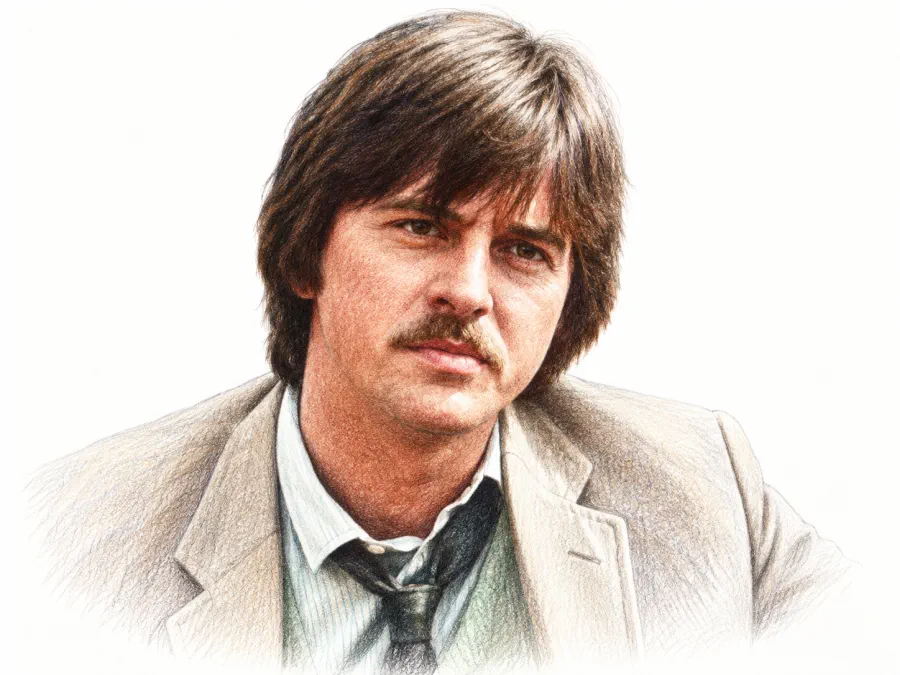
Principal Characters & Performances
Eddie Shoestring
Eddie Shoestring has no licence, no office and no fee. A former computer analyst who had a breakdown and destroyed a roomful of equipment, he takes cases through a phone-in slot on Radio West from a rented flat in Bristol.
Trevor Eve plays him as a man on the edge of his own nerves. BFI Screenonline called the character “valiant and idealistic, yet strangely vulnerable, almost naïve”, and singled out the “occasionally manic quality” Eve brings when Eddie is rattled: in “Knock for Knock” he kicks a reluctant informant into talking. Competence was not the point of this detective.
Little in Eve’s career beforehand suggested a star, and the wardrobe did as much work as the scripts. The crumpled linen was never hung up, the kipper tie sat at half mast, and the sketchbook he uses to draw the people he questions was filled with Gray Jolliffe’s cartoons.
Eve left after two series, wanting the theatre rather than to be typecast as the man from Shoestring, and it is part of why the run stayed short and stayed liked.
Don Satchley
Don Satchley owns Radio West, which gives the series a second centre of gravity. Neither villain nor fool, he likes Eddie and the audience Eddie brings, and turns difficult the moment a case threatens an advertiser or the station’s standing. Much of the show’s comedy comes out of that collision.
Michael Medwin was cast against expectation, deliberately: Banks Stewart wanted a station boss who was “not what you’d expect”, thought first of Mickey Rooney, then chose Medwin because he was Albert Finney’s partner at Memorial Films. Medwin asked his agent how he had got the part: “Michael, it’s as big a mystery to me as it is to you.”
Erica Bayliss and Sonia
Erica Bayliss is Eddie’s landlady and a working barrister, which is what makes the premise bearable. She supplies the legal reality his cases would otherwise lack, and Doran Godwin plays her as the adult in a house full of unfinished ideas.
Godwin arrived with more television experience than her leading man: the title role in the BBC’s Emma, then Harriet’s Back in Town and Quiet as a Nun. Banks Stewart cast her partly to steady a first-time lead, thinking it “wouldn’t be too bad an idea to have a lady alongside who might sort of steady it down a little bit”.
Sonia is the show’s comic engine and the person who invents it: Radio West’s receptionist proposes that Eddie become the station’s private ear, in a pilot whose planning meeting has produced nothing else. Liz Crowther, a dancer’s daughter trained in mime, went on to long runs in The Bill and London’s Burning.
Notable Support and Guest Stars
The station staff supply the texture: Colin Maitland as Pete the studio engineer across eight episodes, John Vine and Stewart Bevan as the DJs, Julian Littman and Jeanna L’Esty elsewhere in the building.
“Nine Tenths of the Law” is the darkest hour, and it belongs to Harry H. Corbett, still identified with Steptoe and Son, playing a violent man, with Geraldine James as the mother whose child has been taken. “Find the Lady” assembles a 1979 pop cast: Toyah Willcox, Christopher Biggins, Gary Holton, Lynda Bellingham.
The finale gives Michael Elphick a market trader whose shoddy racing game nearly kills his son, with Celia Imrie as his wife; Imrie later appeared in Bergerac, where Sean Arnold, a guest in the pilot, played Barney Crozier.
The World of Shoestring
The series is set in Bristol, though the scripts seldom say so outright. The choice was contested: the BBC wanted Slough, and Robert Banks Stewart refused, quoting Betjeman’s “Come, friendly bombs” back at the controller. Bristol got the show, and the launch photographs put Eddie and Erica in front of the Clifton Suspension Bridge.
Radio West is the institutional centre: a station owner, a receptionist, DJs, engineers, and a weekly phone-in through which the public hand Eddie their problems for nothing. The building was real. Its premises on Welsh Back are now flats; Eddie’s own flat was filmed in Clifton, a down-at-heel address in one of the city’s smarter quarters.
Location work reached the West Somerset Railway, where “Higher Ground” and “Where Was I?” were shot. A year after the final episode Bristol got its own commercial station and named it Radio West, launching in October 1981 against the fictional station’s 237 metres. It did not last.
Origin Story
Shoestring exists because Target was scrapped. Robert Banks Stewart had been brought to the BBC to overhaul that series, the corporation’s answer to The Sweeney, and about a week in the head of series, Graeme McDonald, asked whether he would rather do something else. His answer was a private eye.
The radio station was the part he had been carrying around. Hearing an advice programme one day, he thought the format should be “a radio station that has its own private eye”, who would go out and solve listeners’ problems, and he sold it to Alasdair Milne. Richard Harris, credited as co-creator, wrote the pilot, the BBC rejected it, and Banks Stewart rewrote it as “Private Ear”.
McDonald’s own summary was drier: the BBC had a chance to develop a new series about a local radio station, “and that’s not a reflection of the budget I may add!” It was only the second all-film drama the BBC had made, with interiors at Ealing.
Narrative Style & Tone
Twenty-one self-contained cases, fifty minutes each, and no arc. They arrive through the station and range from disappearances and blackmail to fraud and the occasional cult. Eddie’s old expertise in computers is a source of trauma rather than a method.
The tone is light on the surface and darker underneath. BFI Screenonline noted scripts “mainly in the Raymond Chandler style, with clever twists and often bleak or ironic finales”, and pointed to the mud fight in “Knock for Knock” sitting weeks away from the stalker of “Mocking Bird”. Banks Stewart told his writers to skip the “blood and thunder” and write “character and human stories”.
Visually it is unglamorous Bristol, from the docks to the station’s glass and carpet, with a title sequence built out of the city itself. The Guardian’s 2012 reassessment found that what looked like “fast, grimy realism” in 1979 now reads as “languid, gentle and unmenacing”.
How is Shoestring remembered?
For two winters it was the biggest thing on British television. The opening episode drew 19.5 million viewers on 30 September 1979, straight after the premiere of To The Manor Born while ITV was off air on strike; the run peaked at 20.7 million.
At the 1981 BAFTAs it was nominated for Best Drama Series or Serial, losing to Oppenheimer, and for Fenton’s music. Afterwards it was easier to remember than to watch: a 2005 DVD was abandoned over music-clearance costs, and the 2002 repeats were cut by six to eight minutes an episode. A 2024 reissue on the BBC’s own label is now the way to see it.
Its afterlife is local, with a Bristol walking tour of the locations. Michael Medwin’s account of the ending is the best evidence of how the cast felt: at his 80th birthday party in 2003 he told Eve, “you put me on the cobbles after 21”, and that they could have done more. Eve later rang to say he wished they had.
In Closing
Two series, twenty-one episodes, and a walk-out at the top. Shoestring was the first British crime series to make a detective’s damaged mind the subject rather than an excuse, and it did it in the gentlest slot of the week. Forty-six years on, that still looks like nerve.