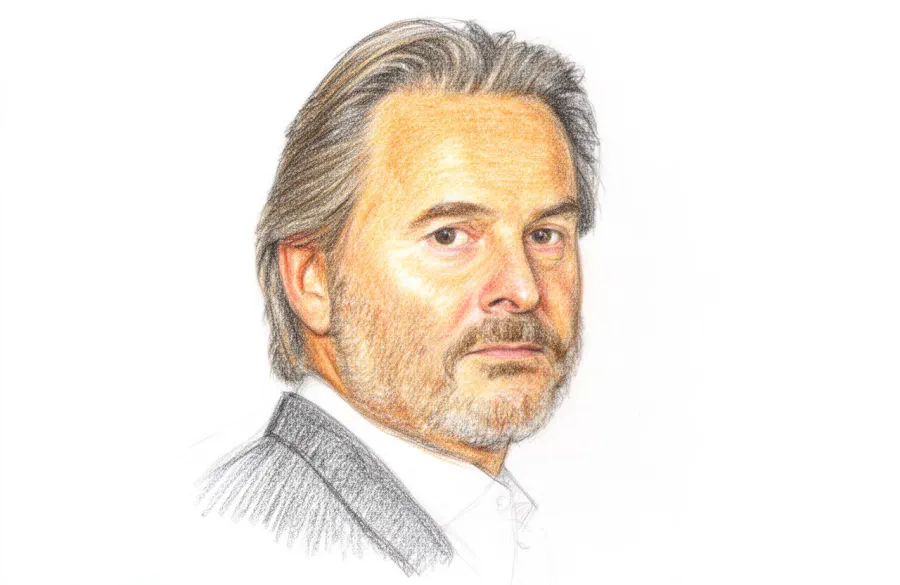
Few actors have changed the course of British crime television simply by refusing to continue. In 1980, after two series of Shoestring had made him an overnight star, Trevor Eve declined a third, worried about being typecast. The same team went on to make Bergerac, the Jersey detective series that ran for a decade with John Nettles in the lead. Nettles, by Eve's account, has never let him forget it: 'I owe my entire career to Trevor Eve. I'm still waiting for him to buy me that pint.'
Two decades later Eve did the opposite with a detective series: he stayed. From the pilot in September 2000 to the final episode in April 2011 he played Detective Superintendent Peter Boyd in all 92 episodes of Waking the Dead, through nine series and eleven years. The two roles bracket the modern era of British crime television: the scruffy private eye of the late seventies and the institutional detective of the noughties.
The roundabout route to Radio West
Eve was born in Sutton Coldfield, on the Warwickshire edge of Birmingham, in 1951, the son of a Welsh mother from Glynneath and an English father. Acting was not the obvious destination. At his boarding school, Bromsgrove School in Worcestershire, which he has said he hated, he took no parts in school plays and excelled instead at cricket; his parents thought him insane for wanting to act. He studied architecture at Kingston Polytechnic for three years before dropping out. 'I was quickly disillusioned, it just wasn't creative.' Wanting to be a director, he found RADA in the Yellow Pages, having never been to the theatre but having caught the bug sneaking into Royal Court plays during the interval. He graduated in 1973, and within a year was playing Paul McCartney in Willy Russell's John, Paul, George, Ringo... and Bert at the Liverpool Everyman, which transferred to the West End, won the Evening Standard and London Critics' awards for best musical and got him noticed.
The patronage that shaped him came from Laurence Olivier. In 1976 Eve won a part in Hindle Wakes, a television play Olivier was directing, and Olivier became a mentor: he advised Eve to 'be bold', sponsored his American green card, and appeared opposite him in John Badham's 1979 Dracula, in which Eve played Jonathan Harker. In Zeffirelli's West End production of Filumena he met the actress Sharon Maughan; they married in 1980.
Shoestring: the hero who might not cope
Shoestring, created by Robert Banks Stewart and developed with Richard Harris, gave Eve the role that defined his persona. Eddie Shoestring is a former computer analyst who has suffered a nervous breakdown (he was institutionalised after destroying electronic equipment) and rebuilt himself as a private investigator in Bristol, fronting a 'Private Ear' phone-in slot on the fictional Radio West and sketching compulsively as therapy. BFI Screenonline called him 'valiant and idealistic, yet strangely vulnerable, almost naïve': a twist on the hard-boiled detective; the BFI judged the scripts 'mainly in the Raymond Chandler style, with clever twists and often bleak or ironic finales'. The series was a huge ratings success, with peak audiences reported at around twenty million, and Eve became, in the BBC's fond recollection, 'the epitome of cool' — half-mast tie, unbuttoned collar.
The scruffy look was his own insistence, against the producer's wishes; the tie, in particular, was a matter of principle. On the first day of shooting he had a stand-up row with the director over whether Eddie's tie should be slimline or 'kipper' style. Eve won. It was the earliest documented instance of the exactness that followed him for the rest of his career. 'He has a certain vulnerability,' he told the Daily Mail in 1980. 'He's not the kind of cool, confident hero who walks into a situation and everyone knows he can cope. With Eddie, you are never sure if he will cope.'
That uncertainty, the detective who might not cope, is the note he has returned to for forty-five years, in Boyd, in the hostage negotiator Dominic King, in the murdered tycoon Jack Wright. Then, at the peak, he left: two series, twenty-one episodes, and he refused a third, alarmed by the prospect of being known as Trevor 'Shoestring' Eve. By then the star was elsewhere: Children of a Lesser God won him the first of his two Olivier Awards, and the eighties took him to Los Angeles, where he made the short-lived ABC series Shadow Chasers while commuting to the London stage, 'the only actor living in Beverly Hills working at the National Theatre', as he put it.
The sleaze specialist
The nineties were where Eve worked out what he was actually good at. In A Sense of Guilt (1990) he played Felix Cramer, a philandering novelist conducting an affair with his best friend's teenage daughter; the series made headlines. In The Politician's Wife (1995), Paula Milne's Channel 4 drama, he was Duncan Matlock, an adulterous minister opposite Juliet Stevenson; the series won a BAFTA, an International Emmy and a Peabody. The Times concluded that since A Sense of Guilt Eve had 'been best when personifying sleaze'. He won his second Olivier Award, for Dr Astrov in Uncle Vanya, in 1997, and played the cruel stepfather Edward Murdstone in the BBC's 1999 David Copperfield, opposite a young Daniel Radcliffe.
The decade also brought him back to crime. Heat of the Sun (1998) cast him as Superintendent Albert Tyburn, a Scotland Yard detective exiled to 1930s Nairobi after shooting an untouchable child killer, investigating murder among the British expatriate set. The three-part Carlton/WGBH co-production, filmed in Zimbabwe, was created by Russell Lewis, later of Endeavour, and Timothy Prager. It is the least remembered of Eve's crime leads, and a telling one: the exiled, rule-breaking officer is the figure he would make his own two years later.
Waking the Dead: eleven years of Boyd
Waking the Dead began with a two-hour pilot in September 2000. Eve played Peter Boyd, head of the Metropolitan Police's cold-case unit: volatile, abrasive, rule-bending, 'part-bully, part-inspiration to his team', as the Independent put it, a man whose obsessive pursuit of old cases was rooted in catastrophe. His teenage son had gone missing on the streets in the 1990s, and Boyd is never allowed to get past it. Barbara Machin's creation did as much as any single series to put the cold-case format at the centre of British television crime, and Eve was the whole of it: all nine series, all 92 episodes, all 46 two-part stories.
'Boyd is a role he created,' said Daniel Percival, who directed episodes of the show. 'He's honed it for almost a decade.' The Guardian's 2007 review billed the pairing as 'Detective Superintendent Peter Boyd (Trevor Eve and his hair), psychological profiler Dr Grace Foley (Sue Johnston and her long suffering)'. At the other end of the ledger, the Herald found the whole performance 'all too studied; an actorly essay in self-analysis, mannered detachment and controlled self-absorption'. The same review hailed him as 'a revelation' as Hughie Green, the game-show host of a 2008 BBC Four biopic. Critics never agreed whether to call the result riveting or mannered.
The series opened with 8.4 million viewers and won an International Emmy in 2004; at one point Eve was reportedly the BBC's highest-paid actor. The end was characteristic: Eve announced the ninth series would be his last, and it was wrapped rather than recast. A proposed budget change, from an even studio-location split to 80/20, meant, he said, it 'just wouldn't be the same'. He has since said the show 'should have ended in 2007'. Sue Johnston, his Grace Foley for all nine series, was more puzzled than he was: 'It was a lovely job. The show gets great audiences, it's sold all over the world and I don't quite get why it's going.' The franchise staggered on without him: a 2018 radio prequel recast Boyd, and a spin-off, The Body Farm, which Eve executive-produced through his own company, lasted one series. John Crace's Guardian send-off remains the best epitaph: 'Once as lean as a shoestring, Eve has become an actor who knows how to fill out a suit.'
Later crime: negotiators, suspects, villains and a corpse
Eve did not take long to find the follow-up. Kidnap and Ransom (ITV, 2011–12) cast him as Dominic King, a former soldier turned hostage negotiator and a deliberate change from the volatile Boyd. He was executive producer through his own company, Projector. King was researched against real negotiators; one, Eve recalled, apologised for keeping her phone on because she was expecting a call from Somali pirates. The Guardian's Sam Wollaston found him in his element: 'Eve is very good at playing the flawed and difficult professional, the maverick taking on the world', and a year later Stuart Jeffries judged him better still. ITV cancelled it in May 2012; the cast included John Hannah, a previous screen Rebus, and Eve's wife.
Lawless (ITV, 2004), a two-part thriller written by Chris Lang early in that writer's career, put him back in uniform as DI John Paxton, a Tyneside detective framed for his own boss's murder. It drew 7.17 million viewers for its opening episode.
It was Lang who gave Eve his best late-career suspect. In the first series of Unforgotten (ITV, 2015) he played Sir Phillip Cross, one of four suspects in the 1976 killing of a teenage boy: a gruff, Alan Sugar-ish tycoon and former East End gangster who had 'bribed his way into the aristocracy'. Reviews of his strand divided: one found it contrived, an academic critic thought he was rarely better, but the casting made its own point: by 2015 Eve had aged into the suspect rather than the detective, and the authority that once bent rules now had something to hide.
The same year he took the unusual step of playing the villain outright. In The Interceptor (BBC One, 2015), Tony Saint's eight-part drama about an undercover HMRC unit, he was Roach, the respectable scaffolding-firm owner who secretly runs a drug empire. 'What I've enjoyed about playing Roach,' he told the BBC, 'is being at the other side of the spectrum — the law is chasing me as opposed to the other way around for the first time in nine years!' After three decades of playing the chaser, he had briefly been the chased.
Lang's third Eve vehicle has him playing the corpse: in I, Jack Wright (U&Alibi, 2025; BBC One, 2026), a six-part whodunnit, the title character, a billionaire property magnate, dies in the first five minutes, his apparent suicide ruled murder, and his will, which disinherits his widow and sons in favour of his granddaughter, ignites an inheritance war. Eve agreed by email, without reading a full script, on Lang's name alone. The casting brief, according to the Times, was for someone who could 'command the screen for a few minutes and then loom menacingly over the action for the remaining six episodes'. A second series was commissioned in March 2026.
Eve never joined the great guest circuit: no Morse, no Midsomer, no Vera, no Silent Witness; his only franchise guest credit is a single American outing in Murder, She Wrote. His one-off crime work was small and carefully chosen: DI Malcolm Iverson in a 1994 Screen One thriller opposite Charlotte Rampling, the manipulative godfather Alex Kyle in An Evil Streak (1999).
The exacting art of being difficult
He is drawn to characters other actors fear: 'I think a lot of people are afraid of playing characters that aren't likeable... Just because someone is a shitbag, it doesn't mean they don't help old ladies across the street.' The Independent once crowned him 'telly's most irresistible bastard' and 'the king of small-screen venality'; the persona is anchored in a 'silkenly condescending baritone' and a physical control that can tip, under stress, into something manic. BFI Screenonline noted the 'occasionally manic quality' in Shoestring, and thirty years later the same coiled energy was Boyd's. He has two Olivier Awards, for Children of a Lesser God and Uncle Vanya, and published a debut novel, Lomita For Ever, in 2019.
The off-screen reputation is part of the story, and he disputes it. He has been called difficult in print since the early eighties; a 2011 Independent profile opened with a row over a theatre seat and berating smokers at a polo match. His account is simpler: 'I upset some people. But I was only difficult because I cared.' He admits it cost him work: 'I regret it hugely, which is why I've kept my mouth shut for ten years', and blames part of it on a feud with one newspaper chain. He also disputes the 2011 reports that he attacked BBC spending on Doctor Who and Top Gear, blaming the critic A.A. Gill for the remarks, while owning the line that the show 'should have ended in 2007'. Lorraine Heggessey, former controller of BBC1, offered the counter-case: 'He's a very intelligent actor... He's meticulous.'
The detective who stayed
Eve's career is a small map of British crime television. His walk-off created Bergerac; the co-creator of Heat of the Sun went on to create Endeavour; Kidnap and Ransom put him opposite an actor who had been Rebus. Chris Lang has written for him across two decades, and his own company, Projector, founded after a 1995 riding accident, executive-produced two crime series. Daughter Alice Eve is an actress; in She's Out of My League (2010) the family played father, mother and daughter on screen.
British crime drama has always known what to do with Trevor Eve: hand him a man with authority, a wound and a capacity for misrule, and leave the rest to him. He left Shoestring and gave John Nettles a career; he stayed with Boyd and gave the cold-case format a decade of primacy; in his mid-seventies he is still the man Chris Lang wants looming over the action. He complained at 29 that journalists called him Trevor 'Shoestring' Eve; at 75 he is philosophical: 'there isn't a day goes by when someone doesn't ask me about it. And that's fabulous.' That is a fair return for caring about the tie.