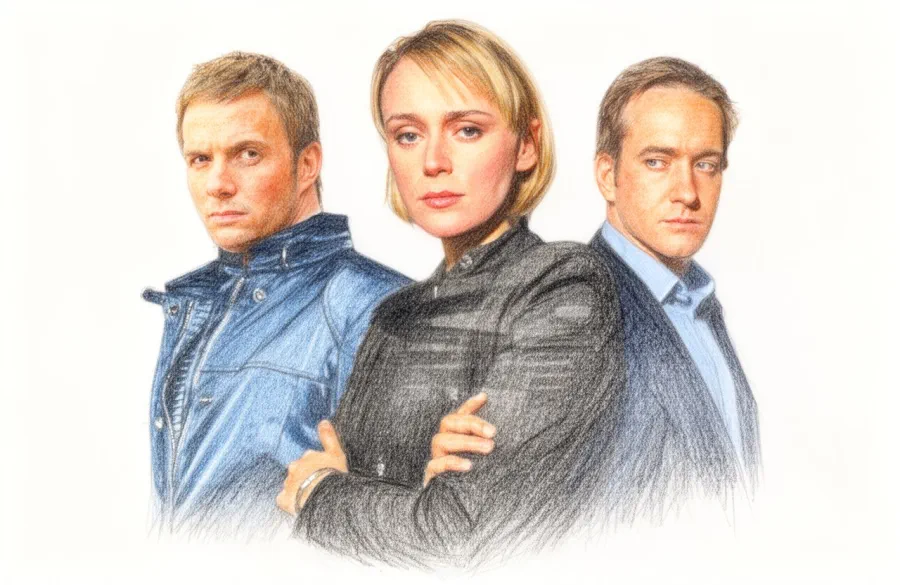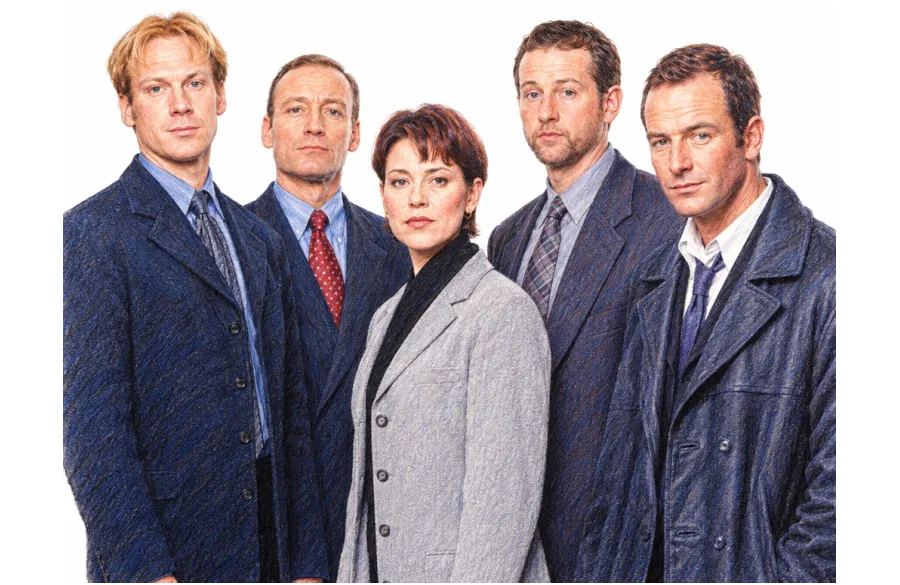
Principal Characters & Performances
Detective Inspector Dave Creegan
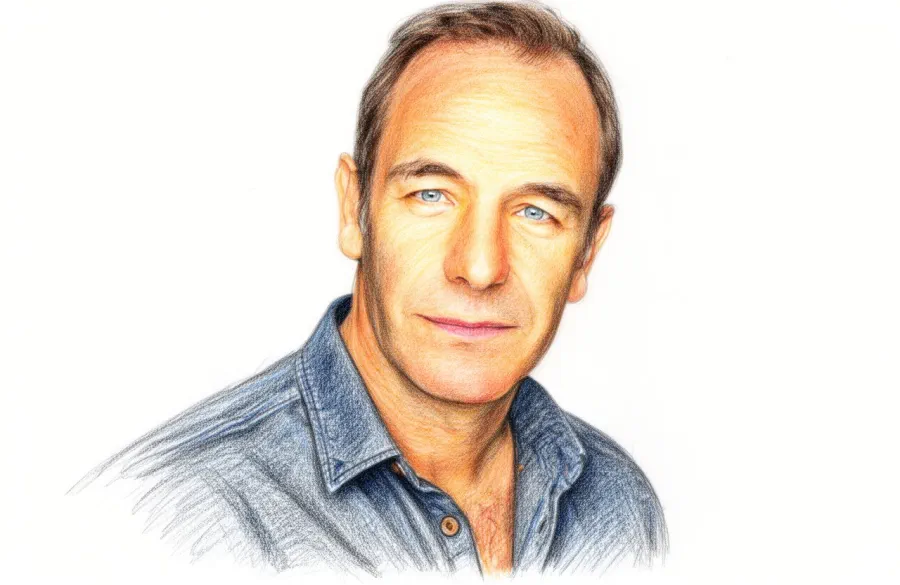
Robson Green plays D.I. Dave Creegan as a man given a second life and no clear idea what to do with it. Shot in the line of duty, he returns to the Organised and Serial Crime Unit with a scar on his forehead and a conviction that his instincts deserve more trust than the evidence does.
It is a performance pitched on the edge, flashes of intuition followed by terrible misjudgements, and a deliberate break from the grinning leading man of Soldier Soldier and Reckless. Green said the series gave him the chance to get away from the clown image audiences associated him with.
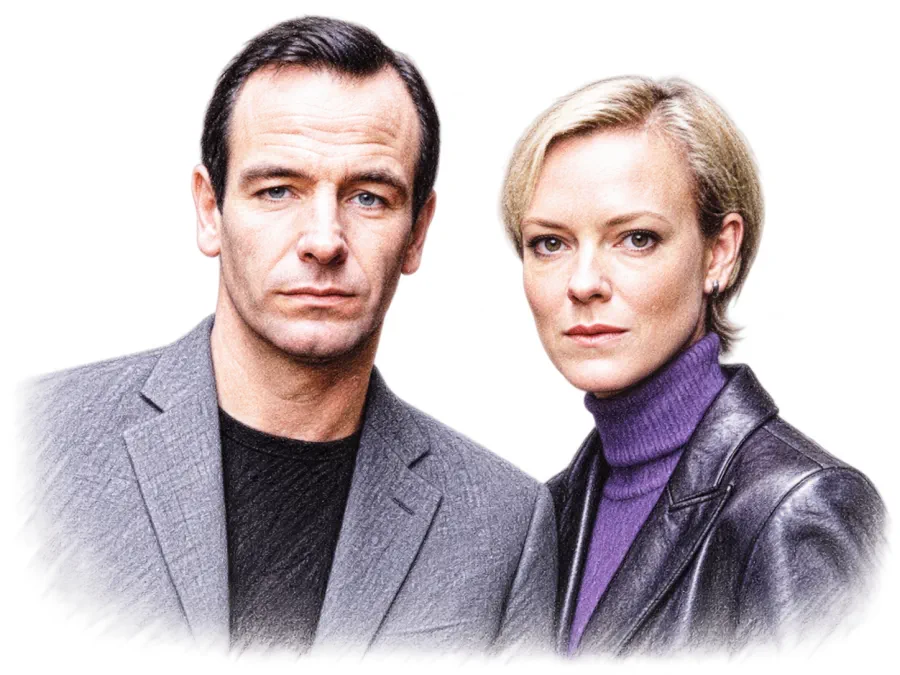
Creegan is the unit’s unorthodox arm and its liability. Paired with D.I. Susan Taylor on his first day, he is the instinct to her procedure, and the series’ central relationship is her insistence on other lines of enquiry against his refusal to look.
The part changed his market position: The Independent reported in 1997 that Green was paid in excess of £30,000 an episode. The critical reaction split: The New York Times found Creegan sympathetic, The Independent saw a familiar maverick.
Across the run the character is dismantled. Series two takes his marriage and then his girlfriend; series three opens with him on sick leave after a nervous breakdown, returns him to Newcastle to overturn a conviction he always doubted, and ends with him risking his life to save a hostage.
Detective Inspector Susan Taylor
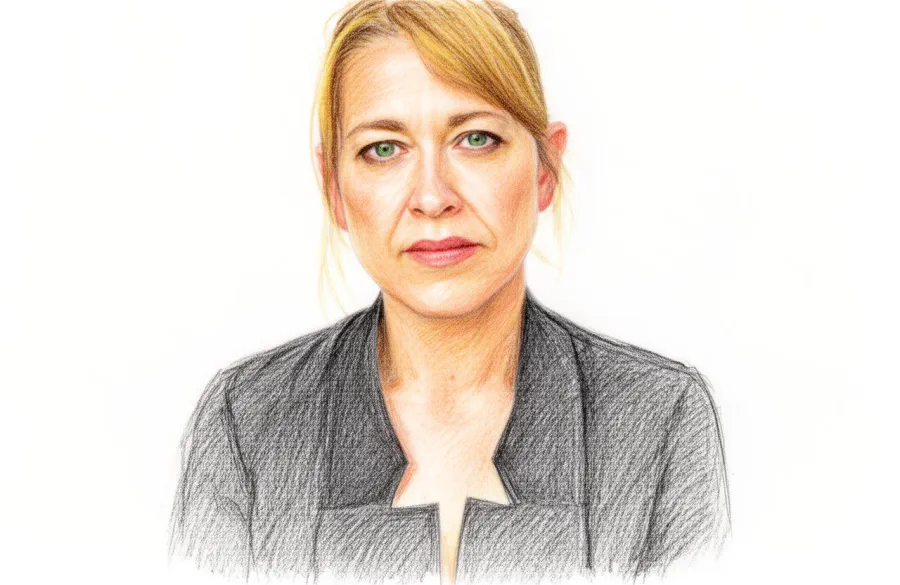
Nicola Walker’s Susan Taylor is Creegan’s equal and the series’ counterweight, blunt where he is intuitive. The New York Times called her a valuable, enigmatic presence, and singled out the line that defines the relationship: when Creegan appears late at night wanting to talk over a case, she tells him to go home and at least pretend to be a normal person.
She carries stories rather than reacting to his: Taylor runs the house-to-house, goes undercover to Romania to recover a trafficked child, and re-arrests a released suspect when Creegan will not. For Walker it was the part that introduced her to a mass ITV audience before Spooks and Unforgotten, and the revival press now presents her as the reason to watch.
Detective Constable Mark Rivers
Shaun Dingwall’s Mark Rivers is the third leg of the unit and the character the series destroys. He hesitates on a stakeout in Scalping and a woman dies; the guilt drives him to shoot the suspect dead; a year later the killer murders him. His death is the series’ one irreversible event.
Dingwall’s later career gives the site a clean connection: he went on to play Pete Tyler in Doctor Who, the series revived by Russell T Davies, who wrote one episode of Touching Evil in 1997.
Notable Support and Guest Stars
The standing ensemble is small and institutional. Michael Feast’s Commander Stephen Enwright is the unit’s commanding officer and its voice of procedure; Mary Cunningham plays the attached police psychologist Marion, who disappears between the second and third series; Adam Kotz’s D.C. Kreitman kills a suspect and is dismissed without charge.
Guest casting is unusually strong for sixteen episodes. Ian McDiarmid plays the suspect in The Lost Boys, James Nesbitt the journalist revealed as the killer in Scalping, and Jill Halfpenny the young mother who becomes Creegan’s lover. Philip Jackson, Claire Rushbrook and Sean Gallagher fill out the earlier stories.
The connections matter to this site. Touching Evil sits between Cracker, whose second series Abbott produced, and Wire in the Blood, which gave Green his next damaged investigator. Walker went on to Spooks and Unforgotten, Dingwall to Doctor Who.
The World of Touching Evil
The series has one institution: the Organised and Serial Crime Unit, a national rapid-response squad staffed by officers seconded from forces across the country, commanded by Enwright, with a psychologist attached. Its patch is the whole of England and Wales, and the office, the incident room and the interview suite are the only recurring sets that matter.
Cases travel. The Lost Boys reaches back to Stuttgart; Killing With Kindness follows a killer into a Welsh hospital; War Relief begins in Bosnia; What Price a Child goes to Romania for a trafficked child. Series three moves the production north, to Newcastle and Northumberland.
That move was real rather than cosmetic: Coastal Productions, Green’s own company, based the final series in his native North East, filming at Blyth and in locations Green associated with Get Carter. The effect is thematic as much as logistical. The series argues that serious crime is dispersed, ordinary and close to home, and its England is post-industrial rather than pastoral.
Origin Story
Touching Evil is an original screenplay, not an adaptation, which places it in the Cracker line of psychology-led ITV crime rather than the Morse and Wexford tradition of adapting novels. Paul Abbott created it at the busiest point of his career: he had produced Cracker’s second series in 1994 and written for its third in 1995, and in 1997 alone he had three serials on air.
Series one was written by Abbott with Russell T Davies, who contributed one episode; the two sequel serials were written by others — Mike Cullen and Sian Orrells in 1998, Tony Etchells and Sian Evans in 1999. Abbott’s departure is documented; his reasons are not, and the research found no interview in which he gives any.
United Productions made it for Anglia Television, the ITV franchise for the East of England, with WGBH Boston joining as American co-producer for the PBS Mystery! screenings. There was no pilot: the serial went straight to transmission on 29 April 1997.
Narrative Style & Tone
The structure is eight two-part stories of fifty minutes each, with a light serialised spine running through them: Creegan’s injury, the unit’s internal politics, the destruction of his family life, and Rivers’ guilt. Cases are largely why-dunnit, and several identify the offender early and spend the second half on the chase and the cost.
Investigations proceed by interview, surveillance, house-to-house and forensic recovery, with psychology as the unit’s preferred instrument and the series’ most unreliable one. A recurring interest is what police do that they cannot write down: a suspect’s dog taken to run a scent, a suspect shot dead.
The look is stylised and photography-led, and it drew criticism at the time: one contemporary review called the slow motion and prowling cars vacuous stylisation, a way of announcing a modern series that the plotting had not earned. Violence is mostly withheld on screen and horrific in conception, and there is no comic relief.
How is Touching Evil remembered?
Contemporary British reviews were hostile. The Independent, reviewing series three, disliked both of the ITV serials that had used the word evil in their titles that fortnight, and complained that the plotting was telegraphed. The American reception was different: The New York Times, reviewing the same episodes for PBS, called it possibly the best Mystery! of all and found it irresistible precisely because it was not warm and fuzzy.
Its notices were respectable rather than triumphant. Touching Evil was nominated for the 1998 BAFTA for Best Drama Series and for RTS awards including Best Actor for Green, and won an RTS Craft and Design award for its editing; Mike Cullen’s Scalping was nominated for an Edgar in 2001.
There is no anniversary canon and no spin-off — only a 2004 American remake that inverted the premise. What has kept the series visible is streaming: series one and two returned to ITVX in the 2020s, packaged around Nicola Walker’s early work, and the run survives on disc as eight stitched-together films.
In Closing
The series is remembered less for its cases than for its cost accounting: what the hunt for serial offenders does to the people who volunteer. Eight stories, no filler, and a cast at a turning point — Green away from his comic persona, Walker on the way to Unforgotten.