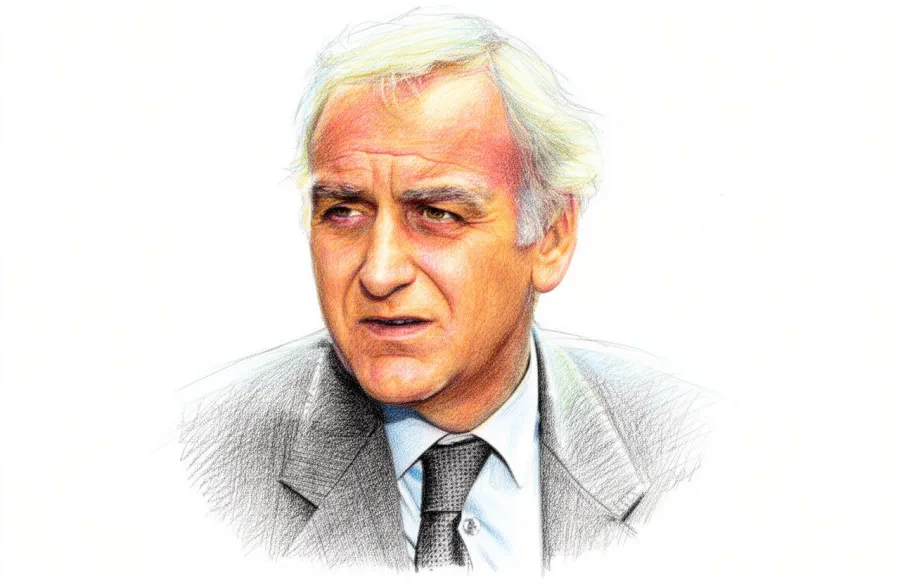
Early Life
John Edward Thaw was born on January 3, 1942, in the working-class district of Gorton, Manchester. His mother, Dorothy, left the family when John was seven. He was raised by his father, Jack, a tool-setter and later a long-distance lorry driver, alongside his younger brother, Ray.
He went to Ducie Technical High School for Boys and left with a single O Level. Acting still pulled at him, and at sixteen he auditioned for the Royal Academy of Dramatic Art (RADA) and got in.
He won the Vanbrugh Award at RADA. The training took him from Manchester to the national stage.
Early Career & First Roles
Thaw’s professional work began in the early 1960s with stage and screen roles. He made his stage debut in 1960 at the Liverpool Playhouse, and in 1962 he shared a stage with Laurence Olivier in ‘Semi-Detached’.
On screen he took a small part in the British New Wave film ‘The Loneliness of the Long Distance Runner’ (1962), and early television work followed on the police series ‘Z-Cars’.
Major Roles
Two characters defined John Thaw’s television career: the rule-breaking detective of the 1970s and the melancholic inspector of the 1980s and 90s.
Detective Chief Inspector Endeavour Morse – Inspector Morse (1987–2000)
In the role of Detective Chief Inspector Endeavour Morse, John Thaw created a character the audience took to heart. Morse was an opera-loving, classic-car-driving, real-ale-quaffing intellectual who worked among the dreaming spires of Oxford, not the backstreets of London.
Thaw built the detective through silence, a steady gaze, and measured speech. Morse’s loneliness, his frustration with the mundane, and his romantic idealism were never stated outright. They came through in how Thaw looked and how he said the lines.
His scenes with his down-to-earth sergeant, Lewis (Kevin Whately), became one of television’s great partnerships, and they showed Morse’s brilliance and his isolation at the same time. The series turned the television detective from a solver of puzzles into a tragic figure.
The show’s success—its cinematography, its baroque musical score, its intricate plots—rested on Thaw’s performance. Inspector Morse ran for 13 years, and the Lewis and Endeavour series carried the character on afterwards.
Detective Inspector Jack Regan – The Sweeney (1974–1978)
Jack Regan was the opposite of Morse. As the hard-drinking, rule-bending Detective Inspector in the Flying Squad (nicknamed "The Sweeney" after the Cockney rhyming slang "Sweeney Todd"), Thaw played a character who broke with the polite image of the TV policeman. Regan was abrasive, violent, and morally ambiguous, a product of 1970s Britain.
Thaw played him without swagger: a working-class cop in a cheap suit, fuelled by anger and a brutal sense of justice. The catchphrase "Shut it!" and the show’s fast, documentary-style car chases and punch-ups caught on with the public, and it was Thaw’s intensity that gave the series its power.
He showed the weariness behind the rage. Alongside Dennis Waterman as Sergeant Carter, Thaw played a partnership built on mutual survival. The Sweeney changed the police procedural and influenced the shows that followed. Thaw’s Regan remains the archetypal "hard man" copper.
Other Notable Work
Morse and Regan were not the whole of it. Thaw first drew attention as Sergeant John Mann in the army drama Redcap (1964-66), and he played the exasperated father Henry Willows in the sitcom Home to Roost.
Later he played the title role in Kavanagh QC, and he kept working on stage, playing historical figures such as Sir Francis Drake.
Acting Style
John Thaw was the opposite of the flashy, instinctive performer. He built characters with precision and quiet control, and he avoided flourish, working through small things instead: a slight shift in gaze, a measured pause, a change in vocal tone.
He worked from the text and the intention behind it, and the result felt lived-in. Whether it was Regan’s rage or Morse’s introspection, he placed every emotion deliberately and trusted silence to do the rest.
Personal Life
Thaw married actress Sheila Hancock on Christmas Eve 1973. He had three daughters, one of them Hancock’s from an earlier marriage.
A committed socialist and lifelong Labour Party supporter, he kept a working-class sensibility in his life and work. He was appointed CBE in 1993. A heavy smoker and drinker, he gave up alcohol in 1995, the year most sources give, though accounts differ. He was diagnosed with oesophageal cancer in June 2001 and died on February 21, 2002. His memorial service at St Martin-in-the-Fields on 4 September 2002 was reported to have drawn 800 people, including Prince Charles.
In closing...
John Thaw shaped modern British television drama through two opposite characters, and he played both of them as people rather than types. Morse and Regan still hold up, and the actors who followed him have been measured against them ever since.