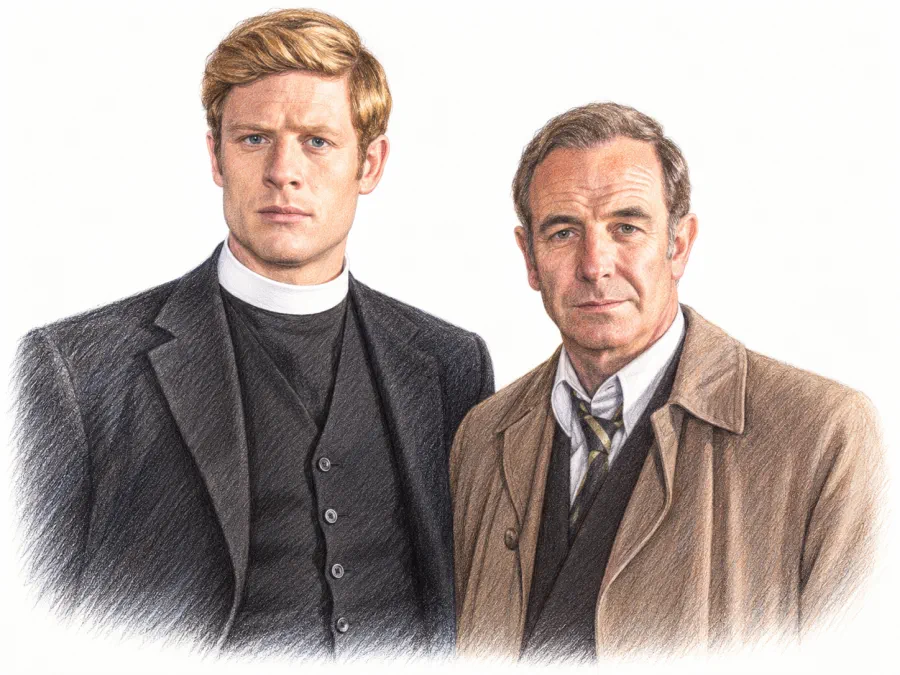
Principal Characters & Performances
Sidney Chambers and Geordie Keating
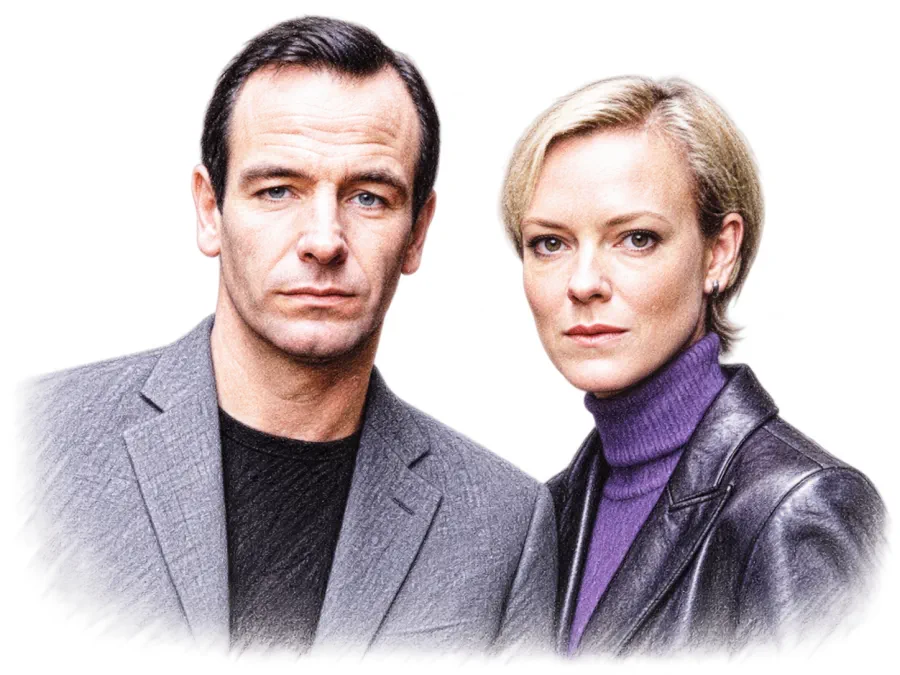
The show is the pairing. Sidney Chambers is an Anglican vicar with a Military Cross from his time as a Scots Guards officer, and Geordie Keating is a police inspector who came home from the war and never stopped working. One gets people to talk by being trusted; the other gets them to talk by being persistent, and the difference between the two methods is the whole engine of the series.
James Norton arrived from Happy Valley, where he had spent a series playing Tommy Lee Royce, 2014’s most hated television character. The Guardian thought a fast change of costume could have sunk the show, and credited Norton’s skill at putting clear daylight between the two men. It also noted that the producers were not shy about their star’s looks: the scythe in the overgrown churchyard, and Dickens the black Labrador puppy.
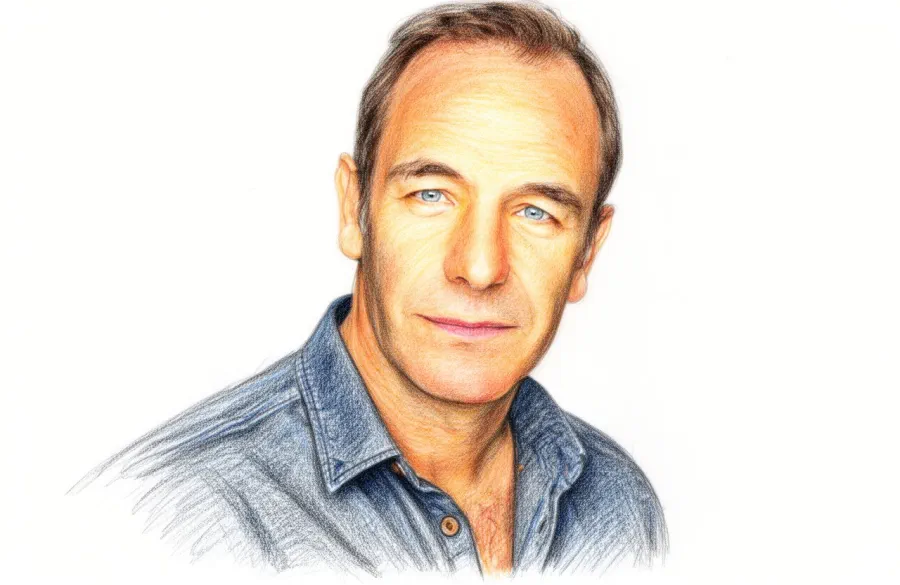
Robson Green is the one constant across all eleven series, and from the third episode of series 4 he took top billing. The bromance carries the show’s emotional weight: an afternoon of beer and backgammon stolen from parish duties, and a copper with no time for church-going who nonetheless needs the vicar. The Guardian’s example was the episode where Geordie’s youngest child falls dangerously ill, which stretched the relationship to breaking point and, in doing so, made it more plausible.
Green gives this site its strongest editorial link. Once Wire in the Blood is written he will lead two of the shows in this batch, and the two parts could hardly be less alike: Tony Hill on the periphery of every institution he touches, Geordie Keating at the centre of his village.
Will Davenport and Alphy Kotteram
Norton wanted to leave after three series, and Morven Christie had already gone when her character’s story concluded, so there was talk of ending the show. It was popular enough that the producers chose to continue with a new lead instead. Norton appears in the first two episodes of series 4 to hand over, Chambers leaves for America at the end of the second, and Tom Brittney takes over from the third as the Rev Will Davenport.
The recast released two actors who had been waiting in the background: Kacey Ainsworth’s Cathy Keating and Oliver Dimsdale’s Daniel Marlowe were given room to expand once the show was no longer built around one vicar’s love life.
There was a second handover, handled the same way. ITV announced in 2023 that series 9 would be Brittney’s last, and Rishi Nair was cast as the Rev Alphy Kotteram, arriving in a series broadcast in January 2025. Sustaining a British crime series through two complete replacements of its protagonist is rare enough that it is the show’s real achievement.
Notable Support and Guest Stars
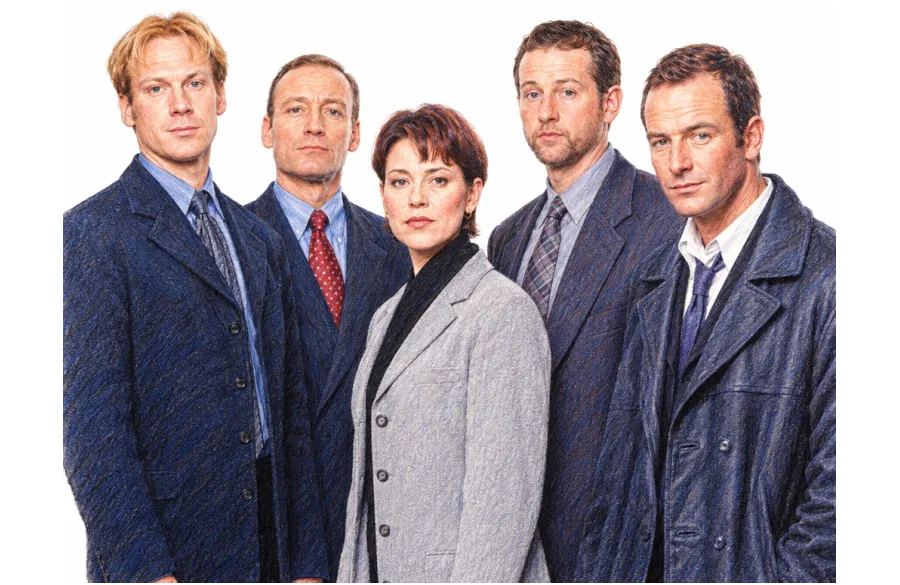
Two parish characters run the entire length of the series. Tessa Peake-Jones plays Sylvia Chapman, the vicarage’s devout housekeeper, who marries Nick Brimble’s retired businessman Jack; Al Weaver plays the curate Leonard Finch, whose homosexuality is the show’s longest social thread — his licence is revoked when he is discovered, and he is imprisoned in a later series, with Ahmed Elhaj’s Henry Jones arriving as a replacement curate in series 6.
Around them there is a substantial recurring bench: Morven Christie as Amanda Hopkins, Sidney’s great romance and an heir who restores paintings at the National Gallery; Bradley Hall as DC Larry Peters; Melissa Johns as the police secretary Jennifer Scott; Charlotte Ritchie as Bonnie Davenport. Stuart Bowman arrives from series 6 as Bishop Aubrey Gray, a role that gives this site a second point of contact with him after Bodyguard.
The World of Grantchester
The village is the set. Grantchester itself is used for filming, with the Church of St Andrew and St Mary for the church interior and churchyard scenes, while the vicarage’s interiors belong to a private house in Lemsford, Hertfordshire. The Red Lion is really the Windmill pub in Chipperfield, and King’s Parade is dressed with period cars and buses for 1950s Cambridge.
The geography is a magpie’s nest of doubles: Horsted Keynes station on the Bluebell Railway for Cambridge station, Chatham Dockyard for London streets, Rotherfield Park in Hampshire for the Davenport manor. The world it lives in is parish, pub, police house and Cambridge college, with the fifth series using Newnham and St John’s.
Social history is the second subject, which keeps the show from being merely decorative. Leonard’s situation is set before the 1967 decriminalisation of male homosexual behaviour and runs on past it, the American civil rights thread carries Simona Brown’s Violet Todd out of the series, and Sidney’s jazz records, with John Lunn’s score underneath, do a lot of the work of telling you who he is.
Origin Story
The source is James Runcie’s The Grantchester Mysteries, written by the son of a former Archbishop of Canterbury. Series 1 adapted the six stories in the first collection, Sidney Chambers and the Shadow of Death, and Daisy Coulam developed the show for television as a Kudos and Masterpiece co-production.
That structure is why the series is an ITV fixture in Britain and a Masterpiece Mystery fixture in the United States, and why it could survive losing its star. Series 1 filmed in London, Cambridge and Grantchester from March to June 2014, with later runs shooting in 2015, 2016, 2018 and 2019.
It was given a planned ending, which is unusual for a show of its length. ITV renewed it for a tenth series in May 2024, that run went out in January 2026, and in July 2025 the network announced the eleventh would be the last, with those final episodes airing on PBS from 14 June to 2 August 2026.
Narrative Style & Tone
Self-contained episodes of 45 to 60 minutes, each built around a murder in or near the parish with a second thread underneath: Leonard’s situation, Cathy’s work, the church hierarchy. The investigation is interviews, confession and village gossip, because a vicar has access a policeman does not.
The tone is deliberately gentle, and the Telegraph described it best: “delightfully neat and economical of plot, it’s Cluedo with cassocks and just enough noir for the modern palate”, before finding the better line, “Victoria sponge with a tablespoon of battery acid”. The Independent called it a treat for anyone who liked Endeavour.
ITV scheduled it on Mondays, which the Guardian found puzzling, since Sunday is period drama’s traditional home; the answer was The X Factor owned the weekend. The first series had a turbulent ratings ride against New Tricks and Gotham before settling, and the Guardian’s verdict stands: “far better than its Sunday evening image might suggest”.
How is Grantchester remembered?
The first episode was well reviewed and the first series holds a Metacritic score of 70 from fourteen reviews. In Britain the audience averaged 6.63 million for series 1 and 6.44 million for series 2, per BARB figures. No awards were traced, and what the show has instead is length: eleven series across twelve years, two complete changes of lead, and an audience that stayed.
It ended by announcement rather than cancellation, the happier version of a British crime drama’s death. Availability is wide for a village detective series: ITVX at home, PBS in the United States, Amazon Prime historically, and a French-language version on France 3 from 2015.
Three legacies are concrete rather than sentimental: it made James Norton a leading man, it kept Robson Green on screen as a crime lead for another decade, and it gave British television a sympathetic, non-tragic gay storyline set before decriminalisation, which the cosy end of the genre had not done before.
In Closing
Eleven series and three vicars, which almost nothing else in British crime drama has managed. Grantchester solved the problem that sinks most gentle period detective shows by putting a believer’s moral framework opposite a policeman’s, then running the 1950s underneath the cosiness where it belongs.