
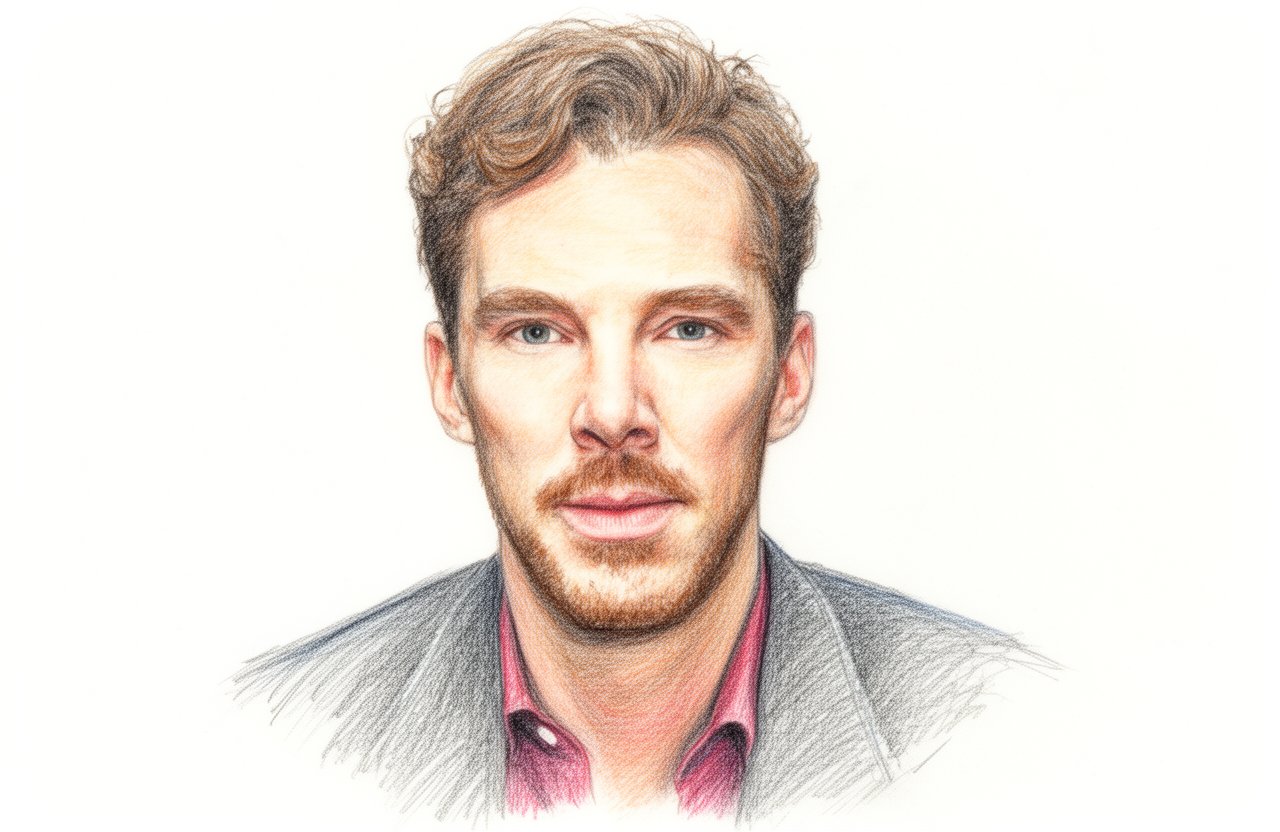
My Critique of Benedict Cumberbatch
Benedict Cumberbatch’s defining strength is an intellectually charged precision that commands complex, cerebral protagonists, from Sherlock Holmes to Patrick Melrose. Yet this very precision can curdle into a brittle mannerism, a clipped vocal tic that risks suggesting a performance more assembled than inhabited.
Positioned against contemporaries like Tom Hiddleston or Michael Fassbender, he is the actor of choice for obsessive, wounded genius rather than loose, mercurial charisma. For the modern viewer, he matters as the pre-eminent conduit for high-end British literary adaptation, elevating prestige projects with global cachet but occasionally flattening rawness into technical polish.
Early Life
Benedict Timothy Carlton Cumberbatch was born on July 19, 1976, in the London borough of Kensington and Chelsea, into a world already steeped in performance. His parents, actors Timothy Carlton and Wanda Ventham, provided a creative backdrop, though they initially cautioned him against the profession’s uncertainties.
He has a half-sister, Tracy Peacock, from his mother’s first marriage.
His path was set early. Educated at Brambletye School and later as an arts scholar at the prestigious Harrow School, he found his calling on the stage.
At just twelve, he made his acting debut as Titania, Queen of the Fairies, in ‘A Midsummer Night’s Dream’. He was an active member of Harrow’s Rattigan Society, the school’s premier dramatic arts club, honing his craft in Shakespearean roles.
Before university, Cumberbatch took a formative gap year, traveling to India to teach English to Tibetan Buddhist monks—an experience that fostered a lifelong affinity for Buddhist philosophy and mindfulness. He then formally pursued acting, studying drama at the University of Manchester before refining his technique with a master’s degree in classical acting from the London Academy of Music and Dramatic Art (LAMDA), an institution he would later lead as President in 2018.
Early Career & First Roles
Cumberbatch’s professional journey began, fittingly, in classical theatre with two seasons at the New Shakespeare Company in London’s Regent’s Park. His early screen work in the early 2000s saw him taking supporting roles in series like ‘Tipping the Velvet’, ‘Silent Witness’, and ‘Fortysomething’.
A significant breakthrough arrived in 2004 with his first lead television role, portraying the brilliant physicist Stephen Hawking in the BBC biopic ‘Hawking’. His sensitive and physically committed performance earned him a BAFTA TV Award nomination for Best Actor, signaling the arrival of a serious talent.
This was followed by a notable turn as Edmund Talbot in the BBC miniseries ‘To the Ends of the Earth’.
His film career began in earnest with roles in ‘Amazing Grace’ (2006) as William Pitt the Younger and ‘Starter for 10’ (2006). A pivotal moment came in 2007 with his chilling portrayal of the cynical chocolatier Paul Marshall in ‘Atonement’, a performance of such memorable arrogance it directly caught the attention of producers who would later cast him in a career-defining role.
Major Roles
Benedict Cumberbatch’s career is a masterclass in range, moving seamlessly from cerebral modern detectives to tortured aristocrats, historical titans, and superhero sorcerers. For the discerning mystery and crime aficionado, his work offers a rich tapestry of complex characterizations, often centered on brilliant, isolated minds navigating moral and existential puzzles.
Sherlock Holmes in ‘Sherlock’ (2010–2017)
It is not hyperbole to state that Benedict Cumberbatch, alongside co-creators Steven Moffat and Mark Gatiss, redefined the modern detective for a generation. His portrayal of Sherlock Holmes in the BBC’s ‘Sherlock’ was a seismic cultural event.
This was not the pipe-smoking, deerstalker-clad Victorian of pure nostalgia, but a “high-functioning sociopath” thrust into 21st-century London, using texts, blogs, and a smartphone as deftly as a magnifying glass.
Cumberbatch’s genius lay in making this technological wizardry and blistering deductive speed feel organic to a timeless character. He captured Holmes’s legendary intellectual arrogance and impatience with stunning precision, delivering rapid-fire deductions with a machine-gun cadence that became iconic.
Yet, beneath the cold, vibrating intellect, Cumberbatch expertly charted a slow, grudging, and deeply moving evolution towards human connection, primarily with Martin Freeman’s perfectly pitched Dr. John Watson.
He physicalized Holmes’s restless genius—pressing his fingertips together in thought, pacing like a caged predator, or lying perfectly still on the sofa in boredom. The performance was a compelling study in contrast: glacial logic occasionally shattered by volcanic emotion, misanthropic isolation battling a latent, unacknowledged need for friendship.
For mystery lovers, Cumberbatch’s Sherlock became the new benchmark, a performance so complete and authoritative that it influenced public perception of the character itself. It was a defining role that made him a global star and demonstrated how a classic could be thrillingly reinvented without losing its essential soul.
Patrick Melrose in ‘Patrick Melrose’ (2018)
If Sherlock showcased intellectual mastery, the 2018 miniseries ‘Patrick Melrose’ revealed Cumberbatch’s staggering capacity for emotional and physical endurance. In this tour-de-force adaptation of Edward St.
Aubyn’s semi-autobiographical novels, he portrayed the titular aristocrat across decades, grappling with the horrific childhood abuse inflicted by his father and the subsequent decades of drug addiction, self-loathing, and attempted recovery.
Cumberbatch delivered a performance of raw, unflinching vulnerability. He navigated the tonal extremes of St.
Aubyn’s writing with breathtaking skill: the pitch-black, whip-smart satire of upper-class mores, the harrowing realism of heroin addiction and withdrawal, and the profound, aching sadness of a man trying to piece together a self from the ruins of his past. His embodiment of Melrose’s drug-fueled paranoia in the first episode was both terrifying and darkly comic, a virtuoso display of physical decay and mental fragmentation.
As the series progressed, he peeled back the layers of addiction to expose the wounded, intelligent man beneath, grappling with inherited trauma and the ghost of his monstrous father. It was a monumental acting achievement that laid bare every nerve ending, earning him a BAFTA TV Award and an Emmy nomination.
For audiences accustomed to his more controlled, intellectual roles, ‘Patrick Melrose’ was a potent reminder of his profound depth and fearless commitment to psychological truth.
Other Notable Work
Cumberbatch’s gallery of remarkable characters extends far beyond these pillars. He delivered a brilliantly malevolent and physically transformative performance as the dragon Smaug in Peter Jackson’s ‘The Hobbit’ trilogy, his voice dripping with ancient greed and malice.
In the Marvel Cinematic Universe, he brought a sardonic wit and mystical gravitas to Doctor Stephen Strange, masterfully charting the character’s arc from arrogant neurosurgeon to humble Sorcerer Supreme.
He received an Academy Award nomination for his poignant portrayal of the enigmatic codebreaker Alan Turing in ‘The Imitation Game’ (2014). He was chillingly charismatic as the villain Khan in ‘Star Trek Into Darkness’ (2013), and delivered a quietly powerful supporting turn as the loyal Peter Guillam in ‘Tinker Tailor Soldier Spy’ (2011).
More recently, he earned another Oscar nomination for his repressed, cruel rancher Phil Burbank in Jane Campion’s ‘The Power of the Dog’ (2021), a performance of simmering, toxic masculinity that showcased his continued evolution as a film actor.
Acting Style
Cumberbatch’s approach to acting is one of deep intellectual excavation and empathetic construction. He is known for his meticulous preparation, immersing himself in the psychology, history, and physicality of his characters to build fully realized individuals from the inside out.
He believes profoundly in the connection between external gesture and internal state, often altering his voice, posture, and movement patterns to fundamentally change how he, and thus the character, feels.
His technique prioritizes subtlety and emotional honesty over grand theatricality. He is a master of the micro-expression and the loaded pause, understanding that the most powerful moments often live in what is unspoken.
He has described acting as “an exploration—a constant discovery of new ways to express the human condition,” and values collaboration deeply, viewing listening as one of an actor’s most crucial skills. This results in performances that feel authentically inhabited, whether he is portraying a genius detective, a tortured addict, or a mythical beast.
Personal Life
Cumberbatch is fiercely protective of his private life. He was in a long-term relationship with actress Olivia Poulet for twelve years before their separation in 2010.
In 2015, he married theatre director and opera singer Sophie Hunter. The couple have two sons together and maintain a family life largely away from the spotlight in London.
His personal philosophy has been shaped by his early experiences, including a harrowing incident in 2005 when he and two friends were briefly abducted at gunpoint in South Africa, an event he credits with teaching him to embrace life. The mindfulness practices he explored during his gap year in India continue to inform his outlook.
Beyond acting, he is a committed philanthropist, supporting numerous charities, and in 2018 he assumed the role of President of his alma mater, LAMDA, guiding the next generation of performers.
In closing…
Benedict Cumberbatch stands as one of the most distinguished and versatile actors of his generation. From redefining the world’s most famous detective to plumbing the darkest depths of the human psyche, he consistently chooses challenging, complex roles and meets them with unparalleled intelligence, technical skill, and emotional courage.
For lovers of mystery, character, and sheer acting craft, his body of work offers a rewarding and endlessly fascinating journey. He is not merely a star but a serious artist, whose continued evolution promises further extraordinary performances for years to come.