
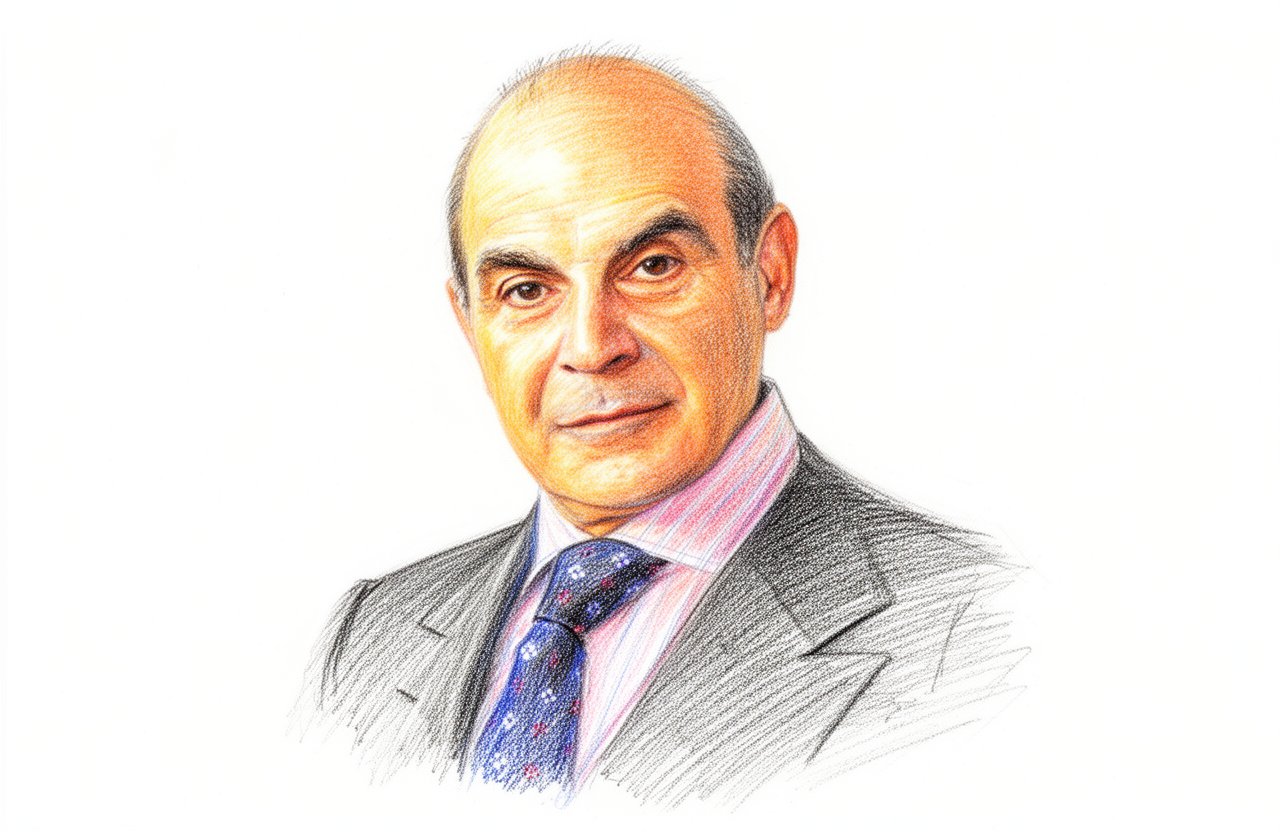
My Critique of David Suchet
David Suchet’s defining achievement, his Hercule Poirot, set a technical benchmark for literary adaptation. His meticulous character immersion yielded a performance of startling precision, yet this very success forged a gilded cage.
Compared to peers like Robin Ellis or John Hurt, Suchet achieved franchise iconography but at the cost of dramatic range, his later television work often measured against an impossible standard. For the modern viewer, he remains essential viewing, a masterclass in persona construction whose career exemplifies the reward and peril of ultimate identification.
Early Life
David Suchet was born on May 2, 1946, in Paddington, London, into a family where artistry and intellect intertwined. His father, Jack Suchet, was a South African-born obstetrician of Lithuanian-Jewish descent, while his mother, Joan Patricia Jarché, was an English actress with Russian-Jewish and English Anglican roots.
This blend of medical precision and theatrical flair would later become a hallmark of his own work.
He was the middle of three brothers, with John and Peter both forging careers in broadcast journalism. Education at Grenham House boarding school and Wellington School in Somerset provided structure, but it was at age 16, upon joining the National Youth Theatre, that his true calling sparked to life.
He honed his craft formally at the London Academy of Music and Dramatic Art (LAMDA), an institution he would later serve as Vice President.
Though raised without strong religious doctrine, a personal spiritual journey would lead him to become a practising Anglican in 1986. His heritage, from his paternal grandfather in Kretinga to his maternal grandfather, the famed Fleet Street photographer James Jarché, gifted him a rich, multifaceted perspective on character and human story.
Early Career & First Roles
Suchet’s professional journey began in 1969 at the Gateway Theatre in Chester, immersing himself in the demanding world of regional repertory across Worthing, Birmingham, Coventry, and Liverpool. This rigorous apprenticeship forged a formidable stage actor.
By 1973, he had earned a place with the prestigious Royal Shakespeare Company, tackling classical roles like Bolingbroke in ‘Richard II’.
His early screen work showcased his chameleonic range, from a bigfoot hunter in ‘Harry and the Hendersons’ (1987) to the intense drama of ‘Oleanna’ on the London stage in 1993. These years were a masterclass in building a character from the ground up, a skill he would deploy to legendary effect.
Major Roles
Hercule Poirot in ‘Agatha Christie’s Poirot‘ (1989-2013)
To say David Suchet played Hercule Poirot is to understate a quarter-century of meticulous, transformative artistry. His portrayal from 1989 to 2013 is not merely a performance; it is the definitive embodiment of Agatha Christie’s fastidious Belgian detective, a cultural touchstone that has shaped the visual and emotional language of the character for generations.
For the discerning mystery aficionado, Suchet’s Poirot is the benchmark.
Suchet approached the role not as an impersonation but as a complete psychological and physical reconstruction. He famously compiled a 92-page dossier on Poirot’s traits, mined directly from Christie’s texts, noting everything from his precise walking speed to the number of sugar cubes in his coffee.
This forensic preparation birthed a creation of astonishing consistency and depth—the fastidious walk, the trademark moustaches (which Suchet insisted be exactly as described, “stiff and military”), the delicate, precise gestures, and the subtly authentic Belgian-accented English.
What elevates Suchet’s interpretation from excellent to iconic is the profound humanity and moral complexity he gradually revealed. Over 70 episodes and 13 series, he charted Poirot’s arc from a somewhat vain, confident problem-solver in the sun-dappled 1930s to a weary, spiritually troubled man in the grim post-war years.
Suchet allowed us to see the loneliness beneath the brilliance, the Catholic guilt wrestling with his role as an avenging angel, and the deep, often melancholic compassion for the human condition laid bare by murder.
His final episodes, particularly ‘Curtain: Poirot’s Last Case’, stand as a masterclass in tragic closure. Here was a detective facing his own mortality and moral limits, portrayed with a devastating, quiet power that transcended the genre.
It was a farewell that felt earned and profoundly moving, cementing the series not just as entertainment, but as a seminal work of character drama. For ACOC readers, Suchet’s Poirot is the absolute zenith of detective portraiture—a masterpiece of detail, intelligence, and emotional truth.
Augustus Melmotte in ‘The Way We Live Now’ (2001)
If Poirot showcased Suchet’s genius for sympathetic precision, his BAFTA-nominated turn as Augustus Melmotte in the 2001 BBC adaptation of Trollope’s ‘The Way We Live Now’ was a thunderous display of monstrous complexity. Melmotte, a mysterious European financier invading Victorian London’s high society, is a gargantuan figure of greed, fraud, and desperate aspiration—a character Suchet inhabited with terrifying, Shakespearean force.
Suchet’s Melmotte was a monumental study in contradiction—externally a bull-like force of nature, all bluster and dominating presence, yet internally a seething cauldron of paranoia, insecurity, and volcanic rage. He captured the character’s profound vulgarity and his pathetic, almost childlike desire for acceptance by the aristocracy that secretly despised him.
The performance was a physical transformation, with Suchet employing a lumbering gait and a voice that could shift from a manipulative whisper to a roar of wounded pride.
In a narrative acutely relevant to modern corporate scandals, Suchet never reduced Melmotte to a simple villain. He exposed the raw nerve of the outsider, the tragic pathos of a man whose entire identity is a constructed facade.
It was a commanding, compelling performance that rightly won him both RTS and Broadcasting Press Guild awards, proving his prowess extended far beyond the confines of Baker Street into the realm of classic literary anti-heroes.
Other Notable Work
Suchet’s gallery of characters is a testament to his extraordinary range. He brought a quiet, intellectual intensity to historical figures like **Edward Teller** in ‘Oppenheimer’ (1980) and a pioneering, nuanced gravity to **Sigmund Freud** in the 1984 series ‘Freud’.
His stage work is equally distinguished, including a celebrated Broadway run as the envious **Salieri** in ‘Amadeus’ and a powerful performance in ‘The Last Confession’.
For mystery and crime fans, his supporting roles are gems: the dogged **Inspector Japp** in ‘Thirteen at Dinner’ (1985), a chilling **Robert Maxwell** in the 2007 biopic, and memorable guest spots in everything from ‘The Bank Job’ to an eerily perfect **Landlord** in ‘Doctor Who’. Each role, no matter the size, is treated with the same rigorous commitment to authenticity.
Acting Style
David Suchet’s acting methodology is the foundation of his iconic status. He is the consummate character archaeologist, a performer for whom preparation is a sacred process.
His approach is less about “becoming” a character and more about constructing one from the inside out, brick by meticulous brick. This involves deep textual analysis, historical research, and the creation of detailed biographical backstories, even for roles where such notes never reach the screen.
This process manifests in performances of remarkable physical and vocal specificity. He masterfully uses posture, gait, and gesture to externalize internal states, from Poirot’s fastidious prissiness to Melmotte’s aggressive bulk.
Vocally, he is a virtuoso, crafting distinct accents and rhythms that feel organically tied to a character’s psychology. The result is a transformative quality where the actor himself seems to disappear, leaving only the fully realized, utterly believable person in his place.
It is a style rooted in profound respect for the audience and the craft.
Personal Life
Away from the camera and stage, David Suchet leads a life grounded in family and faith. He has been married to actress Sheila Ferris since 1976, and they have two children: Robert, a captain in the Royal Marines, and Katherine, a physiotherapist.
His conversion to Anglicanism in 1986 and subsequent confirmation in 2006 is a central pillar of his life, a journey he has discussed with thoughtful openness, noting how it provides a moral framework that influences his choice of roles.
His personal passions reflect his artistic heritage and curiosity. An avid photographer, he channels the legacy of his grandfather, James Jarché.
He is also a musician who plays clarinet and drums. For many years, he made his home in Pinner, Greater London, and has been a dedicated supporter of various charitable causes.
This blend of the spiritual, the artistic, and the familial paints a picture of a man whose depth off-screen fully matches the depth he brings to his work.
In closing…
David Suchet stands as a colossus of his craft, an actor whose name is synonymous with integrity, transformation, and iconic characterization. For lovers of mystery and beyond, his legacy is secured by the masterpiece that is his Hercule Poirot—a performance that defined a character for all time.
Yet, to view him only through that lens is to miss the breathtaking scope of a career built on relentless curiosity and peerless skill. He is the definitive example of an actor who serves the story, honors the character, and in doing so, creates enduring art.
A true master, and a permanent fixture in the pantheon of greats.