My Critique of Edward Hardwicke
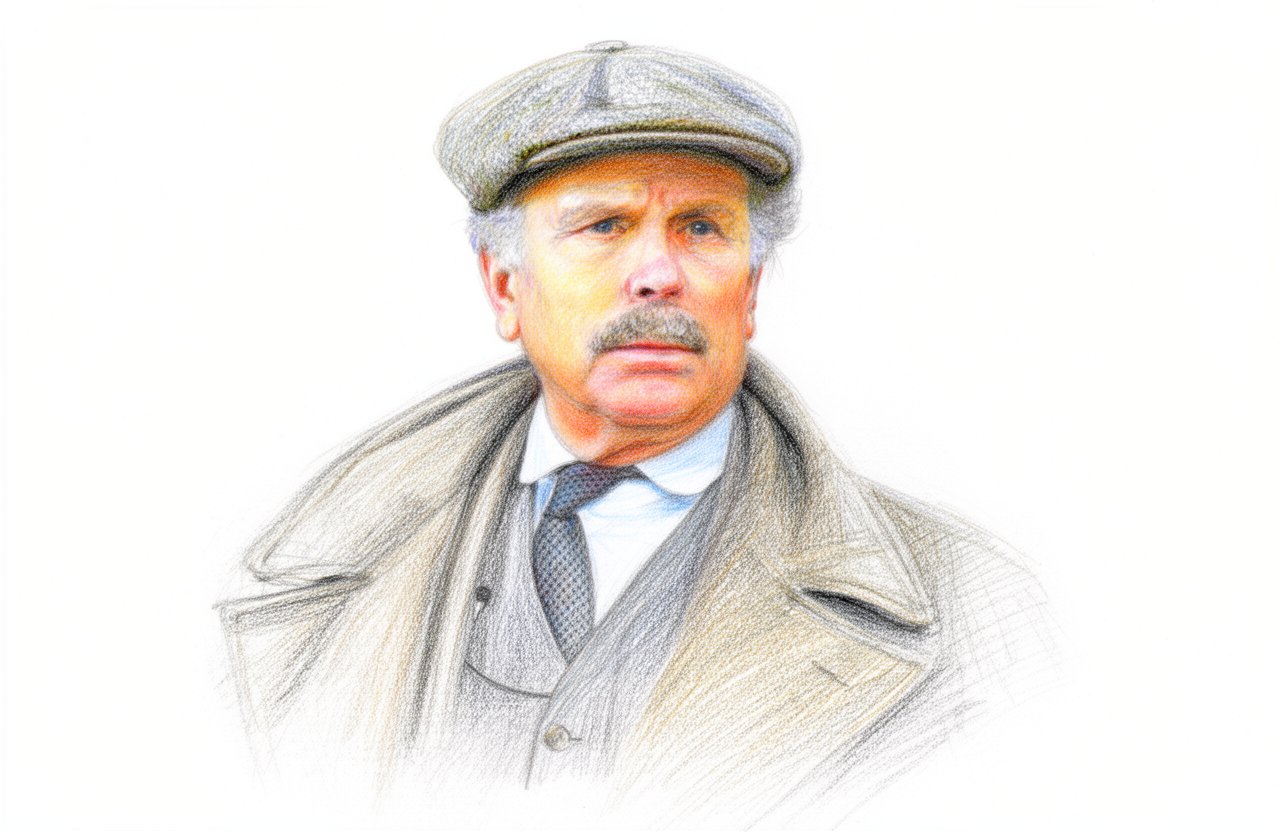
As the definitive Dr. Watson for a generation, his performance provided a necessary anchor of human warmth to Jeremy Brett’s mercurial Holmes.
His solidity and innate authenticity created a character of quiet dignity. This strength, however, also defined a career of capable support, a constraint that kept him from the flamboyant star power of his contemporaries.
For the modern viewer, his work remains the essential blueprint for the grounded companion. He proves that true dramatic power lies in restraint, ensuring his legacy is not merely one of service, but of irreplaceable presence.
Early Life
Edward Hardwicke was born into theatrical royalty on August 7, 1932, in London. His father was the distinguished actor Sir Cedric Hardwicke, and his mother was actress Helena Pickard.
This lineage placed him at the heart of British stage and screen from the very beginning, with actor Ralph Richardson serving as his godfather.
His own journey before the cameras began extraordinarily early, with a film debut at age ten in Victor Fleming’s ‘A Guy Named Joe’ (1943). After an education at Stowe School, he answered the call of national service, serving as a pilot officer in the Royal Air Force from 1951 to 1952.
Determined to forge his own path, he formally studied his craft at the Royal Academy of Dramatic Art (RADA). There, and in the vibrant theatrical world of post-war London, he developed formative friendships with fellow students who would become legends: Albert Finney, Anthony Hopkins, and Peter O’Toole.
Early Career & First Roles
After his childhood debut, Hardwicke returned to professional acting in 1954. He cut his teeth in films like ‘Hell Below Zero’ and honed his stagecraft during a vital tenure at the Bristol Old Vic from 1954 to 1957, even sharing a flat with his friend Peter O’Toole during this period.
The following decades saw him build a solid, reliable career across mediums. He appeared in Laurence Olivier’s ‘Othello’ (1965), played Dr.
Astrov in Chekhov’s ‘Uncle Vanya’, and took on television work including a role in the gritty police drama ‘The Sweeney’. He was a versatile and steadily working actor, well-respected within the industry.
Major Roles
Dr. John H. Watson in ‘Sherlock Holmes’ (Granada Television, 1986-1994)
For a generation of mystery enthusiasts, Edward Hardwicke is, definitively, Dr. Watson.
He inherited the role from David Burke in Granada Television’s seminal series starring Jeremy Brett as Sherlock Holmes. What followed was not merely a recasting, but the crystallization of one of fiction’s most beloved partnerships.
Hardwicke’s Watson became the standard against which all others are measured, a performance of such quiet integrity that it forever redefined the character.
Gone was the bumbling caricature; in his place was a man of intelligence, courage, and profound decency. Hardwicke portrayed Watson as a competent former army surgeon, a solid professional in his own right, whose steadfast loyalty was a choice, not a default.
His calm, attentive presence provided the essential ballast to Brett’s mercurial, electrically intense Holmes.
This Watson was the perfect companion—not a follower, but a partner. He was the empathetic human conduit for the audience, his reactions of wonder, concern, or exasperated friendship making Holmes’s genius accessible.
Hardwicke mastered the art of listening, his face a canvas of thoughtful consideration. When he did challenge Holmes, it was with a firm, principled dignity that commanded respect from both the detective and the viewer.
The chemistry between Hardwicke and Brett was the series’ bedrock. It felt less like acting and more like witnessing a profound, if occasionally fractious, friendship.
Hardwicke’s portrayal emphasized Watson’s crucial role as Holmes’s moral compass and emotional anchor, especially as Brett’s health declined in later episodes. His performance ensured Watson was never in the great detective’s shadow, but standing faithfully beside him, an equal in spirit.
It is a masterful, career-defining achievement in character acting.
Captain Pat Grant in ‘Colditz’ (BBC, 1972-1974)
Before Baker Street, Hardwicke delivered another memorable and nuanced performance in the acclaimed BBC drama ‘Colditz’. As Captain Pat Grant, he was part of the ensemble depicting Allied officers imprisoned in the infamous German POW camp, Colditz Castle.
The series was distinguished by its psychological realism and avoidance of jingoistic cliché, focusing on the tensions, camaraderie, and relentless pressure of captivity.
Hardwicke’s Grant was a quintessential British officer—reserved, resourceful, and determined. The role allowed him to explore a different kind of steadfastness under pressure.
It was not the supportive loyalty of Watson, but the grim, dogged perseverance of a soldier committed to the duty of escape. His performance was a compelling study in controlled tension, portraying a man who internalizes stress while outwardly maintaining the disciplined facade required for leadership and survival.
In ‘Colditz’, Hardwicke demonstrated his exceptional ability to hold the screen without overt theatrics. He was a pillar of the ensemble, his quiet authority and believable military bearing lending the series significant credibility.
This role solidified his reputation as a dependable and compelling actor capable of carrying substantial weight in a serious, adult drama, proving his range long before he donned the deerstalker’s companion’s tweeds.
Other Notable Work
Hardwicke’s filmography is a testament to his versatility and the high regard in which he was held by directors. He brought gravitas to Roman Polanski’s ‘Oliver Twist’ (2005) as the benevolent Mr.
Brownlow. For television, he delivered a poignant performance as Warnie Lewis, C.S.
Lewis’s brother, in ‘Shadowlands’ (1993), and appeared in classic series like ‘Lovejoy’ and ‘Agatha Christie’s Poirot’.
One of his most striking early television roles was as Judas Iscariot in Dennis Potter’s radical passion play ‘Son of Man’ (1969), showcasing his willingness to tackle complex, challenging material. From the harrowing miniseries ‘Holocaust’ (1978) to a late-career appearance in ‘Shameless’ (2010), his career was marked by consistent quality and a captivating, trustworthy presence.
Acting Style
Edward Hardwicke’s acting style was the epitome of refined, naturalistic craftsmanship. He possessed an extraordinary economy of expression, achieving profound effects through subtlety rather than force.
His strength lay in reaction, in listening, and in conveying deep thought and feeling through a glance, a pause, or a slight shift in demeanor.
He specialized in portraying decency and intelligence without ever seeming bland or passive. There was always a warmth and a keen mind at work behind his eyes.
This made him the ideal foil for more flamboyant performers, as evidenced perfectly with Jeremy Brett. He grounded every scene with authenticity, his presence feeling less like an performance and more like an invitation to observe a real, fully-formed person.
Critics often spoke of his “innate” ability, a credit to both his heritage and his disciplined technique. He avoided actorly tricks, instead building characters from a foundation of psychological truth and emotional honesty.
Whether as a military officer, a Victorian doctor, or a kindly gentleman, his performances were unified by a core of integrity, making every character he played inherently believable and worthy of the audience’s trust.
Personal Life
Edward Hardwicke’s life away from the set was one of quiet contentment and enduring relationships. He was married twice: first to Anne Iddon in 1957, with whom he had two daughters, Kate and Emma (the latter following him into acting).
Following their divorce, he found lasting happiness with Prim Cotton, whom he married in 1994 and remained with until his death.
In his later years, he enjoyed a peaceful life in Chichester, West Sussex. He was known to relish long walks with his dogs and the simple pleasure of Sunday lunches with close friends.
His deep connection to the theatrical community was reflected in his role as a trustee of the Ralph and Meriel Richardson Foundation, established in honor of his godfather, which supports actors in need.
Edward Hardwicke died of cancer on May 16, 2011, in a hospice in Chichester. He is remembered not only for his distinguished career but as a gentleman of the old school—kind, professional, and deeply respected by all who knew him.
In closing…
Edward Hardwicke’s legacy is that of the consummate professional and the perfect companion. He never sought the spotlight’s brightest glare, yet he illuminated every scene he was in with understated brilliance.
For mystery fans, he gifted us with the definitive Dr. Watson, a portrayal that forever enriched our understanding of Arthur Conan Doyle’s stories.
His career stands as a masterclass in supportive acting, proving that strength often resides in calm assurance, not loud declaration. He was the steady hand, the reliable presence, and the empathetic heart—both on screen and, by all accounts, off it.
Edward Hardwicke was, quite simply, the man you wanted by your side.