
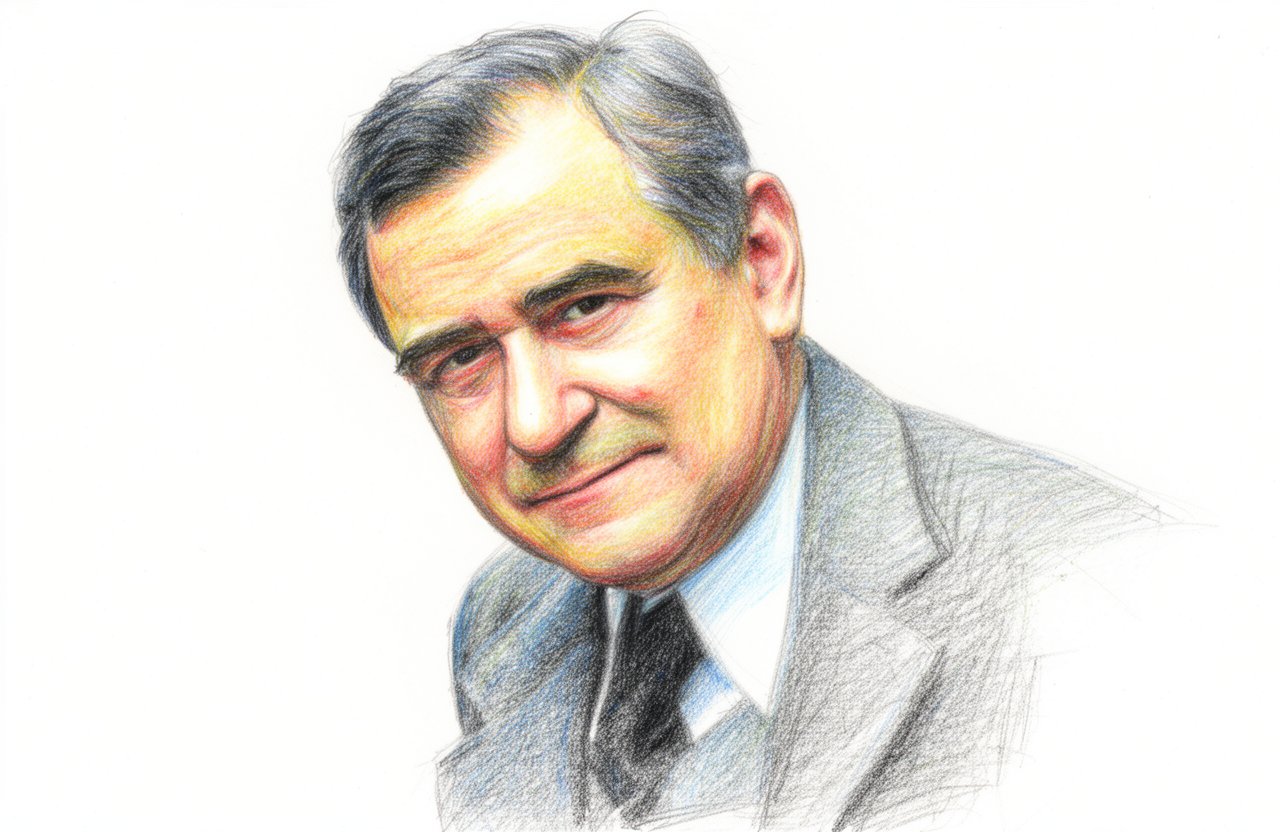
My Critique of George Baker
George Baker’s authoritative vocal command and classical poise secured his place in British drama, yet the shadow of his defining role often obscured his broader theatricality. His Tiberius in ‘I, Claudius’ remains a formidable study of imperial decay, yet in television’s memory he is permanently tethered to the affable Reg Wexford.
Where peers such as John Thaw or David Suchet explored grittier, psychological terrain, Baker’s performance often felt more equable than incisive. For modern viewers, his work offers a valuable document of a certain school of British acting, polished and resolute, but perhaps lacking the disruptive spark that makes contemporary crime drama truly essential.
Early Life
George Baker’s story begins not in the heart of England, but on the shores of the Black Sea. He was born on April 1, 1931, in Varna, Bulgaria, into a life of international diplomacy and service.
His father was an English businessman who served as honorary vice consul, while his mother was an Irish Red Cross nurse. This cosmopolitan beginning was soon overshadowed by the gathering clouds of war.
As World War II intensified, the family relocated to the safety of England. Baker’s education continued at Lancing College in Sussex, where the first sparks of his interest in acting were kindled.
His path, however, first led him to national service. He joined the 3rd Royal Tank Regiment and was posted to Hong Kong, a long way from the Sussex Downs.
His military career was cut short by illness, leading to a period of convalescence and completion of his service in the quieter landscapes of Pembrokeshire, Wales. With the war behind him and his health restored, a teenage Baker made a decisive turn towards the stage, joining the Deal repertory company in Kent at the age of fifteen, setting the course for a remarkable life in performance.
Early Career & First Roles
George Baker’s professional journey began in the vibrant, demanding world of post-war British cinema and theatre. His film debut came in “The Intruder” in 1953, a solid entry into an industry teeming with talent.
He quickly established himself as a reliable and compelling presence, starring alongside Richard Attenborough in “The Ship That Died of Shame” (1955) and appearing in the iconic war film “The Dam Busters” the same year.
Television soon called, with his first small-screen appearance in the anthology series “Adventure Theater” in 1956. A significant early lead role arrived in 1959 with “Nick of the River,” a crime series based on a real-life detective.
This period cemented his reputation as a versatile actor capable of handling both heroic and complex character roles, a foundation upon which he would build for decades.
Major Roles
Over a career spanning more than half a century, George Baker inhabited a gallery of memorable characters, but two roles, in particular, stand as pillars of his legacy. One defined him for a generation of television viewers as the quintessential British detective, while the other showcased his formidable power in a classic historical drama.
These performances bookend a career of consistent quality and intelligent characterisation.
Detective Chief Inspector Reg Wexford, The Ruth Rendell Mysteries (1987-2000)
For many, George Baker is Inspector Reg Wexford. His portrayal of Ruth Rendell’s thoughtful, humane, and occasionally irascible detective across numerous television adaptations from 1987 to 2000 is a masterclass in bringing literary depth to the screen.
Baker did not merely play Wexford; he seemed to embody him, presenting a detective whose strength lay not in flashy deduction but in a profound understanding of human nature and the quiet rhythms of English provincial life.
Baker’s Wexford was a family man, grounded by his relationship with his wife Dora (played by Baker’s real-life wife, Louie Ramsay, from 1993). This domestic anchor provided a crucial counterpoint to the darkness of the crimes he investigated.
Baker excelled at conveying the weight of the job—the bureaucratic frustrations, the moral quandaries, and the personal toll of confronting evil. His performance was a slow burn of intelligence and empathy.
He captured Wexford’s essential decency without making him a saint, his occasional stubbornness and flashes of temper making him thoroughly believable. Baker understood that Wexford’s method was conversational, psychological.
He solved crimes by listening, by observing the nuances of behaviour and class in the fictional town of Kingsmarkham. This was not action-hero policing; it was a meticulous, compelling study in patience and perception.
The role demanded a sustained subtlety over more than a decade, and Baker delivered with unwavering consistency. He made Wexford’s thought process visible, his growing certainty palpable.
In doing so, he created one of the most fully realised and beloved detectives in British television history, a character who felt less like a fictional construct and more like a trusted, if sometimes weary, public servant. It is a distinguished and defining performance.
Emperor Tiberius, I, Claudius (1976)
Long before he commanded the respect of Kingsmarkham, George Baker delivered a performance of chilling, calculating power in one of television’s greatest historical dramas: “I, Claudius.” As the Emperor Tiberius, Baker presented a masterful study in corrupted authority and profound melancholy. His Tiberius was a complex figure, a capable soldier and reluctant ruler increasingly poisoned by paranoia, the machinations of those around him, and his own suppressed desires.
Baker brilliantly charted Tiberius’s tragic arc from a grimly competent heir, weary of his mother Livia’s scheming, to a isolated and bitter old man, retreating to the debaucheries of Capri. He conveyed a deep-seated cynicism and a palpable disgust for the sycophancy and treachery of the Roman court.
His scenes were laden with a world-weariness that made his eventual descent into tyranny and suspicion psychologically credible and deeply unsettling.
His performance was a compelling counterpoint to the more overt villainy of others. Baker’s Tiberius was a villain forged by circumstance and expectation, whose menace lay in his intelligence and his decaying moral compass.
It was a role that required immense control and the ability to suggest vast, unspoken histories of disappointment and resentment, which Baker achieved with formidable skill. This performance remains a high watermark in television acting, showcasing his range far from the cosy confines of the detective genre.
Other Notable Work
Baker’s versatility ensured his presence in an array of iconic British productions. He memorably played the duplicitous “Number Two” in the first episode of the surreal classic “The Prisoner” (1967), immediately establishing the enigmatic tone of the series.
He brought aristocratic poise to another detective, Inspector Roderick Alleyn, in four 1977 adaptations of Ngaio Marsh’s novels.
He demonstrated a deft comic touch as the Chief Beefeater in an episode of “The Goodies,” and even entered the world of James Bond, playing the ill-fated Captain Benson in “The Spy Who Loved Me” (1977). On stage, his credentials were impeccable, with tenures at the Old Vic and the Royal Shakespeare Company, where he played roles like Claudius in “Hamlet” and Bolingbroke in “Richard II,” underscoring his classical prowess.
Acting Style
George Baker’s acting style was distinguished by its intelligence, authority, and remarkable lack of pretension. He possessed a commanding presence and an authoritative, resonant voice that could convey both reassurance and threat with equal potency.
This vocal strength was never used for mere declamation; it was a tool for nuance, capable of delivering a cutting remark or a moment of quiet wisdom with perfect weight.
His great skill was his ability to portray complex inner lives. Whether as the decent, dogged Wexford or the morally bankrupt Tiberius, Baker built his characters from the inside out, making their motivations and conflicts tangible.
He was a master of reactive acting, his face often a landscape of thoughtful calculation or suppressed emotion. This made him equally convincing as a heroic lead and a nuanced antagonist.
He moved seamlessly between classical theatre and contemporary television, bringing a theatrical depth to screen roles without ever seeming stagey. His performances were grounded, human, and meticulously crafted.
He was the epitome of the reliable, skilled professional who could elevate any material, yet he consistently sought out and excelled in roles of substance, leaving a legacy of characters defined by their psychological authenticity and quiet power.
Personal Life
Away from the cameras and footlights, George Baker’s life was centred on family and service. He was married three times: first to Julia Squire from 1950 to 1974, with whom he had four daughters; then to actress Sally Home from 1974 to 1992, with whom he had a fifth daughter; and finally to actress Louie Ramsay from 1993 until her death in 2011.
His partnership with Ramsay was both personal and professional, as she played his on-screen wife Dora in “The Ruth Rendell Mysteries.”
Baker was a man of varied interests and deep commitment to charitable causes. He authored an autobiography, “The Way to Wexford” (2004), and even a cookery book, “A Cook for All Seasons” (1992).
His charitable work, particularly for the Musicians’ Benevolent Fund and as a trustee of the Savage Club, was recognised in 2007 when he was appointed a Member of the Order of the British Empire (MBE). This blend of artistic achievement and public service painted a picture of a well-rounded, deeply principled individual.
In closing…
George Baker’s career is a testament to the enduring power of craft, consistency, and intelligent characterisation. He was not a fleeting star but a steady, brilliant presence, enriching every project he touched.
From the paranoid corridors of ancient Rome to the deceptively quiet streets of Kingsmarkham, he created characters of depth, authority, and humanity. For lovers of mystery and quality drama, his work, especially as the definitive Reg Wexford, remains a benchmark of television excellence—a legacy of a highly respected and wonderfully accomplished actor.