
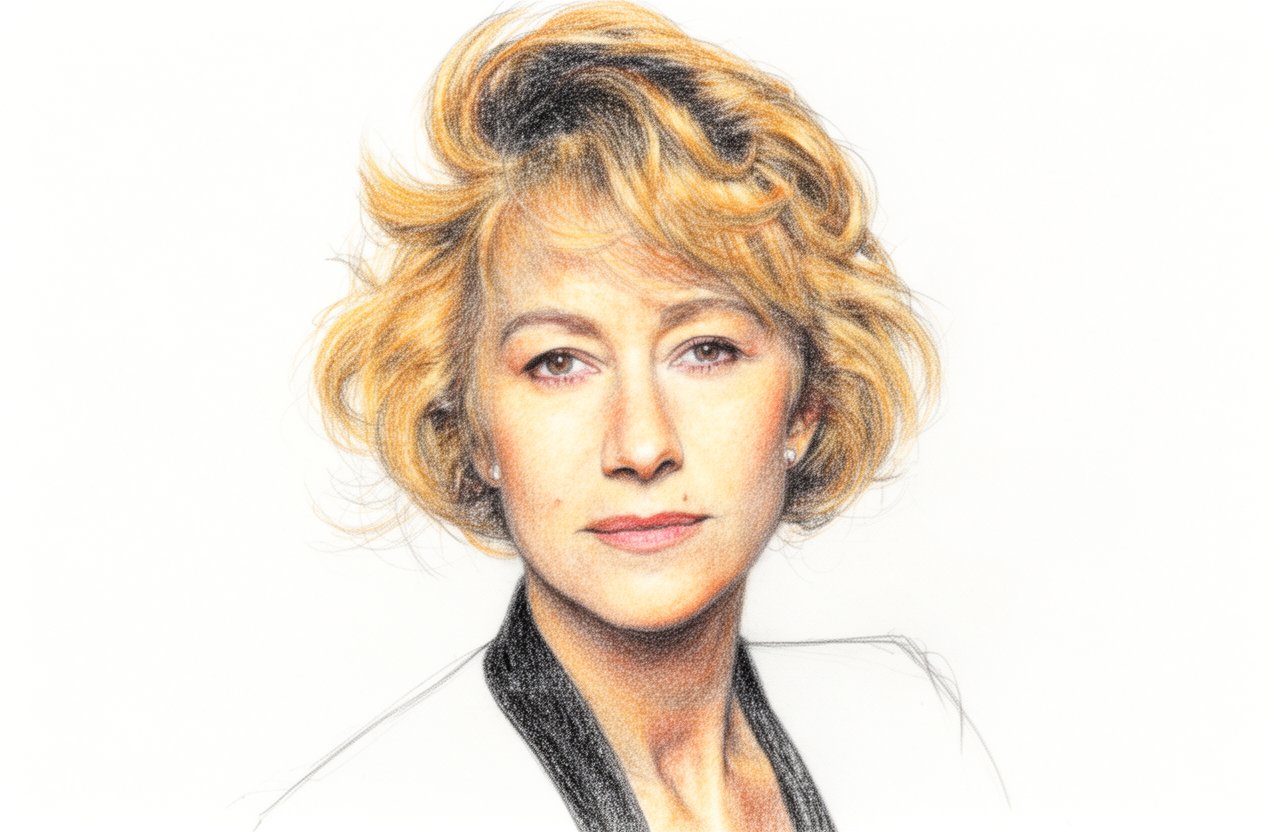
My Critique of Helen Mirren
Helen Mirren’s defining strength lies in her forensic precision, gifting even familiar archetypes with a lived-in authority. Her DCI Jane Tennison remains a watershed portrait, yet such mastery is not without its counterpoint.
Her penchant for poised, regal composure can occasionally curdle into a cool, almost hermetic technical perfectionism, a restraint that occasionally blunts raw emotional immediacy. Where contemporaries like Julie Walters often wield earthy warmth, Mirren opts for layered steeliness, a more formidable armour.
This makes her work vital for modern viewers, offering an uncompromising blueprint for navigating age and power within an industry still resistant to both. An enduring, formidable presence, then, but one defined by control as much as vulnerability.
Early Life
Helen Mirren was born Ilyena Lydia Mironoff on July 26, 1945, in Hammersmith, London. Her heritage is a tapestry of English and Russian nobility; her mother was from a large English family, while her father was descended from an exiled Russian aristocratic lineage dating back centuries.
This unique background instilled in her a sense of being an outsider looking in, a perspective that would later fuel her deep character explorations. She nurtured a passion for performance at the Queen’s School in London, a pursuit that became a serious vocation at 18 when she joined the National Youth Theatre.
Her classical training began in earnest there, with early roles in Shakespearean productions like ‘Antony and Cleopatra’ and ‘Macbeth’. This foundation was cemented when she joined the prestigious Royal Shakespeare Company, where she honed her craft on stages that demanded precision, power, and emotional truth.
Early Career & First Roles
Mirren’s transition to screen was gradual, marked by a small part in ‘Herostratus’ (1967) before her breakthrough as a young artist’s muse in Michael Powell’s ‘Age of Consent’ (1969). Throughout the 1970s and 80s, she fearlessly built a filmography of complex, often challenging women.
She was a magnetic presence in Lindsay Anderson’s satirical ‘O Lucky Man!’ (1973), navigated the notorious excess of ‘Caligula’ (1979), and delivered a steely, unforgettable performance as Victoria, the gangster’s wife in the classic British crime film ‘The Long Good Friday’ (1980).
Her role as the sorceress Morgana le Fay in ‘Excalibur’ (1981) showcased a different kind of power, while her work in Peter Greenaway’s ‘The Cook, the Thief, His Wife & Her Lover’ (1989) as Georgina Spica was a bravura study in survival and revenge. These roles established her as a formidable and unflinching screen presence.
Major Roles
Helen Mirren’s career is a masterclass in range, but it is anchored by a series of monumental performances that have not only defined her legacy but have also reshaped expectations for women on screen. Her work in mystery and crime drama, in particular, stands as a towering achievement.
Detective Chief Inspector Jane Tennison in Prime Suspect (1991-2006)
To discuss the modern police procedural without acknowledging Helen Mirren’s Detective Chief Inspector Jane Tennison is to tell an incomplete story. This was not merely a role; it was a cultural reset.
Over seven series and fifteen years, Mirren didn’t just play a detective—she embodied the seismic struggles of a professional woman in a relentlessly patriarchal institution.
Tennison was a revelation: brilliant, flawed, fiercely ambitious, and deeply human. Mirren presented her not as an infallible superhero, but as a consummate professional whose greatest battles were often within the station walls rather than on the streets.
We saw the cost of her dedication in the loneliness, the chain-smoking, the fraught personal relationships, and the constant need to prove her authority to skeptical, often hostile, male colleagues.
Mirren’s genius lay in her meticulous layering. She mastered the technical jargon and the procedural gait, but she infused every scene with a palpable emotional and psychological weight.
In the groundbreaking first series, her pursuit of a serial killer is as much about dismantling the institutional misogyny that hampers the investigation as it is about solving the crime.
We watched Tennison evolve, grow wearier and wiser, her victories often bittersweet. Mirren never allowed the character to soften into simple likability; her toughness was her armor and her necessity.
This uncompromising portrayal redefined the archetype of the female detective, moving it from supportive sidekick to complex, commanding center.
The performance earned her three consecutive BAFTA Awards and two Emmys, but its true legacy is its transformative impact. Jane Tennison paved the way for every flawed, formidable female investigator that followed, creating a blueprint that the genre still follows.
It is a seminal, era-defining performance that stands as one of the greatest in television history.
Georgina Spica in The Cook, the Thief, His Wife & Her Lover (1989)
Long before she commanded the incident room as Tennison, Helen Mirren delivered a performance of raw, transformative power in Peter Greenaway’s operatic and brutal allegory. As Georgina Spica, the wife of a monstrous, vulgar gangster, Mirren traverses a stunning arc from gilded prisoner to avenging angel.
Trapped in the grotesque, color-coded world of her husband’s restaurant, Georgina is initially a vision of silent, porcelain despair. Mirren communicates volumes through posture and gaze, her elegance a stark contrast to the barbarism around her.
Her affair with a quiet bookshop owner becomes an act of profound rebellion, a reclaiming of her own sensuality and autonomy.
The film’s notorious extremity demanded an actor of immense courage and control, and Mirren provided its unwavering moral and emotional core. Her journey culminates in a finale of shocking, poetic vengeance that is both horrifying and cathartic.
Mirren ensures that Georgina’s act is not one of mere violence, but of terrible, justified retribution.
This role was a critical declaration of Mirren’s fearlessness. She embraced the film’s stylized theatricality while grounding Georgina in a deeply relatable humanity.
It showcased her ability to dominate a frame with quiet intensity and to navigate material of the highest artistic ambition, proving her mettle as a lead actress capable of carrying the most challenging cinematic visions.
Other Notable Work
Mirren’s prowess in mystery and psychological drama extends beyond her iconic television work. As Annie Marsh in The Hawk (1993), she brought a haunting vulnerability to the wife of a man suspected of being a serial killer, masterfully depicting the terror of doubt within one’s own home.
In the atmospheric thriller Pascali’s Island (1988), her portrayal of Lydia Neuman, a mysterious artist entangled in espionage, is a study in enigmatic allure and concealed motive. Each of these roles, though different in scale, is treated with the same rigorous commitment to psychological truth that defines her most famous performances, building a formidable portfolio within the genre.
Acting Style
Helen Mirren’s approach to acting is a disciplined fusion of meticulous craft and liberated artistry. She is a fervent believer in groundwork: deep research, script analysis, and a collaborative relationship with hair, makeup, and costume to physically build a character from the outside in.
Her classical stage training, particularly with the RSC, ingrained in her a respect for technique and text. Yet, she argues that true performance begins only after this technique is mastered and can be forgotten, allowing imagination and spontaneity to take over.
She is a keen student of the camera, understanding how to modulate a performance for the lens with profound subtlety.
This philosophy results in performances that feel utterly lived-in and authentic. Whether she is a monarch or a detective, her characters are never imitations; they are complex human beings with histories, motivations, and contradictions.
She draws from life but transcends biography, creating portraits that resonate with universal truth.
Personal Life
Mirren’s life off-screen reflects the same intelligence and authenticity she brings to her roles. She was in a long-term relationship with actor Liam Neeson in the early 1980s before meeting film director Taylor Hackford on the set of White Nights (1985).
They married in 1997 in Scotland, forming a enduring creative and personal partnership.
She has been candid about her choice not to have children, and she faced profound personal grief with the passing of her stepson, Rio Hackford, in 2022. An avid and passionate gardener, she finds in it a parallel to her work: a practice in patience, presence, and humility that clears the ego.
A vocal advocate for feminism, she has consistently challenged ageism and sexism in Hollywood, using her platform and her own illustrious career as powerful rebuttals to industry prejudice. In 2003, her services to drama were recognized with the title Dame Commander of the Order of the British Empire.
In closing…
Dame Helen Mirren is more than an actress of exceptional skill; she is an institution of one. Through Jane Tennison, she permanently altered the landscape of television crime drama.
Through a myriad of other roles, from queens to commoners, she has demonstrated a peerless range anchored by unwavering integrity.
Her career is a testament to the power of talent deepened by intelligence, courage, and relentless curiosity. For audiences with a discerning taste for mystery and profound character work, Helen Mirren remains not just a performer to admire, but a standard against which excellence is measured.