My Critique of Ian Hogg
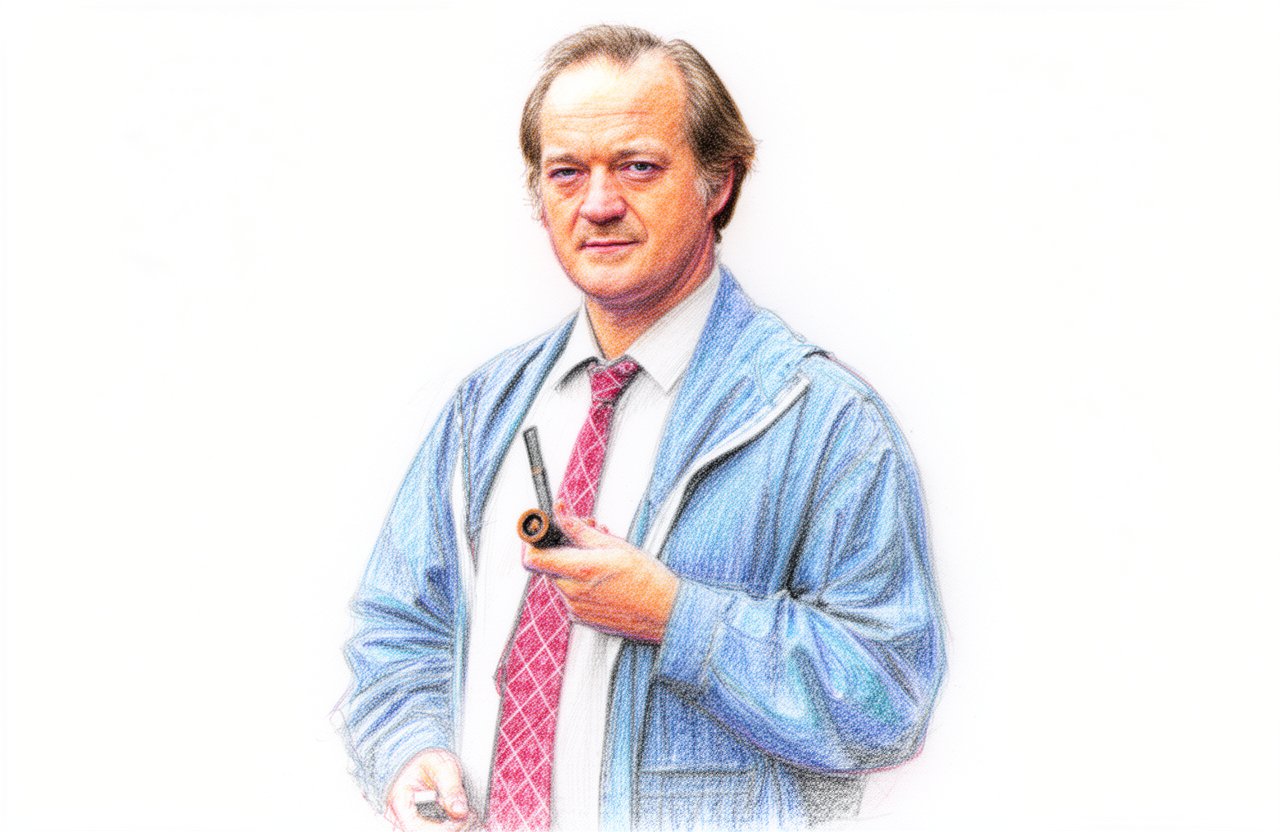
Brian Hogg’s commanding presence was ideally suited to British crime drama, elevating procedural formulas with authentic gravitas. His signature lead as Detective Rockliffe offered a compelling, weary intelligence, yet too often such strengths were confined to forgotten supporting slots in mainstream hits like Midsomer Murders, where he was reliably underused.
While contemporaries secured iconic franchises, Hogg’s versatility remained a specialist’s asset rather than a headline brand. For modern viewers, his career matters as a masterclass in texture over flash; his work rewards attentive watching, proving that a single, well-judged scene can outlast many a celebrated lead.
Early Life
Ian Hogg was born on August 1, 1937, in Newcastle upon Tyne, England, into a professional family. His father, Walter Alexander Hogg, was a doctor, and his mother was Ena Mary (Robinson).
He had an older sister, Thelma. His education was a classical one, first at Durham School and then at Durham University’s St John’s College, where he graduated with a Bachelor of Arts degree in 1959.
This academic foundation, however, was a prelude to a different calling. Hogg subsequently trained at the prestigious Central School of Speech and Drama, studying under the influential tutor Yat Malmgren.
This rigorous training honed his instrument and prepared him for a serious career on the stage, a path that began auspiciously with a place in the renowned Royal Shakespeare Company immediately after his studies.
Early Career & First Roles
Ian Hogg’s professional journey began firmly on the stage with the RSC, but his screen career commenced in the late 1960s. His film debut was in Peter Brook’s cinematic adaptation of the RSC stage production ‘Marat/Sade’ (1967).
This established a pattern of working on intellectually demanding material.
He quickly became a recognizable presence in British cinema of the period, appearing in films like ‘Tell Me Lies’ (1968) and ‘The Last Valley’ (1971). A significant early credit was his portrayal of the treacherous Edmund in Peter Brook’s stark 1971 film of ‘King Lear’.
Throughout the 1970s, he worked consistently in features such as ‘The Hireling’ (1973), ‘Dead Cert’ (1974), and ‘Hennessy’ (1975), building a portfolio of often gritty, character-driven parts.
Major Roles
While his film work was steady, it was on British television where Ian Hogg crafted his most enduring and beloved characters, particularly for audiences of mystery and drama. His career is a masterclass in reliable, compelling character acting across decades of programming.
Detective Sergeant Alan Rockliffe
For fans of British police procedurals, Ian Hogg is indelibly linked to Detective Sergeant Alan Rockliffe. He first embodied the role in the 1987 series ‘Rockliffe’s Babies’, where Rockliffe was the seasoned, slightly world-weary mentor to a group of new, young detectives.
The character’s popularity led to the sequel series, ‘Rockliffe’s Folly’ (1988).
Hogg’s portrayal was a cornerstone of the show’s appeal. He brought a wonderful, grounded authenticity to Rockliffe.
This was no flashy super-detective, but a competent, dedicated professional navigating office politics, bureaucratic inertia, and the complexities of street-level crime. Hogg excelled at conveying Rockliffe’s quiet intelligence, his dry sense of humor, and his fundamental decency, which was often tested but never broken.
The genius of the performance lay in its subtlety and lack of ego. Rockliffe was the steady center around which the dramas unfolded, and Hogg made that reliability fascinating.
He communicated volumes through a weary glance, a resigned sigh, or a carefully measured piece of advice. His chemistry with the ensemble felt genuine, portraying the camaraderie and frustrations of a real police unit.
In an era of increasingly eccentric TV detectives, Hogg’s Rockliffe was a refreshing and deeply believable portrait of police work, making him a definitive and warmly remembered figure in the genre.
Inspector Bucket in ‘Bleak House’ (1985)
Long before his turn as Rockliffe, Hogg delivered another masterful performance as a lawman, this time from the 19th century. In the acclaimed 1985 BBC adaptation of Charles Dickens’ ‘Bleak House’, he played Inspector Bucket.
This role showcased a different facet of his ability to portray authority and investigation.
Dickens’ Bucket is a seminal figure in detective fiction—one of the first professional detectives in English literature. Hogg captured the character’s essence perfectly: the polite, persistent, and inscrutable manner, the watchful eyes that missed nothing, and the air of quiet, implacable purpose.
He played Bucket not as a flamboyant sleuth but as a bureaucratic functionary of justice, methodical and patient.
His scenes were studies in controlled power. He could be both reassuring and intimidating, often within the same conversation.
Hogg understood that Bucket’s authority came from his knowledge and his connection to the systems of power, not from overt force. This performance stands as one of the most authentic and respected interpretations of a classic literary detective, highlighting Hogg’s skill in bridging historical characterisation with compelling drama.
Other Notable Work
Ian Hogg’s filmography is a map of quality British television. He guest-starred in countless iconic series, always leaving a strong impression.
For ‘Doctor Who’ fans, he was the sinister Josiah Samuel Smith in the Gothic serial ‘Ghost Light’ (1989). He brought gravitas to historical drama as Purishkevich in ‘Rasputin’ (1996) and delivered a chilling, pathetic portrayal of Alois Hitler in ‘Hitler: The Rise of Evil’ (2003).
His presence was a mark of quality in crime drama, with memorable turns in ‘Foyle’s War’ (2002), ‘New Tricks’ (2003), and multiple appearances in ‘Midsomer Murders‘ and ‘Heartbeat‘ over many years. Even in soap opera, his stint as Mike Cherry in ‘EastEnders’ (1999) was notably effective.
His voice work also extended to the acclaimed audio drama of ‘The Sandman’ (2002), voicing General Voshkar.
Acting Style
Ian Hogg was the epitome of a distinguished, reliable character actor. His style was built on a foundation of immense technical skill and intelligent character analysis, devoid of showy mannerisms.
He possessed a commanding presence and a rich, resonant voice that could convey authority, warmth, or menace with equal conviction.
He specialized in portraying complex, often authoritative figures—detectives, officials, military men—but he always sought the human truth beneath the uniform or title. His performances were nuanced and layered, suggesting a full life and history behind the character’s immediate actions.
This made him equally compelling as a steadfast hero like Rockliffe or a troubling figure like Alois Hitler.
His versatility across genre—from classic literary adaptation to contemporary police drama, from historical epic to science fiction—was a testament to his profound professionalism and adaptable craft. He was an actor who listened and reacted truthfully, making every scene partner better and every narrative more believable.
Personal Life
Ian Hogg maintained a notably private life, distinctly separate from his public career. He married actress Thea Bean on August 7, 1962, and they had a daughter, Sarah.
Preferring a quiet, grounded existence, his hobbies reflected a love for the pastoral and the intellectual.
He was an avid reader, a pursuit that aligned with his thoughtful approach to his work. Beyond that, he found solace and satisfaction in hands-on, rural activities.
He was a keen horse rider, enjoying the solitude and connection with nature it provided. More unusually, he was also a goatkeeper, a hobby that speaks to a practical, self-sufficient, and patient character—traits that undoubtedly informed the steady, reliable personas he often portrayed on screen.