
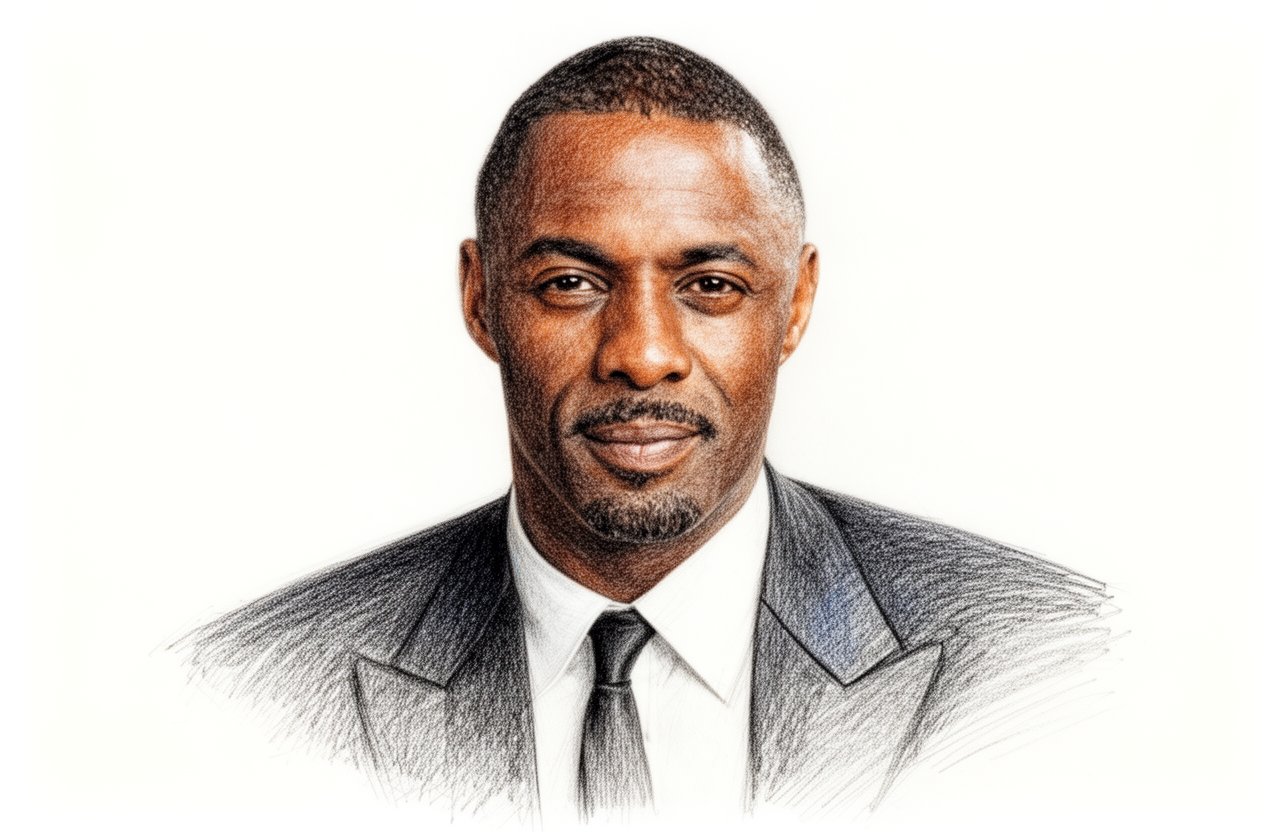
My Critique of Idris Elba
Idris Elba’s defining strength is a commanding physicality tempered by psychological nuance, a combination that has defined British crime drama. His turn as DCI John Luther in *Luther* is a masterclass in charismatic turmoil, a portrayal that elevates familiar procedural tropes into genuine tragedy.
Unlike many contemporaries, Elba imbues his leads with a palpable weight; his performance in *Hijack* demonstrates this, where he single-handedly anchors the high-concept suspense. However, this magnetic screen presence can also be a constraint.
While his range is impressive, he often appears too dominant for the material he’s given, suggesting a talent that can outgrow the confines of genre. Ultimately, Elba matters because he is a standard-bearer for a more muscular, cinematic approach to British television drama, ensuring its international relevance.
Early Life
Idris Elba was born on September 6, 1972, in the Hackney borough of London, England. He is the only child of Winston Elba, a Sierra Leonean man, and Eve, a Ghanaian woman, who had married in Sierra Leone before moving to London.
Raised in the working-class neighborhoods of Hackney and East Ham, Elba’s childhood was steeped in the diverse cultural fabric of the city.
His first foray into performance came at school in Canning Town, where he discovered acting. A pivotal moment arrived when he secured a grant from The Prince’s Trust, which allowed him to study at the prestigious National Youth Music Theatre.
This formal training planted the seed for his future career. Parallel to this, a young Elba was cultivating another passion: music.
By 1986, he was helping his uncle DJ at weddings, and within a year, he had started his own DJ company with friends, a side hustle that would persist for decades.
Early Career & First Roles
Like many British actors, Elba’s early career was a mosaic of small television parts. He cut his teeth in the grim realism of “Crimewatch” murder reconstructions before landing roles in children’s drama “The Boot Street Band” (1994) and the medical series “Bramwell” (1995).
His first named television role was a brief, memorable turn as a gigolo in an episode of the iconic comedy “Absolutely Fabulous” in 1995.
Throughout the late 1990s, he became a familiar face in supporting roles on series like “The Bill,” “The Ruth Rendell Mysteries,” and the soap opera “Family Affairs.” Feeling limited by the opportunities in the UK, Elba made the bold decision to move to New York City. There, he faced the classic actor’s struggle, working as a doorman at Carolines comedy club and DJing to make ends meet, all while auditioning relentlessly.
This period of perseverance would soon pay off in spectacular fashion.
Major Roles
Idris Elba’s career is a masterclass in building a formidable body of work across television and film, anchored by two iconic roles that showcase the full spectrum of his commanding presence.
Detective Chief Inspector John Luther – Luther (2010–2019, 2023)
For fans of cerebral, psychologically intense crime drama, Idris Elba is synonymous with Detective Chief Inspector John Luther. This role is not just a career highlight; it is a defining piece of modern television noir.
Elba’s Luther is a force of nature—a brilliant detective with a preternatural understanding of the criminal mind, yet perpetually on the brink of being consumed by the darkness he battles. The genius of Elba’s performance lies in its profound physicality and emotional volatility.
He doesn’t just play Luther; he inhabits him with a terrifying, coiled intensity. You see the weight of every case in his weary stride, the moral conflict in his piercing gaze, and the raw, unchecked fury in his outbursts.
The iconic image of Luther, silhouetted against a grey London skyline, coat billowing, is a perfect metaphor for the character: a solitary, towering figure operating in the shadows between justice and obsession. Elba makes Luther’s intelligence visceral and his vulnerability devastating.
The character’s complexity is legendary. He is both the ultimate protector and a walking liability, a man whose dedication saves lives but whose methods constantly jeopardize his own soul and career.
Elba navigates this dichotomy without ever asking for easy sympathy, rendering Luther as tragically flawed as he is heroic. The role earned him a Golden Globe, multiple Emmy and BAFTA nominations, and a permanent place in the pantheon of great television detectives.
The 2023 film “Luther: The Fallen Sun” successfully translated this brooding intensity to the big screen, proving the enduring power of Elba’s creation.
Russell ‘Stringer’ Bell – The Wire (2002–2004)
While Luther cemented Elba’s status as a leading man, it was his portrayal of Stringer Bell in HBO’s “The Wire” that announced him as a performer of extraordinary depth and intelligence. In a series lauded for its novelistic complexity and rich characterizations, Stringer Bell stood out as a singular creation, and Elba’s performance was its cornerstone.
Stringer was the cerebral counterpart to the street-level chaos of West Baltimore—a drug lord who studied economics, applied business principles to his illicit trade, and dreamed of legitimacy.
Elba brought a chilling, quiet authority to the role. Unlike the more volatile characters around him, Stringer was measured, strategic, and ruthlessly pragmatic.
Elba mastered the character’s calculating gaze and composed demeanor, making his occasional eruptions of violence all the more shocking. He portrayed Stringer’s tragic aspiration not as a caricature, but as a believable, even relatable, drive for a better life through a twisted path.
The performance was a revelation, showcasing Elba’s ability to find the human complexity within a formidable antagonist. Stringer Bell remains one of the most iconic and studied characters in television history, and it served as Elba’s undeniable passport to international acclaim.
Other Notable Work
Elba’s versatility extends far beyond these twin pillars. He demonstrated deft comedic timing as the stern, out-of-his-depth Vice President of Northeast Sales, Charles Miner, in the American version of “The Office.” He brought gravitas to the harrowing HBO genocide drama “Sometimes in April” (2005) and charm to “The No.
1 Ladies’ Detective Agency” (2008). More recently, he proved his mastery of real-time tension as the shrewd negotiator Sam Nelson in the thriller “Hijack” (2023).
He has also stepped behind the camera, making his directorial debut with the gritty London-to-Jamaica drama “Yardie” (2018).
Acting Style
Idris Elba’s acting style is defined by a formidable and immersive physical presence. He is an actor who thinks with his entire body, using posture, gait, and a powerful stillness to communicate volumes before a word is spoken.
This physical command allows him to embody characters as diverse as a calculating drug lord, a tormented detective, and a Norse god with equal conviction. His performances are anchored in a deep, resonant voice that can convey threat, vulnerability, or wisdom with subtle shifts in tone.
He excels at portraying intelligent, driven men who often operate in moral grey areas, bringing a compelling internal logic to each role. There is an intensity to his work that feels earned and authentic, never theatrical.
He avoids stereotype by investing even his most powerful characters with palpable inner conflict and human frailty, making his heroes more compelling and his villains strangely understandable. Elba doesn’t just play characters; he fully occupies them, resulting in performances of remarkable authenticity and power.
Personal Life
Beyond the screen, Elba leads a multifaceted life. He was previously married to stylist Hanne Nørgaard (with whom he has a daughter) and, briefly, to attorney Sonya Nicole Hamlin.
In 2019, he married model Sabrina Dhowre in Marrakesh, with whom he shares a son from a previous relationship. A lifelong supporter of Arsenal Football Club, his passions are eclectic and deeply felt.
He is a skilled DJ (performing under the name DJ Big Driis) and an accomplished kickboxer, even winning a professional fight in 2016.
He leverages his platform for significant philanthropic work, notably collaborating with the UK government to combat the Ebola outbreak in West Africa. A vocal advocate for diversity in the entertainment industry, he has addressed the UK Parliament on the subject.
These endeavors paint a picture of a man of considerable depth, discipline, and social conscience, far removed from the characters he often portrays.