
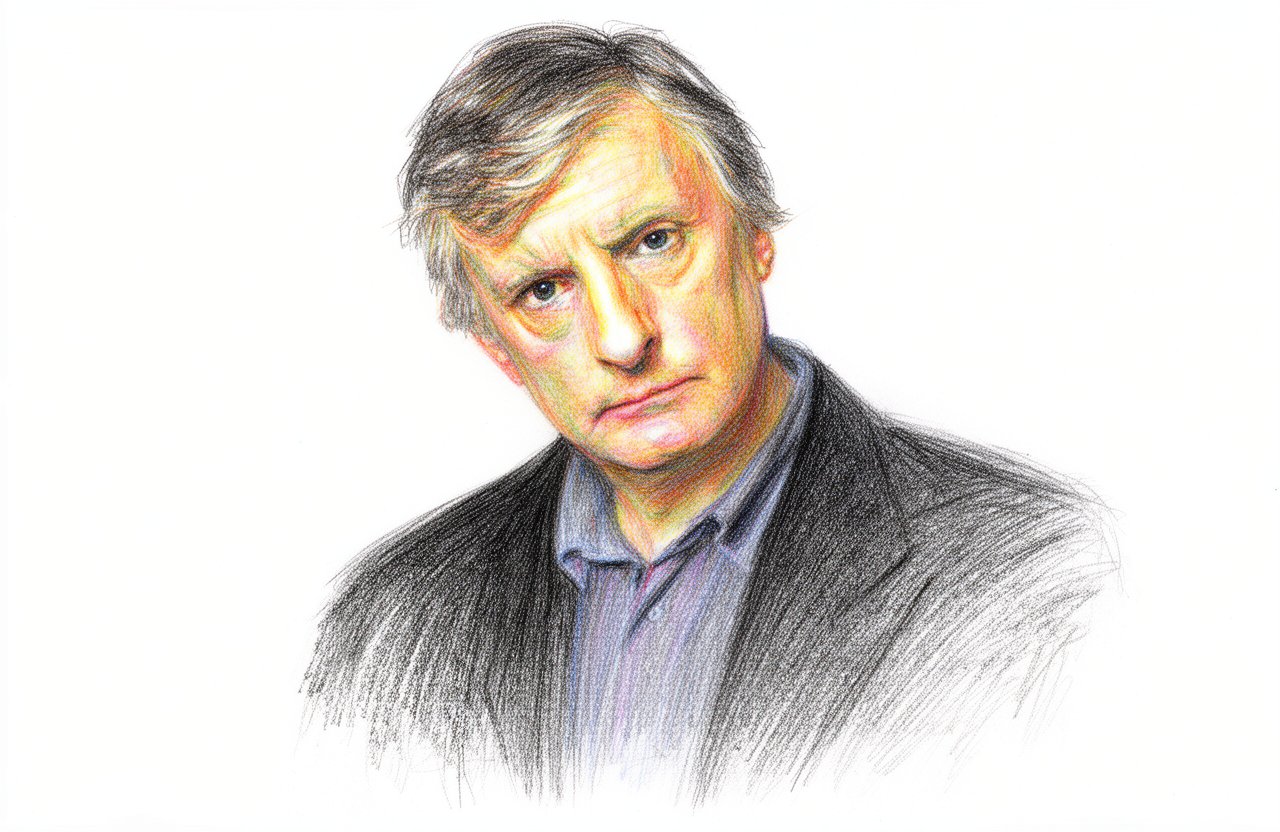
My Critique of Jack Shepherd
Jack Shepherd possessed a rare scholarly gravitas, setting him apart from contemporaries who gravitated toward television’s more rugged leading men. His defining strength was an intellectual intensity, which made his long-running turn as Detective Superintendent Wycliffe a masterclass in psychological policing.
However, this same quality sometimes rendered his performances austere, creating an emotional remove that could constrain a role’s visceral impact. This cerebral approach often positioned him as a nuanced counterpoint to the era’s more conventionally rugged contemporaries.
For modern viewers, he matters as a consummate character actor whose depth and classical training elevated genre television. His legacy is a masterclass in cerebral restraint rather than overt charisma.
Early Life
Jack Shepherd was born on October 29, 1940, in Leeds, a city in the West Riding of Yorkshire, England. His artistic journey began not on the stage, but in the visual arts.
He studied fine art at King’s College, Newcastle University, earning a Bachelor of Arts degree. It was during this formative period in Newcastle that his path subtly shifted.
While immersed in the world of painting and drawing, he became an amateur actor with the People’s Theatre, discovering a parallel passion for performance. This dual foundation in visual and theatrical arts would become a hallmark of his creative sensibility.
He further formalized his acting training at the Central School of Speech and Drama in London.
Significantly, he was a founding student of the prestigious Drama Centre London, an institution known for its rigorous, psychologically deep approach to actor training. Beyond drama and paint, a third art form pulsed through his life: music.
Shepherd was a talented alto saxophonist, playing in a jazz ensemble with fellow student Jon Lord.
Lord, who would later achieve fame with Deep Purple and Whitesnake, recalled Shepherd as one of the best alto players he knew, even introducing him to the complex works of jazz legend Charles Mingus. This rich, multidisciplinary background—encompassing fine art, music, and methodical acting technique—forged an actor of uncommon depth and rhythmic intelligence.
Early Career & First Roles
Shepherd’s professional career began with the small, uncredited role of a night receptionist in the 1962 film ‘Two and Two Make Six.’ Throughout the late 1960s and early 1970s, he steadily built his filmography with a series of sharp, character-driven parts that showcased his versatility. He appeared as Dwyer in ‘All Neat in Black Stockings’ (1969) and Sergeant Wellbeloved in ‘The Virgin Soldiers’ (1969).
His television work expanded concurrently, with early appearances in series like ‘Special Branch‘ (1969) and ‘Budgie’ (1971). These roles, often in crime dramas or gritty social narratives, provided the perfect apprenticeship for the commanding character actor he would become.
Each part, no matter the size, was a step in honing the precise, grounded authenticity that would define his later work.
Major Roles
Jack Shepherd’s career is a tapestry of compelling performances, but a few key roles stand as pillars, defining his reputation for audiences and critics alike. These characters allowed him to explore the full spectrum of human motive, from radical idealism to dogged procedural integrity, and from servile madness to historical gravitas.
Detective Superintendent Charles Wycliffe – ‘Wycliffe’ (1993–1998)
For many, Jack Shepherd is synonymous with Detective Superintendent Charles Wycliffe, the lead character in the ITV series that ran for five seasons. This role was not just a job; it was a defining portrayal that captured the essence of a certain kind of British detective.
Wycliffe was a departure from the eccentric genius or the troubled maverick. Shepherd played him as a thorough, thoughtful, and deeply human senior police officer.
Transferred to Cornwall, Wycliffe is an outsider navigating the closed communities and stark landscapes of the southwest. Shepherd’s performance was a masterclass in quiet authority.
His Wycliffe was a listener, a man who solved cases through patient procedure and psychological insight rather than flashy deduction. He conveyed intelligence through a measured gaze and a thoughtful pause, his frustration often expressed in a tightened jaw or a weary sigh.
Shepherd brought a tangible weight of responsibility to the role. You felt the burden of command, the pressure from superiors, and the personal cost of immersing oneself in the darkest facets of human nature.
Yet, he also allowed warmth to seep through—in his relationship with his team, particularly DS Doug Kersey, and in his appreciation for the Cornish landscape itself.
The success of ‘Wycliffe’ rested heavily on Shepherd’s ability to make decency compelling. He avoided cliché, presenting a cop who was professional, sometimes stubborn, but fundamentally fair.
This grounded, emotionally resonant portrayal earned him a dedicated fan base and cemented the series as a staple of 1990s British television drama. It remains a benchmark for the procedural genre, valued for its atmosphere, its integrity, and above all, for Shepherd’s distinguished and utterly believable central performance.
Renfield – ‘Count Dracula’ (1977)
Long before ‘Wycliffe,’ Shepherd delivered a performance of chilling brilliance that showcased his range in the genre of gothic horror. In the 1977 BBC television adaptation of ‘Count Dracula,’ starring Louis Jourdan, Shepherd took on the role of Renfield, the solicitor’s clerk who becomes Dracula’s devoted, insane acolyte.
This was not a mere bit of scenery-chewing madness; Shepherd crafted a devastating arc of psychological disintegration.
He began as a perfectly ordinary, somewhat earnest young man, sent on business to the Count’s castle. Shepherd meticulously charted Renfield’s transformation, his initial rational fear slowly curdled by the vampire’s influence into a zealous, insect-eating fanaticism.
His performance was physically and vocally inventive—twitches, whispers, and sudden bursts of lucid terror all painting a portrait of a soul being systematically unraveled.
The power of his portrayal lay in its heartbreaking humanity. Even in his most deranged moments, pleading for flies and spiders, you could glimpse the terrified man trapped within.
His final scenes, a mixture of pathetic loyalty and last-minute, tragic clarity, are unforgettable. This supporting role proved Shepherd’s mastery of intense character study and his ability to hold his own in a classic story dominated by a powerful central figure.
It remains one of the most memorable and psychologically acute interpretations of Renfield ever committed to screen.
Other Notable Work
Shepherd’s capacity for leadership and ideological fervor was powerfully displayed in the 1976 ITV series ‘Bill Brand,’ where he played the titular radical Labour MP. His committed, fiery performance earned him a Royal Television Society Award and a BAFTA nomination, proving his strength as a leading man in politically charged drama.
In the historical sphere, he brought solemn authority to Thomas Becket in ‘The Devil’s Crown’ (1978).
His stage work was equally significant, particularly his performance as Shelley Levene in the original 1983 London production of David Mamet’s ‘Glengarry Glen Ross.’ For this, he won the Society of London Theatre Award for Actor of the Year in a New Play, a testament to his formidable power in the theatre. Later television included a wonderfully dry turn as the unflappable Butler in the miniseries ‘Over Here’ (1996).
Acting Style
Jack Shepherd was an actor of remarkable integrity and quiet power. His style was fundamentally naturalistic, built on a foundation of deep psychological preparation and meticulous craft honed at the Drama Centre.
He possessed the rare ability to be completely compelling while doing very little; his performances were internalized, thought-driven, and expressed through subtle gesture and nuanced vocal delivery.
His musical background as a jazz saxophonist was often cited as an influence, evident in his impeccable rhythmic timing and sense of pace. He listened on screen and on stage with the intensity of a musician waiting for his cue, making his reactions as telling as his dialogue.
This allowed him to excel in both classical theatre and contemporary screen drama, always finding the human truth within the text.
He was neither a showy star nor a blank slate, but a transformative character actor who could lead a series with grounded authority or steal a scene with focused intensity. His versatility was his hallmark, moving from the madness of Renfield to the decency of Wycliffe without a trace of actorly vanity, always serving the story and the truth of the character.
Personal Life
Away from the cameras, Jack Shepherd was a dedicated family man who valued his privacy. He was married twice: first to Judith Harland in 1965, with whom he had two children, Jan and Jake.
Following their divorce, he married film and television producer Ann Scott in 1975. Together they had three children: Victoria, Catherine, and Ben.
His daughter Catherine Shepherd followed him into the acting profession. By all accounts, Shepherd was a supportive and loving father who maintained a close-knit family life, successfully balancing the demands of a prolific career with his home responsibilities.
He was known to colleagues as a thoughtful, professional, and kind presence, devoid of pretension. Jack Shepherd passed away on November 24, 2025, at the age of 85, following a short illness.
In closing…
Jack Shepherd’s legacy is one of profound skill and quiet dignity. He was not an actor who sought the spotlight, but one who earned deep respect through consistent, intelligent, and heartfelt work.
Whether as the definitive modern detective in ‘Wycliffe,’ a haunting study of obsession in ‘Count Dracula,’ or a radical firebrand in ‘Bill Brand,’ he brought a unique depth and authenticity to every role.
For lovers of character-driven mystery and drama, his body of work remains a masterclass in understated power. He exemplified the best of British acting: craft, commitment, and a unwavering dedication to truth.
Jack Shepherd was, quite simply, a distinguished artist whose performances continue to resonate with clarity and power.