Early Life
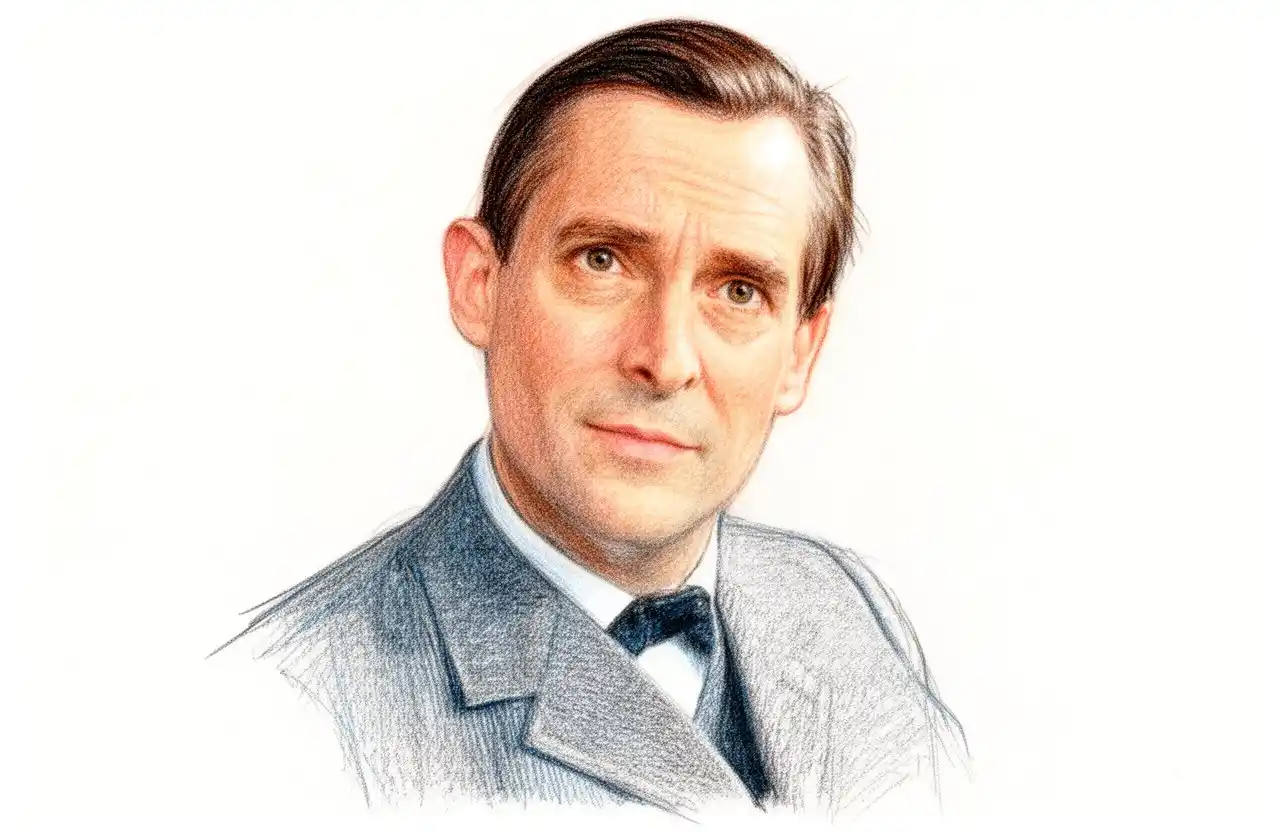
Born Peter Jeremy William Huggins on November 3, 1933, in the village of Berkswell, Warwickshire, Jeremy Brett entered a world of established English tradition. His father was a decorated Lieutenant Colonel, and his mother, Elizabeth Edith Cadbury, hailed from the famed confectionery dynasty.
This background of military discipline and industrial legacy provided a structured, if somewhat rigid, childhood.
Educated at the prestigious Eton College, Brett discovered a passion for performance through the college choir, where his singing talent flourished. This early artistic outlet was a vital counterpoint to the challenges he faced, including dyslexia and a speech impediment known as rhotacism.
Through determined practice and corrective surgery, he overcame these hurdles, forging the precise, resonant voice that would become his trademark.
His path to the stage was cemented at the Central School of Speech and Drama, from which he graduated in 1954. At his father’s request, he adopted the stage name ‘Jeremy Brett’ to shield the family name, a symbolic step into his new, chosen world.
This early life, blending aristocratic heritage with personal struggle, forged the intense, dedicated artist who would later captivate audiences.
Early Career & First Roles
Jeremy Brett’s professional journey began in 1954 at the Library Theatre in Manchester. He swiftly ascended into the heart of British theatre, joining the esteemed Old Vic company in London.
His classical training shone in early roles like Patroclus in ‘Troilus and Cressida’ and Paris in ‘Romeo and Juliet’.
This period established his credentials as a serious and versatile stage actor. A notable Broadway debut followed in ‘Richard II’, and he tackled the romantic lead in the West End musical ‘Marigold’.
His early screen work included a charming turn as Freddy Eynsford-Hill in the 1964 film ‘My Fair Lady’, showcasing his ability to hold his own alongside stars like Audrey Hepburn.
Major Roles
Sherlock Holmes (Granada Television Series, 1984-1994)
To discuss Jeremy Brett is to discuss Sherlock Holmes. His portrayal for Granada Television across 41 episodes and five series is not merely a performance; it is a cultural landmark.
Brett approached the role with the reverence of a scholar and the passion of a devotee, famously calling himself the “caretaker” of Holmes’s legacy. He did not just play the detective; he embodied his very essence, from the hawk-like profile and piercing gaze to the restless, electric physicality.
Brett’s genius lay in his holistic excavation of Sir Arthur Conan Doyle’s creation. He rejected the then-prevailing image of a cold, detached reasoning machine.
Instead, he revealed the complex, mercurial, and often tortured human beneath the deerstalker. His Holmes was a symphony of controlled eccentricity—fluttering hands, sudden explosive movements, languid collapses onto the sofa—all underpinned by a profound, if brittle, intelligence.
He captured the character’s arrogance and impatience with breathtaking clarity, yet also his deep, unspoken loyalty to Watson, his childlike joy in the chase, and the melancholic shadows of his manic-depressive temperament. Brett’s own later diagnosis with bipolar disorder added a poignant, meta-textual layer to this interpretation, informing the portrayal with an authentic, visceral understanding of extreme mental states.
This was acting of obsessive detail. Brett kept exhaustive “Baker Street File” notebooks, analyzing every canonical clue to Holmes’s behavior, from his diet to his violin playing.
The result was a definitive portrayal that has never been surpassed. For a generation and beyond, his voice—that precise, musical, commanding instrument—is the voice of Sherlock Holmes.
It is a masterpiece of characterisation that redefined the detective for the modern age and set the gold standard against which all subsequent interpretations are measured.
Edward Ashburnham (The Good Soldier, 1981)
Long before Baker Street, Brett delivered a performance of devastating tragic power in the Granada adaptation of Ford Madox Ford’s “The Good Soldier.” As Edward Ashburnham, the seemingly perfect English gentleman whose life is a meticulously constructed lie, Brett showcased his unparalleled ability to portray layered inner conflict. This role was a perfect conduit for his acting style, requiring a facade of charming, aristocratic stability to slowly crumble, revealing the torrent of passion, despair, and moral ambiguity beneath.
Brett’s Ashburnham is a man trapped by the conventions of his era and his own uncontrollable emotions. Brett communicates volumes through subtle glances, a slight tremor in the hand, and the quiet desperation in his voice.
He makes the character’s self-destruction not just believable but heartbreakingly inevitable. It is a masterful study in repression and ruin, proving his immense range and his genius for locating the profound vulnerability within seemingly strong figures.
This performance stands as one of the great television acting achievements of its time.
Other Notable Work
Brett’s career was rich with distinguished work beyond his defining role. On stage, his 1961 Hamlet was critically acclaimed for its passionate intensity.
He excelled in classic comedy, playing Captain Absolute in Sheridan’s “The Rivals,” and brought nobility to Bassanio in “The Merchant of Venice.”
Television offered further variety, including a spirited d’Artagnan in a 1966 “Three Musketeers” adaptation. In “A Picture of Katherine Mansfield” (1973), he delivered a sensitive supporting turn as writer John Middleton Murry.
Each role, whether lead or support, was treated with the same meticulous care and emotional truth that became his hallmark.
Acting Style
Jeremy Brett was an actor of formidable technique and deep psychological commitment. His style was a unique fusion of theatrical flourish and rigorous, Stanislavsky-inspired internal work.
He believed in finding the “underbelly” of a character, often mining his own emotional experiences to fuel his performances. This resulted in portrayals crackling with inner life, where every gesture, pause, and vocal inflection felt deliberate yet authentically born from the character’s psyche.
He possessed a profound understanding of the musicality of language, using his rich, resonant baritone like an instrument—capable of withering sarcasm, poetic reverie, or explosive fury. Physically, he was intensely expressive, with a panther-like grace that could convey intense energy even in stillness.
His approach was one of obsessive dedication, involving detailed research and note-keeping to build a complete, living person. This marriage of intellectual precision and raw emotional availability made his performances uniquely compelling and electric.
Personal Life
Jeremy Brett’s personal life was marked by deep affection, profound loss, and private struggle. He was married twice: first to actress Anna Massey, with whom he had a son, David, and later to Joan Sullivan Wilson, whose death from cancer in 1985 devastated him.
His romantic relationships included long-term partnerships with actor Gary Bond and, later, Paul Shenar, though he never publicly discussed his sexuality, maintaining a dignified privacy common to his generation.
In the latter part of his life, he was diagnosed with manic depression (bipolar disorder), a condition he managed with medication. He spoke of finding solace in meditation and yoga.
These private battles with mental health, while challenging, seemed to deepen his empathy and inform the emotional complexity of his later work, particularly his nuanced portrayal of Holmes’s own volatile temperament. He passed away in 1995, leaving behind a legacy defined by both extraordinary artistry and human resilience.
In closing…
Jeremy Brett remains the definitive Sherlock Holmes, a titanic achievement that can sometimes overshadow the breadth of his remarkable career. He was an actor of immense power, intelligence, and sensitivity, who brought a rare combination of theatrical brilliance and psychological truth to every role.
To watch his performances is to witness a master craftsman at work, one whose dedication to his art was absolute. He is remembered not just as the perfect Holmes, but as one of the most distinguished and compelling actors of his generation.