
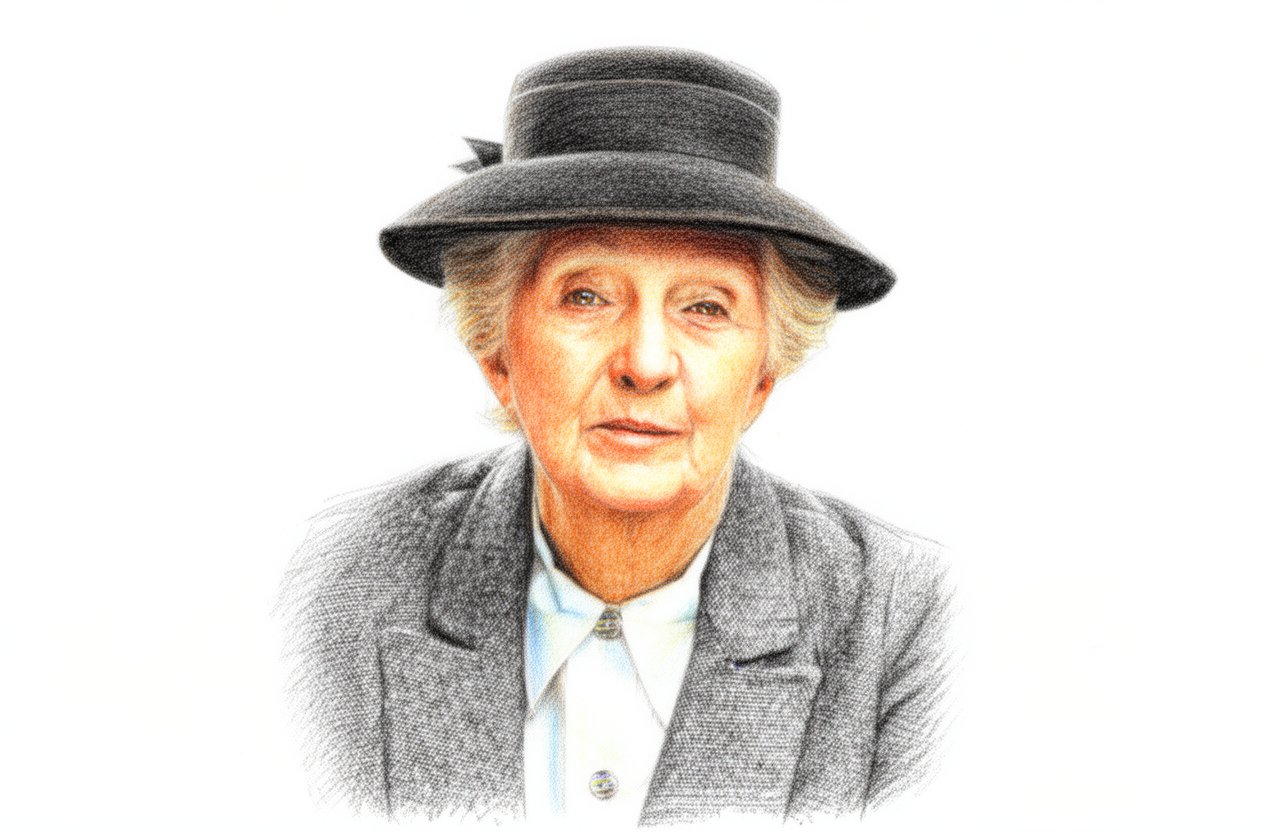
My Critique of Joan Hickson
Joan Hickson’s defining achievement was an unrivalled fidelity to Agatha Christie’s conception. Her Miss Marple, across the BBC series, eschewed theatrical flourish for needle-fine observation.
Where peers sought glamour or forensic intrigue, she emphasised moral vigilance rooted in ordinary experience. That unwavering restraint, indeed a narrower range than contemporaries like Gielgud or Dench, paradoxically strengthened the portrayal.
It delivered an archetype without the interpretive gymnastics sometimes applied to Poirot. For modern viewers, her work endures as a masterclass in narrative economy.
An autumnal poise recalls a culture of deference now largely historical, yet the drama’s psychological precision remains bracingly contemporary.
Early Life
Joan Hickson was born on August 5, 1906, in Kingsthorpe, Northamptonshire, into a comfortable middle-class family. Her father, Alfred Harold Hickson, was a shoe manufacturer, and her mother was Edith Mary (née Bogle).
The details of her childhood are not extensively documented, but her path to the stage was a deliberate one. She received her education at Oldfield School in Swanage, Dorset, a foundation that preceded her formal theatrical training.
Determined to act, Hickson enrolled at the prestigious Royal Academy of Dramatic Art (RADA) in London. This training provided the classical groundwork for a career that would later be defined by its naturalism.
Her professional journey began in the demanding world of provincial theatre, making her stage debut in 1927. These early years in repertory theatre were an invaluable apprenticeship, honing her craft through a wide variety of roles performed for diverse audiences.
Early Career & First Roles
Hickson’s early career was firmly rooted in the theatre, where she quickly became known for her adeptness at comedic and eccentric character parts. Her first London appearance came in 1928 at the Arts Theatre in ‘The Tragic Muse’.
She further developed her skills with the Oxford Repertory Company, a breeding ground for many fine British actors of the era. Her stage persona often leaned towards flustered maids, middle-class housewives, and slightly dotty relations, types she would perfect over decades.
Her transition to film was gradual. Her first screen credit was in the 1934 short ‘Trouble in Store’.
Throughout the 1940s and 1950s, she built a steady portfolio of supporting roles in British cinema. She appeared in films like ‘The Rake’s Progress’ (1945), ‘The Guinea Pig’ (1946), and the thriller ‘Seven Days to Noon’ (1950).
These roles, often uncredited or small, were the building blocks of a reliable character actress, allowing her to develop a keen sense of timing and presence in front of the camera.
Major Roles
Joan Hickson’s career was a long and distinguished one across stage, film, and television, but it is defined by one towering, era-defining achievement that cemented her place in the pantheon of great British character actors.
Miss Marple (1984-1992)
For an entire generation of mystery lovers, Joan Hickson did not merely play Miss Marple; she *was* Miss Marple. Her casting in the BBC’s series of Agatha Christie adaptations was a moment of perfect alchemy between actor and character.
Remarkably, Hickson had been noticed by Christie herself decades earlier; after seeing Hickson in a stage adaptation of ‘Appointment with Death’ in the 1940s, the author wrote her a note saying, “I hope one day you will play my dear Miss Marple.” It was a prophetic wish.
When the BBC embarked on a definitive series in the 1980s, Hickson, then in her late seventies, was the unequivocal choice. From 1984 to 1992, she starred in adaptations of all twelve Marple novels.
Her portrayal was a masterclass in subtlety and intelligence. She discarded any notion of a sweet, knitting old lady to reveal the steely, observant core of Christie’s creation.
Her Marple was deceptively gentle, with a voice that could soothe and eyes that missed absolutely nothing.
Hickson understood that Miss Marple’s power lay not in action but in perception. She would sit, often quietly, absorbing the tensions and lies swirling around her, her face a map of quiet deduction.
The famous “twinkle” in her eye was often the glint of a puzzle piece snapping into place. She brought a profound authenticity to the role, making the character’s leaps of intuition feel earned and real, grounded in a lifetime of observing human nature in her village of St.
Mary Mead.
The cultural impact of this portrayal cannot be overstated. Hickson set the gold standard, a performance so faithful to the spirit of the books that it rendered all previous cinematic attempts obsolete and created a daunting benchmark for all future adaptations.
She earned two well-deserved BAFTA nominations for Best Actress for her work, but more importantly, she earned the devotion of millions of viewers. For them, she remains the definitive Jane Marple—a portrayal that is both iconic and intimately familiar.
Our Man at St Mark’s (1963-1966)
Long before St. Mary Mead, Hickson demonstrated her peerless skill for character comedy in this beloved BBC sitcom.
As Mrs. Peace, the relentlessly inquisitive and gossipy parish magazine editor, she was a constant source of gentle chaos for the show’s protagonist, the long-suffering vicar.
The role was a perfect vehicle for Hickson’s talents, allowing her to play a character who was both immensely frustrating and utterly endearing.
Mrs. Peace was a masterpiece of comic timing.
Hickson perfected the art of the pointed question, the meaningful pause, and the expression of faux-innocence that masked relentless nosiness. She was the archetypal village busybody, but Hickson infused her with such specific humanity and lack of malice that she became a comedy icon of 1960s television.
This role proved her incredible versatility, showcasing her ability to hold her own in a fast-paced ensemble comedy and creating a character who was memorable and hilariously real.
Other Notable Work
Hickson’s career was a tapestry of excellent supporting roles. In the 1970s, she brought her signature warmth and sharp timing to popular sitcoms like ‘Bachelor Father’ as Mrs.
Pugsley and a memorable stint in ‘Whatever Happened to the Likely Lads?’ as Mrs. Chambers.
On film, she delivered a wonderfully sour turn as the disapproving hotel manageress in the classic comedy ‘Clockwise’ (1986) opposite John Cleese.
A fascinating footnote for Christie fans is her appearance in the 1961 film ‘Murder, She Said’, where she played the housekeeper—a role far removed from the detective she would later embody so completely. This extensive body of work across decades made her a familiar and welcome face, an actress whose presence guaranteed a scene would be grounded, truthful, and often quietly hilarious.
Acting Style
Joan Hickson was the quintessential character actress, a label she embraced with clear-eyed pragmatism. She once remarked, “I was never really pretty, so for someone like myself it’s more useful to be a character actress than a leading actress.” This was not self-deprecation but a shrewd understanding of her strengths.
Her style was rooted in profound naturalism. She avoided grand gestures or overt theatricality, instead building performances through meticulous observation and internal life.
Whether on stage or screen, she possessed an impeccable presence. She had the rare ability to be compelling even in stillness, her face conveying a universe of thought and reaction.
Her comic timing was precise, often derived from a perfectly delivered line or a fleeting, knowing glance. She specialized in portraying a certain strand of English middle-class life, finding both the humour and the pathos in characters like housewives, maids, and spinsters.
Her genius was in making the ordinary extraordinary, investing every role, no matter how small, with authenticity, depth, and a complete lack of ego.
Personal Life
Away from the cameras and footlights, Joan Hickson led a private and contented life. In 1932, she married Eric Norman Butler, a physician.
The couple had two children, a son and a daughter. Her marriage provided a stable and happy foundation, though it was tragically cut short by Eric’s death in 1967.
Hickson balanced the demands of her career with her family responsibilities, demonstrating the same quiet fortitude she brought to her roles.
For the last forty years of her life, she lived in a house at 2 Rose Lane in the picturesque village of Wivenhoe, Essex, overlooking the River Colne. On set, she was known for her kindness and nurturing spirit, earning the affectionate nickname “Aunt Joan” from younger colleagues.
She was a devoted fan of Agatha Christie’s novels long before she played Marple, which made her eventual casting a particularly personal triumph. She retired from acting at the age of 88 and passed away peacefully at her home in Wivenhoe on October 17, 1998.