
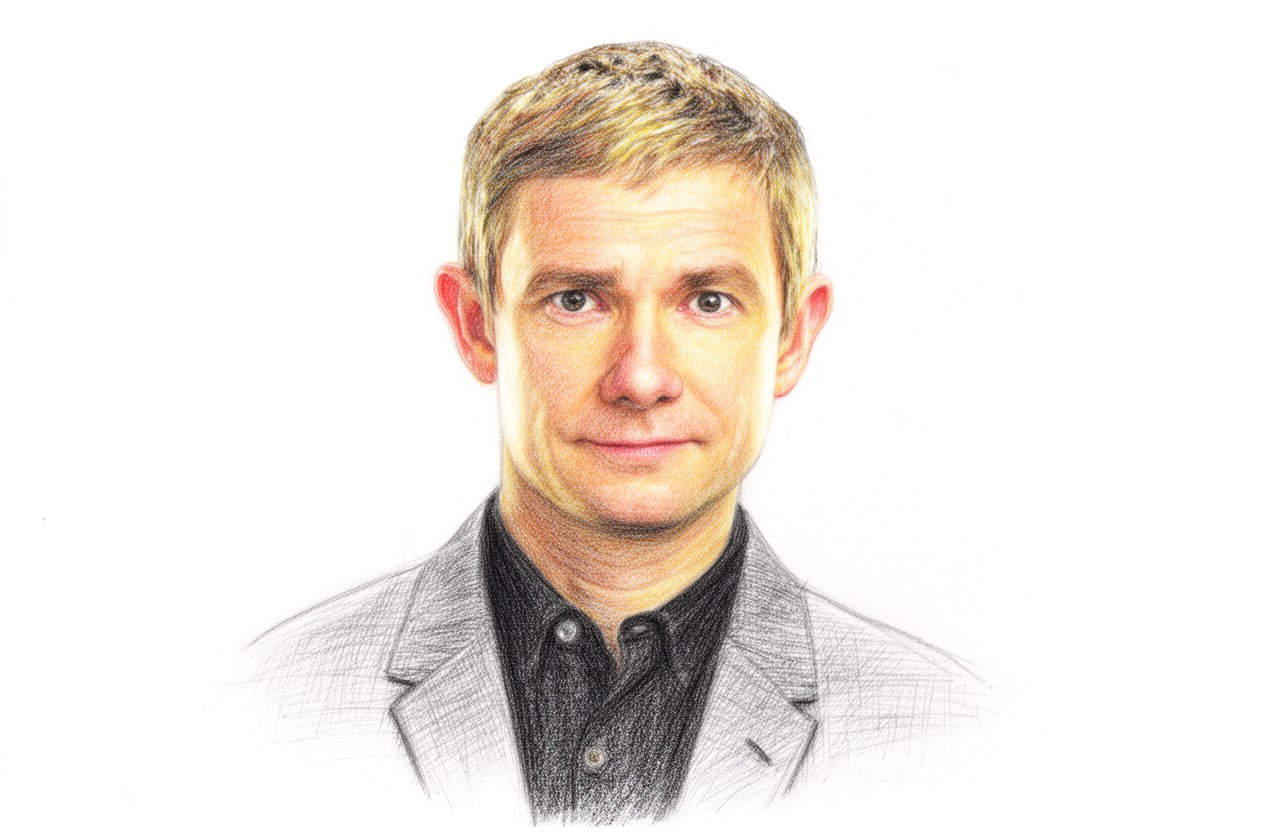
My Critique of Martin Freeman
Martin Freeman’s defining strength is his precise modulation of quiet exasperation, a trait that anchors the emotional realism of The Responder. In a field populated by overtly charismatic leads, his grounded vulnerability offers a refreshing counterpoint to the bluster of contemporary British crime drama.
However, this very ordinariness can sometimes constrain him, as his portrayal of Detective Superintendent Steve Fulcher in A Confession risked a muted response where a more commanding presence might have provoked deeper debate. For modern viewers, Freeman matters because he locates the human cost within institutional crisis, making him a vital, if understated, barometer of British policing’s fraught moral landscape.
Early Life
Martin John Christopher Freeman was born on September 8, 1971, in Aldershot, Hampshire. The youngest of five children in a Roman Catholic household, his early life was marked by both discipline and profound loss.
His father, Geoffrey, a naval officer, died of a heart attack when Martin was just ten, an event that deeply shaped his worldview.
Despite health challenges—childhood asthma and a hip operation—Freeman displayed remarkable tenacity. He was a member of the British national squash team between ages nine and fourteen.
When he left competitive sport, he found a new outlet in a local youth theatre, sparking the passion that would define his life.
He studied media at Brooklands College before committing fully to acting at London’s prestigious Central School of Speech and Drama. A quieter family history also echoes: his paternal grandfather, Leonard W.
Freeman, was a medic killed at Dunkirk just days before the famous evacuation.
Early Career & First Roles
Freeman’s professional journey began with the typical graft of British television, with early appearances in shows like ‘The Bill‘ (1997). His breakthrough arrived in 2001 with the role of Tim Canterbury in Ricky Gervais and Stephen Merchant’s groundbreaking sitcom, ‘The Office’.
His beautifully understated performance as the everyman trapped in a soul-crushing job, nursing a quiet love for Dawn (Lucy Davis), made him a household name. This role established his signature style: relatable, grounded, and brimming with unspoken depth.
It was the perfect launchpad.
Major Roles
Martin Freeman’s career is a masterclass in selective excellence, moving from cult comedy darling to a dramatic anchor of some of the most compelling mystery and crime narratives of the 21st century. His choices reveal an actor drawn to complexity, moral ambiguity, and the quiet battles of ordinary people in extraordinary circumstances.
Chris Carson in *The Responder* (2022–2024)
As Chris Carson, a crisis-stricken Liverpool police officer working relentless night shifts, Freeman delivers what may be the most raw and powerful performance of his career. Shedding any vestige of cozy familiarity, he immerses himself in the grinding despair of a good man being systematically broken by a broken system.
Freeman’s Carson is a portrait of moral decay and desperate survival. His face, often etched with exhaustion and trauma, communicates volumes where the terse, Liverpudlian-accented dialogue leaves off.
We see the conflict in every interaction—the dwindling empathy for the public he serves, the corrosive compromises he makes with local drug dealers, and the terrifying distance growing between him and his family.
This is not a heroic cop drama; it is a harrowing psychological descent. Freeman fearlessly explores Carson’s vulnerability, rage, and profound isolation.
His chemistry with Adelayo Adedayo, who plays his rookie partner Rachel, is electric, a fraught dynamic that becomes the show’s fragile moral core. The role demanded a physical and emotional transformation, and Freeman committed utterly, presenting a character who is by turns frightening, pitiable, and heartbreakingly human.
For fans of mystery and crime, *The Responder* is essential viewing precisely because of Freeman’s work. It transcends procedure to ask difficult questions about duty, corruption, and mental health.
Freeman doesn’t just play Chris Carson; he inhabits his crumbling psyche, offering a devastatingly authentic look at the human cost of policing’s front line. It is a distinguished, compelling piece of acting that cements his status as a dramatic force.
Dr. John Watson in *Sherlock* (2010–2017)
Reimagining a literary icon for a modern audience is a daunting task, yet Freeman’s portrayal of Dr. John Watson became instantly definitive.
In Steven Moffat and Mark Gatiss’s brilliant update, Watson is far from a mere chronicler; he is a wounded war veteran, a man adrift with PTSD, whose life is reignited by the chaotic brilliance of Benedict Cumberbatch’s Sherlock Holmes.
Freeman’s genius lies in making Watson the relatable heart of this fantastical world. His dry, often exasperated wit provides the perfect counterbalance to Holmes’s theatrics, grounding the series in a recognizable emotional reality.
We believe in their friendship—the loyalty, the frustration, the profound, unspoken bond—because Freeman makes Watson’s devotion and bedrock decency so palpable.
He is the audience’s conduit, our sense of wonder and moral compass. Whether navigating crime scenes, personal betrayal, or the complexities of his own love life with Mary Morstan (Amanda Abbington), Freeman brought a subtlety and depth that made Watson a fully realized, modern man.
This role showcased his impeccable timing and his unique ability to convey a universe of thought with a single glance or a weary sigh. It was a masterful performance that earned him global acclaim and a well-deserved Emmy Award.
Other Notable Work
Beyond the small screen, Freeman’s film work showcases his remarkable range. He brought a perfect, bewildered sincerity to Arthur Dent in *The Hitchhiker’s Guide to the Galaxy* (2005).
His collaborations with Edgar Wright—including iconic cameos in *Shaun of the Dead* (2004) and *Hot Fuzz* (2007)—highlight his flawless comedic instincts.
In a blockbuster realm, he anchored Peter Jackson’s *The Hobbit* trilogy (2012-2014) as Bilbo Baggins, capturing the character’s warmth, courage, and internal conflict. On television, his chilling turn as the meek-turned-malicious Lester Nygaard in the first season of *Fargo* (2014) demonstrated a capacity for darkness that surprised many and won him further critical praise.
Each role, whether lead or support, is treated with the same meticulous commitment.
Acting Style
Martin Freeman’s style is the art of the understated. He is a master of naturalism, creating characters that feel authentically, sometimes painfully, real.
There is no grand theatricality, only a profound commitment to psychological truth. His performances are built on subtlety—a micro-expression, a hesitant pause, a weary shift in posture—that conveys more than pages of dialogue could.
He possesses a peerless dry wit and impeccable comic timing, honed in comedy but equally effective in drama to relieve tension or reveal character. Yet, his greatest strength may be his ability to project vulnerability.
He allows his characters to be fragile, confused, and scared, which makes their resilience and moments of courage truly resonate. He is the compelling, highly respected professional who makes exceptional work seem effortless.
Personal Life
Freeman has long maintained a dignified separation between his public and private life. He was in a long-term relationship with actress Amanda Abbington from 2000 to 2016; they have two children together.
A close friendship with actor Simon Pegg, who is godfather to his son, speaks to his loyal circle within the industry.
Raised Roman Catholic, he identifies as non-practicing but acknowledges the faith’s deep influence on his character. He is known for a modest, down-to-earth personality and a sharp, mod-inspired personal style, citing musician Paul Weller as an influence.
He has faced personal loss, including the passing of his brother, Jamie, in 2022. Freeman resides in London and, true to form, focuses public discussion on his work rather than his private world.
In closing…
Martin Freeman’s journey from the Slough trading estate of *The Office* to the night-soaked streets of Liverpool in *The Responder* charts the evolution of a truly distinctive actor. He has become a reliable beacon of quality, choosing roles that challenge and subvert expectation.
For the discerning viewer of mystery and character drama, Freeman is a guarantee of integrity, depth, and captivating humanity. His career is a testament to the power of quiet skill, and his best performances continue to reveal new layers upon each revisit.