
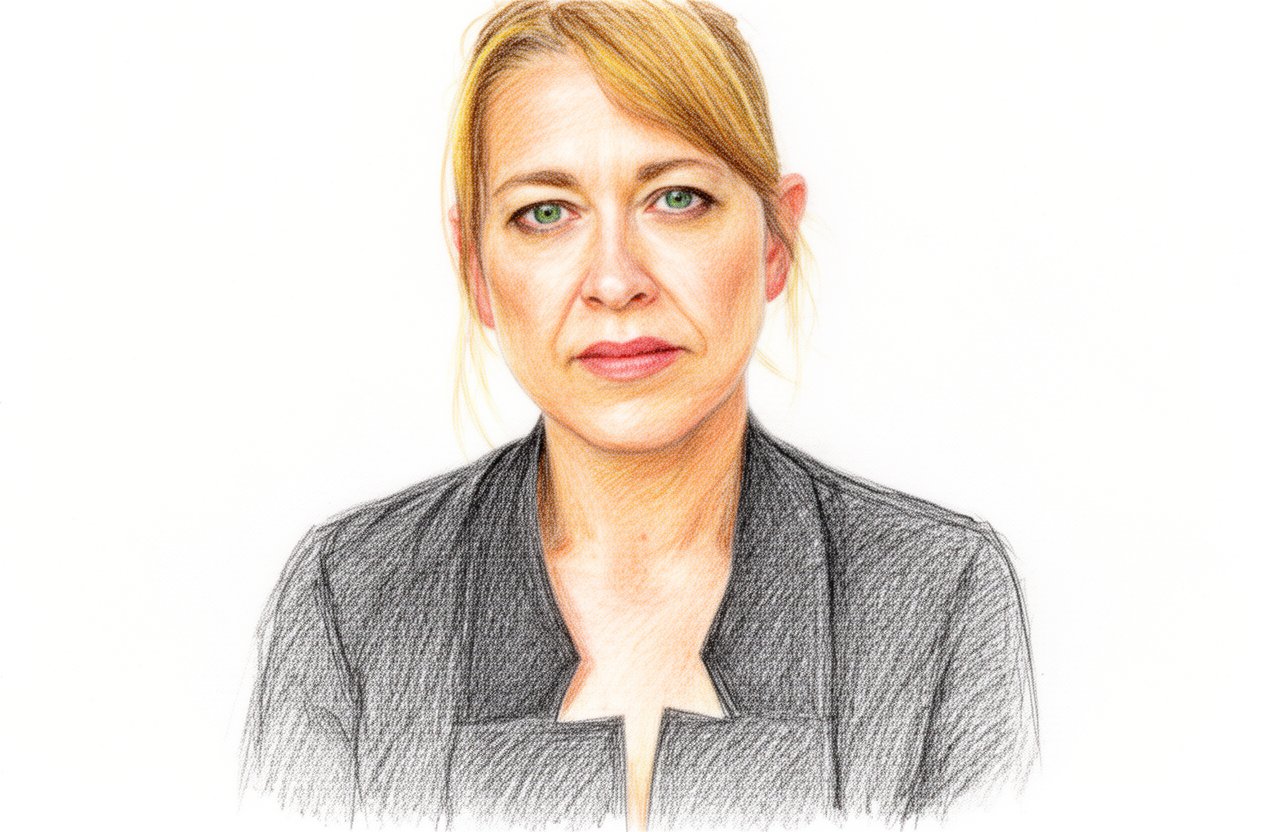
## My Critique of Nicola Walker
Nicola Walker’s defining skill is conveying deep intelligence beneath a shield of emotional restraint.
This quality makes her exceptional within the largely cerebral field of British leads, setting her apart from peers by grounding procedural logic in palpable, simmering grief. There is a darker counterpoint, however: her characters frequently bear trauma or end in tragedy, which can feel like a repetitive, punishing burden on a modern viewer.
Her work in *Unforgotten* remains a benchmark, yet her necessity to such material proves its double-edged sword. Ultimately, she matters because she elevates genre television into a sustained study of human resilience under pressure.
## Early Life
Nicola Walker was born on May 15, 1970, in Stepney, London, into a family where she was the first to pursue higher education. Her childhood was marked by international movement, living in countries like the Bahamas and Spain, which perhaps seeded the quiet observational skills that would later define her acting.
Initially taking acting classes at twelve to navigate social anxieties, she found a genuine passion encouraged by her mother.
Her academic path led her to Forest School in Walthamstow and then to New Hall, Cambridge, where she read English. It was at university that her theatrical life began in earnest with the famed Cambridge Footlights.
There, she performed alongside future collaborators like writer David Wolstencroft and comedian Sue Perkins, with whom she later shared a London flat. Upon graduation, she made a pivotal choice, turning down a place at RADA to dive directly into the professional world, a decision that speaks to a confident, practical approach to her craft from the very start.
## Early Career & First Roles
Walker’s early career was a study in versatile groundwork across stage, radio, and television. After festival performances in Edinburgh and London, her screen breakthrough came with Steven Moffat’s sitcom ‘Chalk’ (1997), playing teacher Suzy Travis.
This immediately demonstrated her aptitude for naturalistic comedy. She swiftly balanced this with dramatic turns, notably as DI Susan Taylor in the gritty ITV serial ‘Touching Evil’ (1997).
Her pre-fame film appearance as a folk singer in ‘Four Weddings and a Funeral’ (1994) hinted at a warmth and authenticity she would later fully deploy. Roles in adaptations like ‘A Dance to the Music of Time’ (1997) and ‘Oliver Twist’ (1999), alongside guest spots in ‘Jonathan Creek’ and ‘Dalziel and Pascoe’, built a solid foundation.
This period established her as a reliable and intriguing presence, capable of moving seamlessly between genres long before her defining roles arrived.
## Major Roles
Nicola Walker’s career is a masterclass in building a formidable body of work through intelligent role selection and profound character commitment. She has become synonymous with complex, emotionally resonant women, often operating in high-stakes professional environments.
Her performances are not mere portrayals; they are deeply lived-in experiences that reward the attentive viewer with layers of nuance and authenticity.
### Detective Chief Inspector Cassie Stuart – Unforgotten (2015-2021)
As DCI Cassie Stuart in ITV’s ‘Unforgotten’, Walker delivered what many consider a career-defining performance, anchoring one of the most respected British crime dramas of its era. Cassie was a revolutionary figure in the genre: a senior detective devoid of the typical tropes of addiction, broken homes, or maverick arrogance.
Instead, Walker presented a woman defined by her profound empathy, meticulous professionalism, and a quiet, resilient humanity.
Her partnership with DI Sunny Khan (Sanjeev Bhaskar) was the heart of the show, a platonic relationship built on mutual respect, dry humour, and unshakeable trust. Walker and Bhaskar crafted a dynamic that felt authentically collegial and deeply affectionate.
Cassie’s strength was in her listening, her thoughtful pauses, and her ability to connect with both victims and suspects on a human level. Walker made the procedural work compelling not through outbursts, but through subtle glances and the weight of understood responsibility.
The emotional depth Walker brought to the role was staggering. In the show’s third series, Cassie’s personal trauma following a violent attack was handled with devastating realism.
Walker portrayed PTSD not as melodrama, but as a quiet, debilitating shadow affecting her work and relationships. Her final series arc, culminating in a heartbreaking and dignified exit, was a testament to Walker’s ability to convey immense inner turmoil with breathtaking restraint.
It was a masterful performance that redefined the possibilities of the television detective.
### Ruth Evershed – Spooks (2003-2006, 2009-2011)
Before ‘Unforgotten’, Walker had already cemented her status with another iconic role: Ruth Evershed in the BBC’s sleek spy drama ‘Spooks’. Initially introduced as a temporary analyst, Ruth’s intelligence, integrity, and vulnerability made her an instant favourite, and Walker was promoted to series regular.
In the hyper-competent, often morally ambiguous world of MI5, Ruth was the conscience—brilliant but not infallible, fiercely loyal, and emotionally transparent in an environment that demanded opacity.
Walker’s great achievement was making Ruth’s analytical genius palpable and her romantic life profoundly moving. Her will-they-won’t-they relationship with Section Chief Harry Pearce (Peter Firth) became one of British TV’s most cherished slow-burn romances.
It was built on years of shared glances, unspoken understanding, and professional devotion. Walker played Ruth’s love not with grand gestures, but with a heartbreaking openness that was constantly at odds with the demands of their secretive profession.
Ruth’s journey, from a nervy analyst to a seasoned, courageous officer willing to sacrifice everything, was beautifully charted by Walker. Her departure from the series (and later return) provided some of the show’s most emotionally charged moments.
The role proved Walker’s unique talent for making the “person in the room thinking” utterly compelling television, establishing a blueprint for the intelligent, nuanced female characters she would continue to excel in portraying.
### Other Notable Work
Walker’s excellence extends far beyond these two pillars. As Hannah Stern in BBC One’s ‘The Split’, she captured the exhausting duality of a high-powered divorce lawyer navigating her own familial disintegration, balancing steely professional resolve with deep personal fracture.
In the BBC Six drama ‘River’, her role as the deceased partner of DI John River (Stellan Skarsgård) was a ghostly, complex presence felt throughout the series.
She brought acerbic warmth and tragic dimension to Gillian, the troubled daughter in Sally Wainwright’s ‘Last Tango in Halifax’. Her guest appearance in ‘Luther’ as Linda Shand was a chilling study in manipulative grief.
On stage, her performance as Siobhan in the National Theatre’s ‘The Curious Incident of the Dog in the Night-Time’ was critically lauded. This diverse portfolio, from the lead in the marine crime drama ‘Annika’ to voice work in the podcast sensation ‘The Lovecraft Investigations’, showcases a remarkable and disciplined range.
## Acting Style
Nicola Walker’s acting style is the antithesis of showy technique. It is an exercise in profound authenticity and emotional precision.
She is a master of minimalism, understanding that the most powerful moments are often found in reaction, in silence, and in the subtle shift of expression. Her performances are built on a foundation of intense listening and truthful presence, making her characters feel not like constructs, but like real people caught on camera.
She specializes in portraying intelligent, professional women who carry the weight of their roles with a relatable weariness and deep competence. There is a palpable interiority to her work; you sense the constant internal monologue, the weighing of options, the management of personal feeling against professional duty.
This makes her ideal for crime and drama, where subtext is everything. Her voice, capable of moving from dry wit to trembling vulnerability in a syllable, is a key instrument.
Walker’s style doesn’t demand attention; it earns it through unwavering commitment and emotional honesty, making her one of the most reliably compelling performers on screen.
## Personal Life
Nicola Walker has successfully cultivated a private life away from the public glare, a rarity in modern celebrity culture. She is married to actor Barnaby Kay, whom she met during a theatre production in the 1990s.
Together, they have a son, Harry, born in 2006. Walker is notably absent from social media, a conscious choice that allows her work to speak for itself and protects her family’s normality.
Her interests reflect a thoughtful and curious mind. An avid reader with a degree in English Literature, she also enjoys photography and visiting museums and galleries.
The peripatetic nature of her childhood instilled a love of travel, which she continues with her family. This balance—a rich inner life and a steadfast commitment to a private domestic world—seems to fuel her artistry.
It provides a well of experience and stability from which she can draw to portray the complexities of the public lives her characters lead, all while maintaining a grounded sense of self.
## In closing…
Nicola Walker represents the pinnacle of intelligent, character-driven performance in British television. Her career is not built on celebrity, but on a quiet, cumulative power—a succession of roles where her extraordinary empathy and technical restraint have deepened every narrative she’s touched.
For fans of mystery and character drama, she is a guiding star: an actor who consistently chooses substance over spectacle, and in doing so, creates television that resonates with lasting emotional truth. She is, quite simply, one of the most valuable players in the industry.