
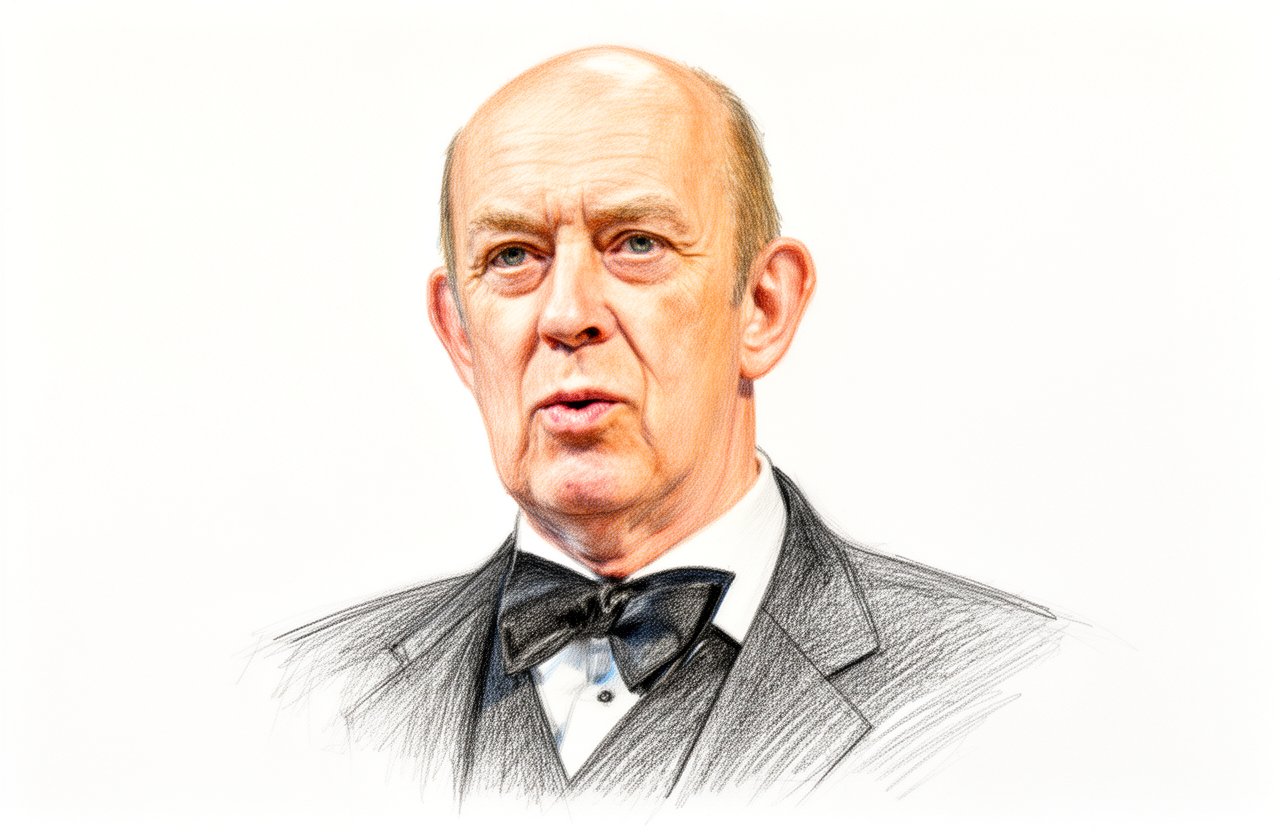
My Critique of Roy Marsden
Roy Marsden carved his niche through an unwavering commitment to introspection and authority, qualities that defined his signature portrayal of Commander Adam Dalgliesh. His ability to project intellectual rigour without sacrificing emotional vulnerability set a benchmark for the genre.
However, his intensity occasionally bordered on the austere, lacking the warmer, more accessible charisma of contemporaries like John Thaw in *Inspector Morse*. This stylistic restraint, while artistically pure, could occasionally alienate audiences seeking a more intimate connection.
For modern viewers, Marsden remains a vital study in dignified, cerebral performance. He represents a British tradition where stoicism is a complex psychological landscape, not merely a character trope.
Early Life
Roy Marsden was born Roy Anthony Mould on June 25, 1941, in Stepney, London. His journey into the performing arts began at the prestigious Royal Academy of Dramatic Art (RADA), a training ground that would shape his future but also witness his rebellious spirit.
Even as a student, Marsden displayed a fierce independence and a commitment to principle, notably attempting to unionize his fellow students—an effort that was ultimately thwarted by the establishment.
This defiance was not an isolated incident. A profound artistic disagreement with a director culminated in a famously theatrical, if unorthodox, protest: Marsden poured a bottle of urine down the man’s suit.
Rather than ending his career, this act of conviction paradoxically forged it. The director, perhaps recognizing a raw talent that needed direction, arranged for Marsden to begin his professional life at a theatre in Nottingham.
It was here that fate intertwined his path with another future great. The student assistant manager at the theatre was a young Anthony Hopkins.
Marsden, convinced of Hopkins’ potential, successfully persuaded him to apply to RADA, a pivotal nudge that helped launch one of cinema’s most celebrated careers. This early chapter revealed a complex individual: artistically bold, intellectually rigorous, and unafraid to challenge authority in pursuit of what he believed was right.
Early Career & First Roles
Following his formative Nottingham experience, Marsden honed his craft with the Royal Shakespeare Company in the early 1960s, immersing himself in the classical canon. His early career was a deliberate tapestry of stage work, favoring the substance of alternative and experimental theatres over London’s more commercial offerings.
He built a formidable reputation in plays by Chekhov, Ibsen, and other demanding dramatists, showcasing a preference for psychological depth.
His screen career began in the late 1960s with television adaptations, playing George Osborne in “Vanity Fair” (1967) and Sir Andrew Ffoulkes in “The Elusive Pimpernel” (1969). The stage, however, remained his primary arena.
He captivated audiences for two consecutive years as a charismatic Long John Silver in “Treasure Island” at London’s Mermaid Theatre and later tackled the iconic role of Henry Higgins in “Pygmalion” at the Albery Theatre. These roles cemented his status as a versatile and compelling stage actor, capable of both swashbuckling flair and intellectual precision.
Major Roles
Roy Marsden’s career is defined by two towering television performances that bookended two decades and showcased the remarkable range of his talent. From the cold, calculating corridors of espionage to the introspective, poetic world of detection, he created characters that were not merely watched but studied, leaving an indelible mark on British television drama.
Neil Burnside in *The Sandbaggers* (1978-1980)
In the late 1970s, Marsden delivered a performance of such chilling authenticity that it redefined the on-screen spy. As Neil Burnside, the Director of Operations for the British Secret Intelligence Service’s “Sandbaggers” unit, he was the antithesis of the glamorous, martini-sipping agent.
Burnside was a bureaucrat of life and death, a man whose battlefield was a grey Whitehall office, whose weapons were files, lies, and cold calculus.
Marsden’s portrayal was a masterclass in minimalist intensity. He conveyed immense pressure and moral corrosion through the slightest tightening of the jaw, a weary rub of the eyes, or a voice drained of all emotion save for a corrosive cynicism.
Burnside was not a hero; he was a necessary monster, sacrificing his humanity and that of his agents on the altar of “the national interest.” The character’s famous line, “I don’t *care* what you feel,” delivered with flat finality, encapsulated a worldview stripped of sentiment.
The genius of Marsden’s performance lay in its heartbreaking contradictions. Beneath the glacial exterior flickered moments of profound guilt and even affection for his team, emotions he was professionally obligated to suppress.
This internal conflict made him tragically compelling. “The Sandbaggers” was never a major ratings hit, but its cult status is built upon the granite foundation of Marsden’s career-defining work.
He created arguably the most realistic and morally complex intelligence officer ever depicted on television, a performance that continues to shadow every subsequent spy drama.
Commander Adam Dalgliesh in the P.D. James Adaptations (1983-1998)
If Neil Burnside was a creature of icy pragmatism, Commander Adam Dalgliesh was his philosophical opposite: a man of deep feeling, channeled through poetry and a relentless pursuit of truth. Cast as P.D.
James’s iconic detective in 1983, Marsden inhabited the role for fifteen years across numerous adaptations, becoming the definitive visual representation of Dalgliesh for a generation.
His Dalgliesh was a study in quiet authority and profound introspection. Marsden captured the character’s essential loneliness, his poetic sensibility, and his almost monastic dedication to his work.
The detective’s method was not brute force but intellectual and psychological penetration, and Marsden excelled at conveying the silent, watchful process of deduction. A scene of him simply observing, his eyes missing nothing, could be as tense as any action sequence.
Marsden guided the character through significant personal evolution, from the younger, more vulnerable detective in “The Black Tower” (1985) to the older, wearier, yet still brilliant Commander in “A Certain Justice” (1998). He beautifully balanced Dalgliesh’s professional detachment with the character’s underlying humanity and compassion for the victims caught in the wake of crime.
This long-term commitment allowed for unparalleled depth, making his Dalgliesh a fully realized human being, not just a puzzle-solving function. It is a distinguished and masterful portrayal that sits at the very heart of the British detective genre.
Other Notable Work
Beyond these two pillars, Marsden’s career is a rich landscape of memorable characterizations. He brought a mischievous glint to Sir Charles Marlow in the 2008 television film “She Stoops to Conquer” and lent gravitas as the suspicious Commander Haydock in Agatha Christie’s “N or M?” (2016).
He even ventured into the world of “Doctor Who,” playing the sinister hospital administrator Mr. Stoker in the 2007 episode “Smith and Jones.”
His talent for impersonation was showcased in the political drama “Margaret” (2009), where he played former Conservative Cabinet Minister Norman Tebbit. Each role, whether lead or support, was treated with the same rigorous commitment to authenticity, further demonstrating the remarkable versatility of this most distinguished actor.
Acting Style
Roy Marsden’s acting style is the embodiment of controlled power and intellectual depth. He is an actor of the interior, specializing in characters who think deeply and feel profoundly, often while presenting a composed, even austere, exterior.
His preferred domain is the psychological landscape, making him a natural fit for detectives, spies, and authority figures burdened by knowledge and consequence.
He possesses a commanding stillness; a Marsden performance is often most potent in silence, where a subtle shift in gaze or a slight physical tension conveys volumes. This economy of expression demands and rewards close attention.
His voice, capable of both steely command and weary melancholy, is a precise instrument used to delineate character and mood. Fundamentally, he is an actor of authenticity, immersing himself fully to present not a caricature of authority, but a believable, complex, and often troubled human being occupying a position of power.
Personal Life
Roy Marsden has rigorously maintained a separation between his public craft and his private world. In 2005, he made official what the acting world had long known, changing his legal name from Roy Anthony Mould to Roy Marsden.
He was married to actress Polly Hemingway from 1972 until their divorce in 1992, and they have two sons together.
Beyond these basic facts, he has chosen to keep the details of his family life and personal pursuits away from the spotlight. He is known to be an avid reader with a particular affinity for the detective novels that align so closely with his famous roles, and he maintains a passion for classical music.
This deliberate privacy is not aloofness, but rather a principled choice to let his substantial body of work speak for itself, a stance that has only bolstered the respect he commands from colleagues and audiences.
In closing…
Roy Marsden’s career is a testament to the power of nuanced, intelligent performance. He did not merely play characters; he excavated them, revealing the complex strata of motive, duty, and emotion beneath the surface.
Whether as the brutally pragmatic Neil Burnside or the poetically minded Adam Dalgliesh, he brought a rare depth and authenticity that transcended genre. For discerning viewers who appreciate craft, subtlety, and psychological realism, his work remains a benchmark of distinguished British acting.