My Critique of A Touch Of Frost
A Touch of Frost centres the procedural on human fallibility rather than forensic theatrics. David Jason’s DI Frost is brilliantly intuitive but insubordinate and emotionally ragged.
This friction with Bruce Alexander’s bureaucratic Mullett yields conflict that feels authentic rather than performative. Compared with contemporaries such as Inspector Morse or Cracker, it avoids aristocratic cerebral polish and procedural bombast.
Its writing consistently interrogates institutional indifference and class privilege, yet some late entries soften stakes with formulaic resolutions. Despite that recurring constraint, the show matters to modern audiences for its compassionate scrutiny of vulnerable suspects and the quiet erosion of policing norms.
Even now, its blend of moral ambiguity, dry wit, and unvarnished provincial detail remains a rigorous benchmark for British crime drama.
Principal Characters & Performances
Detective Inspector Jack Frost
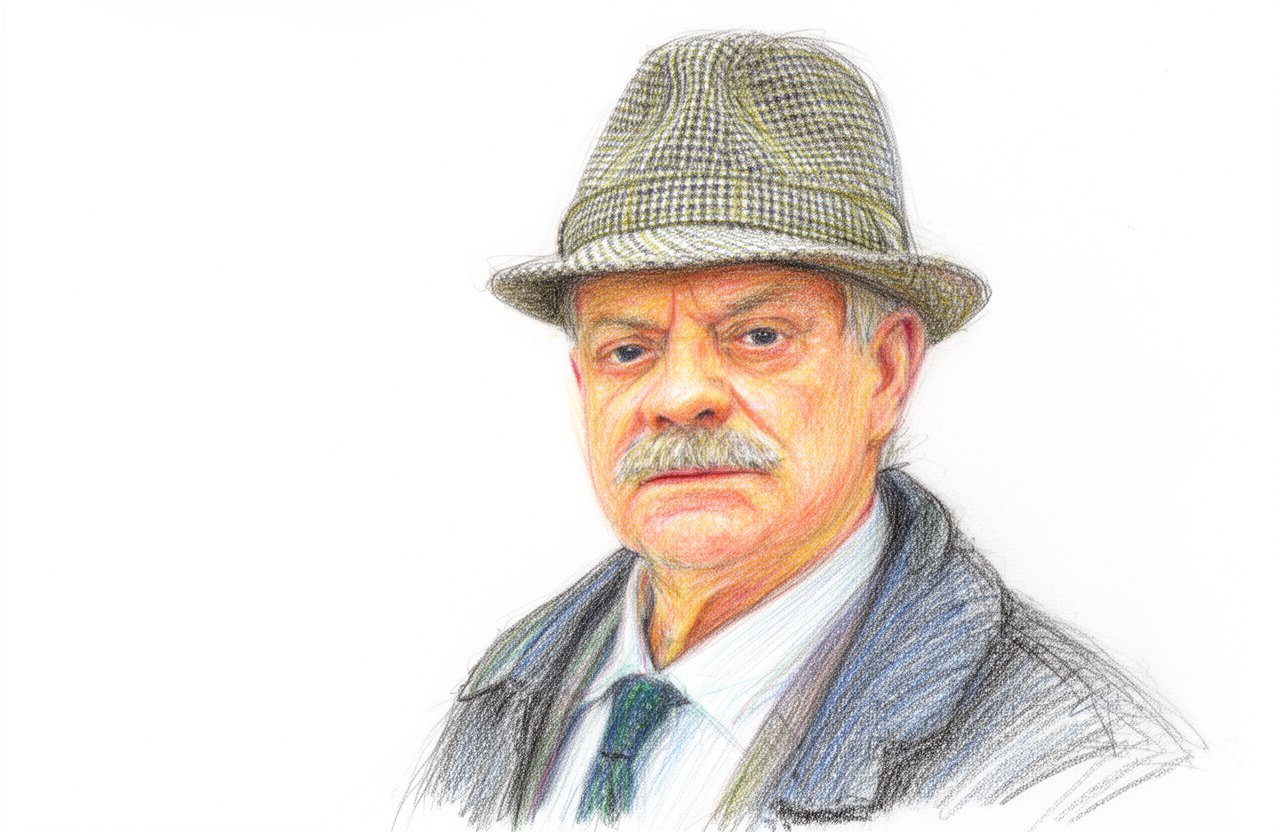
David Jason’s portrayal of Detective Inspector William Edward “Jack” Frost is the definitive performance at the heart of the series. For eighteen years and forty-two feature-length episodes, Jason crafted a character of remarkable depth and enduring appeal.
Frost is the archetypal maverick detective, a figure defined by his rumpled appearance and chaotic methods.
His untidy desk and worn mac are external signs of a mind that operates on instinct and local knowledge rather than strict procedure. Jason infused the role with a profound humanity, balancing Frost’s sardonic, often muttered humour with a palpable undercurrent of personal sadness.
This emotional weight, established from the pilot where he cares for his terminally ill wife, is the engine for his deep-seated compassion. He champions society’s victims with a doggedness that frequently puts him at odds with his superiors.
Jason never allows Frost to become a mere rebel.
He is shown to be a consummate investigator, his unconventional approach frequently uncovering truths that cleaner methods miss. Winning the BAFTA TV Award for Best Actor in 1993 was a public affirmation of Jason’s seamless transition from beloved comic actor to a dramatic lead of great subtlety and power.
The role significantly changed public perception of David Jason, proving his range and securing his status as one of British television’s most versatile stars. His performance added a layer of gritty realism and relatable weariness that made Frost feel authentically human.
Superintendent Norman Mullett
Bruce Alexander’s Superintendent Norman Mullett serves as the perfect bureaucratic counterweight to Frost’s intuitive chaos. Mullett is the personification of modern police management, obsessed with budgets, statistical clear-up rates, and avoiding any scandal that might reflect poorly on the station.
Alexander’s performance is a masterclass in nuanced frustration. He plays Mullett not as a villain, but as a middle-manager perpetually caught between Frost’s effective but messy results and the pressure from his own superiors for orderly, cost-effective policing.
Their dynamic provides a reliable source of both tension and dry comedy. Mullett’s polished shoes and meticulously organised office are a visual joke against the backdrop of Frost’s disarray.
Yet Alexander allows moments of grudging professional respect to peek through the exasperation.
This creates a relationship that feels authentically fraught and long-standing. Mullett represents the institutional constraints Frost constantly tests, making their interactions a central pillar of the show’s internal conflict and a key driver of its narrative tension.
The Station Ensemble and Notable Guests
The Denton CID feels like a real workplace thanks to its rich ensemble. John Lyons provides the steady, reliable core as Detective Sergeant George Toolan, Frost’s long-time colleague and friend.
He is the family man and sounding board, often the voice of cautious reason.
Arthur White is unforgettable as Police Constable Ernie Trigg, the station archivist. His value lies not in technology but in an encyclopaedic memory of local gossip and history, often providing the crucial lead.
Caroline Harker’s WPC, later DS, Hazel Wallace represents a more diligent, by-the-book generation.
Guest stars frequently elevate individual stories with powerful performances. Lennie James brings gravity as DC Carl Tanner in an episode dealing with crimes in a largely Black community.
Bill Stewart’s local journalist Sandy Longford offers a pragmatic, information-trading relationship with Frost.
Other notable figures include Matt Bardock as the ambitious DC Clive Barnard and Philip Jackson as the methodical DS Billy “Razor” Sharpe. These performances collectively root the series in a wider, interconnected community beyond the station walls, adding layers of authenticity.
Key Episodes & Defining Stories
Appropriate Adults
This episode is a harrowing examination of police power and vulnerability. Frost investigates the murder of a young girl, with suspicion centering on Billy Conrad, a well-liked man with Down syndrome.
The moral conflict crystallises with the arrival of DCI Hawkes, played with chilling efficiency by Matthew Marsh.
Hawkes represents a brutal, target-driven style of policing, aggressively seeking a confession from the vulnerable suspect. Frost is forced into the role of protector, challenging coercive interview tactics and the very safeguards meant to exist for people like Billy.
It matters in the series arc because it isolates Frost’s fundamental decency as his guiding principle, placing it in direct opposition to institutional pressure for a quick result. It defines his character not by rule-breaking alone, but by a deeper ethical code.
Fans remember it for its fearless, uncomfortable realism and for showcasing justice as an ethical act, not just a procedural one. The sensitive handling of the subject matter and the stark performance clash between Jason and Marsh make it a standout, controversial instalment.
Line of Fire
This story from Series 6 turns a critical eye on Frost’s own legacy. Returning from compassionate leave, he is drawn into a media storm questioning a past conviction he secured, known as the “Black Farm Murders.” Simultaneously, he investigates the death of art collector Lester Bryce-Jones, a case tied to a stolen Hockney painting.
The two narratives converge to scrutinise the fallibility of Frost’s methods and the potential for past error. Guest star James Laurenson, as the deceased Bryce-Jones, anchors the art-world intrigue.
The episode forces Frost to operate under siege, battling internal politics and his own doubts.
It matters as a turning point that deepens the series’ maturity, moving beyond simple case-solving to explore the consequences and potential compromises of a long detective career. It adds a layer of introspection and vulnerability to Frost’s character.
Fans value it for its complex, interwoven plotting and for presenting a more vulnerable, introspective Frost. The intertwining of media scrutiny, art theft, and a potential miscarriage of justice represents the show at its most ambitious and thematically rich.
If Dogs Run Free
As the two-part series finale, this episode carries the inevitable weight of conclusion. Frost’s final case pits him against Gerry Berland, a ruthless crime boss played by John McArdle, whose illegal dog-fighting ring escalates to murder and witness intimidation.
The narrative directly engages with Frost’s place in a changing police culture and his advancing age, bringing his professional journey to a head. It rigorously tests his old-school resolve and personal methods against a modern, violent criminal enterprise.
It matters profoundly as it provides narrative closure, addressing long-running character arcs and acknowledging the end of an era for both Frost and the series itself. It is the definitive endpoint of his eighteen-year television journey.
Fans remember it as a fitting and emotionally coherent farewell. It provides a conclusion true to the character’s essence: a weary but unwavering detective doing the job right until the very end.
Its broadcast was a significant television event, offering a satisfying sense of finality.
The World of A Touch of Frost
The series is set in the fictional Thames Valley town of Denton, a place given geographical believability through frequent references to real nearby locations like Reading, Oxford, and Swindon. This anchors the drama in a recognisable provincial south of England, within the jurisdiction of the Thames Valley Police.
In production, Denton was brought to life through extensive location shooting across Leeds and West Yorkshire. This choice gives the show its authentic, unvarnished texture.
The environment is deliberately varied, encompassing drab urban housing estates, quieter suburban avenues, and the surrounding countryside with its quarries and farms.
This variety allows for a wide range of crime stories, from domestic tragedies in terraced houses to mysteries rooted in rural secrecy and privilege. Denton Police Station itself, with external scenes filmed at an industrial complex on Burley Road in Leeds, feels like a functional, worn-out workplace.
Frost’s blue Ford Sierra, with its Luton-area registration plate, is a familiar sight traversing this landscape. The use of real locations like Seacroft Hospital for Denton Hospital grounds the drama in a tangible reality, making the town itself a central and tangible character in every story.
Origin Story
A Touch of Frost began as a television adaptation of the detective novels written by R.D. Wingfield.
The pilot episode, “Care and Protection,” was adapted for television by writer Richard Harris and first broadcast on ITV on 6 December 1992.
Yorkshire Television originally produced the series, with the casting of David Jason in the lead role proving to be its masterstroke. The immediate critical and audience acclaim for Jason’s dramatic performance, a significant departure from his comedic roles, secured the show’s future.
Early episodes were largely drawn from Wingfield’s existing novels, with later stories being written directly for television. The production credit shifted over the years due to ITV’s regional restructuring, moving from Yorkshire Television to Granada Yorkshire in 2005, then to ITV Productions, and finally to ITV Studios for the final series in 2010.
The distinctive theme music was composed by Barbara Thompson and Jon Hiseman, with later incidental music provided by Ray Russell from 1999 onwards, contributing to the show’s atmospheric identity.
Narrative Style & Tone
The show is a bedrock example of the British police procedural, distinguished by its patient, character-focused approach. Episodes are feature-length, typically weaving two concurrent investigations that Frost juggles with a dogged, intuitive tenacity over seventy-five to a hundred minutes.
The visual and narrative style is resolutely naturalistic. It favours location shooting, natural lighting, and long stretches of dialogue over forensic glamour or action sequences.
Solutions are arrived at through persistent legwork, interviews, and Frost’s innate ability to read people and situations.
The tone is fundamentally gritty and downbeat, dealing unflinchingly with dark social issues like abuse, racism, and institutional failure within a crime framework. This seriousness is expertly balanced by the dry, sardonic wit that flows naturally from Frost’s character.
Music is used sparingly within episodes, with long stretches relying on dialogue and ambient sound. The narrative resolution usually comes through traditional detective work rather than technological spectacle, emphasizing human interaction and moral complexity.
How is A Touch of Frost remembered?
A Touch of Frost is remembered as one of ITV’s most reliable and high-quality crime drama offerings, a primetime staple for nearly two decades. It consistently attracted high viewing figures during its original broadcasts, demonstrating the enduring public appetite for its well-established formula and central character.
Critically, its legacy is firmly tied to David Jason’s performance, which successfully transformed him from a national comic treasure into a respected and award-winning dramatic lead. The series received a National Television Award for Most Popular Drama and numerous other nominations.
The programme developed a strong reputation for tackling dark and sometimes controversial storylines in a mainstream primetime slot. Media coverage of the 2010 finale framed it as the conclusion of one of ITV’s best-loved detective series, a sentiment echoed in retrospective articles.
Its afterlife remains robust, with frequent repeats on British television channels and a lasting presence in DVD and digital catalogues. This indicates continuing audience interest and cements its place in lists of notable and influential British crime dramas of its era.
In Closing
A Touch of Frost stands as a testament to the power of character-driven storytelling. Its remarkable longevity was built on the rock-solid foundation of David Jason’s Jack Frost.
The series delivered compelling mysteries where the journey of the detective was always as important as the crime itself.